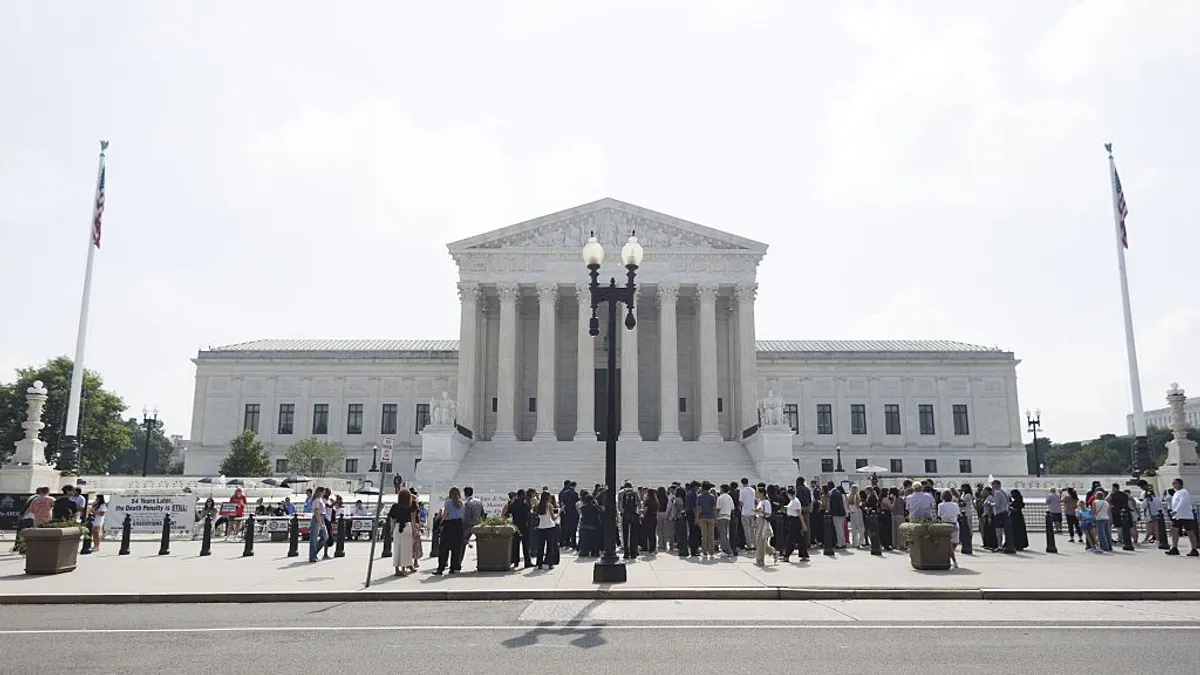
The education policy landscape shifted once more over the course of the latest U.S. Supreme Court term, with K-12 issues continuously coming before the justices for review. Out of the thousands of cases the Supreme Court receives each year, only about 80 are ultimately scheduled for oral arguments — and several of those in recent years have targeted education.
The court dealt a blow to the transgender rights movement in two cases in its October 2025 term, Mirabelli v. Bonta and West Virginia v. B.P.J., and handed wins to the parental rights movement — as it did in its previous term in Mahmoud v. Taylor, a curriculum opt-out case.
At the same time, the court has rejected some education-related cases for its October 2026 term, including on some of those same issues, and leaving gray areas where education policy experts are seeking answers.
As the high court is now in recess, here are takeaways of the last term and issues on the horizon for the next one:
Shadow docket sets high-impact education policy
In recent years, the Supreme Court has expanded its use of the shadow docket, which is a list of cases the court has granted for immediate review and are settled without traditional oral arguments.
The year before its most recent term, the court had settled at least three education cases through that mechanism. The last term's shadow docket also saw a decision in Mirabelli v. Bonta, a California parental notification case that was appealed to the high court earlier this year on behalf of teachers and parents who alleged that the gender support policies violate their First and 14th Amendment rights.
Less than three months later, in March, the Supreme Court ruled that California state policies preventing teachers from sharing students’ LGBTQ+ identities with their parents violated parental rights.
While the case did not answer broader constitutional questions, the case's emergency decision has triggered changes for districts nationwide in recent months, with federal agencies using the decision to launch investigations into districts and appellate courts revisiting their decisions. And districts are "already looking to the decision for guidance because there is little settled national authority," said Nancy Potter, founder of Potter Law and an education civil rights attorney, said in a July 14 email to K-12 Dive.
In a dissenting opinion, Justice Elena Kagan said the case “shows, not for the first time, how our emergency docket can malfunction,” saying the court had “scant and, frankly, inadequate briefing about the legal issues in dispute.” At the time, Kagan said there were almost 40 similar cases working their way through lower courts that the court could've heard.
However, after that decision, justices continued to reject at least three similar parental rights cases.
"So the pattern is not that the Court is avoiding the issue," said Potter. "It is that the Court has spoken quickly in an interim posture and then declined, repeatedly, to take up the same question in the posture that would produce durable guidance."
The result, Potter said, is that schools will be bound by varying rules depending on the state and federal circuit that they are in.
"Parental notification may be decided in a hallway by a first-year teacher who has about thirty seconds to determine what the teacher’s obligation is. That is the interaction districts are now governing based in part on an interim order," she added. "If I were sitting in a district office this month, I would want that conversation to happen before the building opens rather than after."
Potter suggested districts determine what their current policy says, whether it aligns with state law, and what staff are being told to do when issues of parental notification arise.
Setbacks for the transgender rights movement
In addition to the Mirabelli case, a joint decision in two separate but related cases — B.P.J. v West Virginia and Little v. Hecox — also deepened the blow to the transgender rights movement by setting precedent on issues related to athletics and other education programs separated by "biological sex."
The cases arose out of state policies banning transgender students from playing on athletic teams aligning with their gender identities, which are in effect for at least 27 states. Supporters say such bans are allowed under Title IX and meant for the protection of cisgender women, and critics say those bans violate Title IX's protections for transgender students.
Title IX is a federal civil rights law that prohibits sex-based discrimination in education.
In a rare event, all justices agreed that Title IX allows teams to be separated based on sex.
Issued last month, the majority opinion decided that Title IX allows such bans. However, it stopped short of saying that Title IX required them. That means that while bans in Republican states may remain, so may state policies in Democratic states like California allowing transgender students to play on teams aligning with their gender identities.
While the opinion was limited to the state bans, education policy experts expect the U.S. Department of Education to rely on the case to set policy in other areas impacting LGBTQ+ issues, like pronoun usage or bathroom and locker room access.
What's left for future terms
As is often the case, the Supreme Court's actions this term — including which cases the court accepted or rejected — leave as many questions as they provide answers.
On the Title IX front, it remains to be decided what the law requires as opposed to what it permits, whether schools or states may allow transgender students to participate on girls’ and women’s sports teams, or whether statutes or policies requiring school districts to allow transgender females to participate on women’s sports teams violate Title IX or the Equal Protection Clause.
The question of whether there may be a more tailored approach for students who take hormones or puberty blockers also remains.
The court also rejected at least two education-related free speech cases, leaving questions over the limits of students' free speech rights.
In the denial of one case, E.D. v. Noblesville School District, Justice Samuel Alito indicated he would've taken on the issue and urged the court to do so in future terms. The case was brought on behalf of an Indiana high school student whose flyers promoting an anti-abortion school club’s meetups were rejected by school administrators because they contained images of students with “Defund Planned Parenthood” and other signage.
"Until the Court accepts an appropriate case, that judgment remains with the assistant principal who must decide, often in the moment, whether a student's flyer is the student's speech or the school's," said Potter. "Those are fact-specific questions, and the same flyer can come out differently in different circuits."
Meanwhile, the court accepted one case for next term so far related to K-12, St. Mary Catholic Parish v. Roy, which questions whether private schools that get public funding from a state universal preschool program must admit children of same-sex couples. The case has already garnered attention from the Trump administration, which filed a friend-of-the-court brief in January in favor of the schools that, per their faith, will not enroll children of same-sex couples.
The Supreme Court is expected to hear the case during its next term.