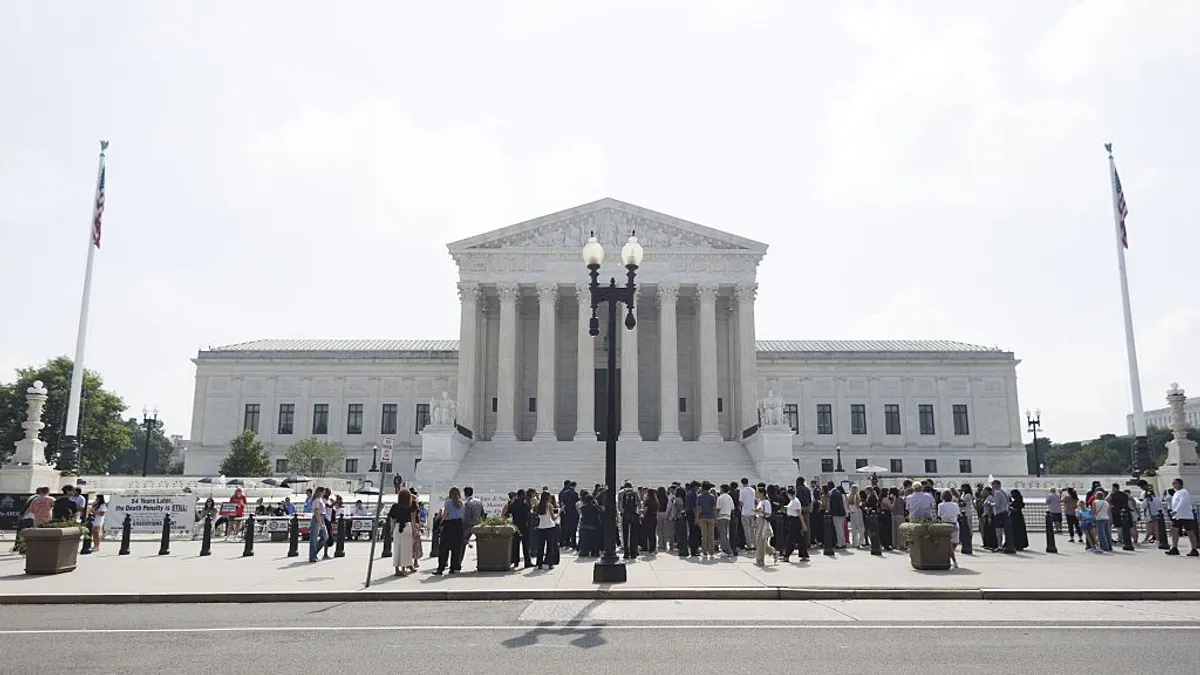
The U.S. Supreme Court declined to hear two free speech cases in the past week brought against school districts, with the rejection of the most recent case on Monday drawing dissent from Justice Samuel Alito and a push to soon revisit the issue.
On Monday, the court rejected a petition in E.D. v. Noblesville School District, which was brought on behalf of an Indiana high school student whose flyers promoting an anti-abortion school club's meetups were rejected by school administrators because they contained images of students with "Defund Planned Parenthood” and other signage.
The student, named in court documents as E.D., attended Noblesville High School and was a 9th grader in 2021 when she formed Noblesville Students for Life, a student-interest and student-led group that was not sponsored by the school. The school ultimately revoked the club's approval after E.D.'s mother attended meetings during and after the formation of the group, as "student interest clubs are 100% student driven and can have no involvement from any adult."
Regarding the club's revocation, the school principal also stated in an email to E.D.s mother that "a poster cannot contain any content that is political or that could disrupt the school environment," and should instead "only state the name of the club and the details of the meeting time and location."
"When the students actually meet, they are able to talk about their common interests," the email from Principal Craig McCaffrey stated.
After the "revamp" to the student club application process initiated by McCaffrey, E.D. resubmitted her application and her club was reinstated in January 2022.
What the courts have said
E.D.'s mother sued the school under various counts, including the First Amendment's free speech clause. The district court where the lawsuit was initially filed and the U.S. 7th Court of Appeals both decided in favor of the district, and the Supreme Court's rejection of the case on Monday means those decisions stay in place.
"Because of where and how E.D. sought to display her flyers, they could reasonably be perceived as bearing the school’s imprimatur," wrote Judge Nancy Maldonado in an August 2025 decision from the appeals court siding with the school district.
"This is not a case about tolerating private student speech," Maldonado continued. "To the contrary, E.D. was permitted to wear her pro-life shirt to school and hand out her flyers to students at the activities fair. Instead, it is a case about whether the school must lend its resources (here, literally its walls) — and, by extension, its authority — to disseminate student messages."
Justice Alito on Monday, however, said he would have heard the case to clarify the limits of permissible school speech, including what would be considered "government speech."
"In an appropriate case, we should do so," he said in his Monday dissent.
The rejection of the case on Monday comes a few days after the high court rejected another free speech case out of the U.S. 6th Circuit Court of Appeals. That case, C.S. v. Craig McCrumb, began in 2022 when a then-3rd grader wore a black baseball cap depicting an AR-15-style rifle and the phrase "COME AND TAKE IT" to school for Wear a Hat Day.
"Because school officials believe wearing weapon imagery is never appropriate in school, they made her remove it," the January petition filed to the high court stated. "Months later, after C.S. sued, the same officials contrived the excuse that a high-school shooting two counties away made them concerned for emotional reactions the hat could prompt — a post hoc rationalization lower courts credited even though it was not referenced the day of the incident and even though there was no evidence any of C.S.’s schoolmates even knew of the tragedy."
The Supreme Court denied that petition on June 8.
Another case could affect Supreme Court precedent
Alito's push to hear another school speech case could settle a gray area between two oft-cited cases, Tinker v. Des Moines Independent Community School District, which was decided in 1969, and Hazelwood School District v. Kuhlmeier, which was settled in 1988.
In Tinker, the court ruled that a school policy restricting students’ own speech or expression — in that case, the wearing of armbands protesting the Vietnam War — was a violation of the Constitution because students do not “shed their constitutional rights to freedom of speech or expression at the schoolhouse gate."
The Hazelwood case, on the other hand, decided that schools can regulate "school-sponsored publications, theatrical productions, and other expressive activities that students, parents, and members of the public might reasonably perceive to bear the imprimatur of the school" as long as the censorship is “reasonably related to legitimate pedagogical concerns.”
The Supreme Court in that case decided that a school could censor a high school newspaper if it was produced as part of the school's journalism curriculum, for example.
"Since Hazelwood was decided, lower courts have struggled to ascertain its precise limits, and in my view, clarification by this Court is in order," Alito said in Monday's dissent. "The question addressed in that case is closely related to the question whether expression is 'government speech' or private expression. And in the nearly four decades since Hazelwood, this Court has decided a series of cases that addressed the latter question."
The Supreme Court has addressed a handful of First Amendment K-12 cases in the past few years. In Kennedy v. Bremerton, for example, the high court decided in 2022 that a football coach's prayer on the 50-yard line after school games, and sometimes with students, was protected private speech.
In 2021, an 8-1 majority justices sided in Mahanoy Area School District v. B.L. with a high school student who was disciplined over an explicit rant in a Snapchat post made off-campus and outside of school hours.