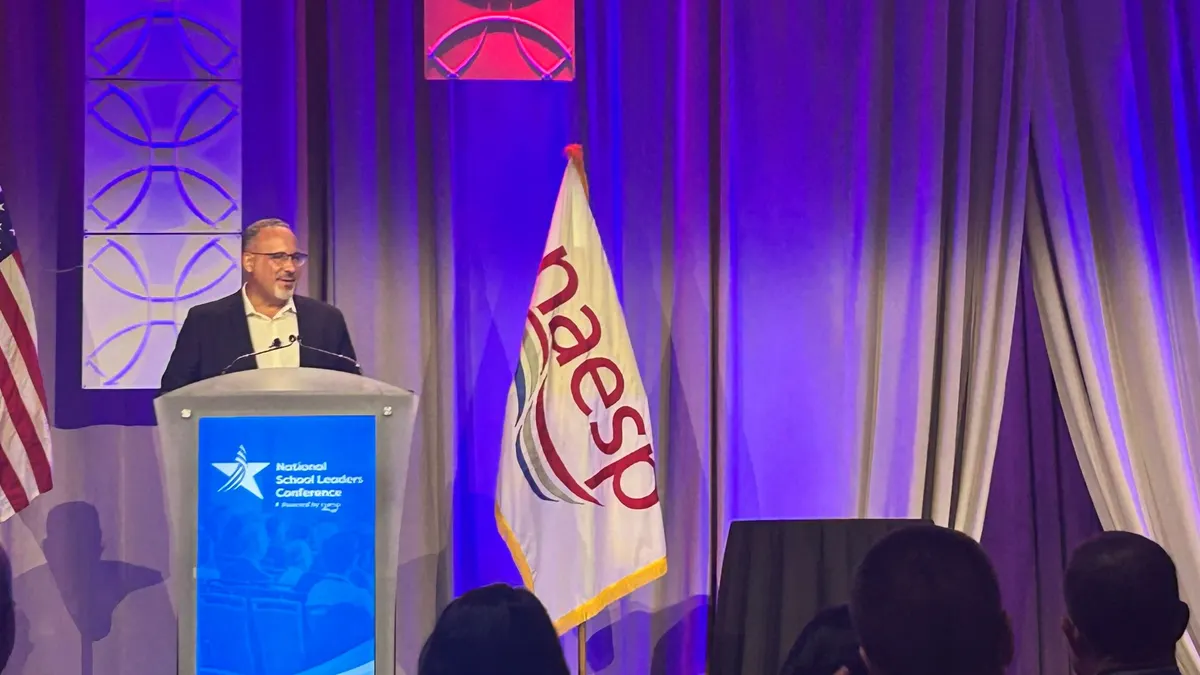
ORLANDO, Fla. — Through a long — and ongoing — education career, former U.S. Education Secretary Miguel Cardona says his decade as an elementary school principal in Meriden, Connecticut, remains his favorite time.
But as rewarding as a principalship may be, Cardona acknowledges that right now is a “tough time to lead.”
For some principals, it may be tempting to just get by managing without leading — especially when trying to balance the needs of students, teachers, the community, the central office and the superintendent, Cardona told a roomful of elementary and middle school administrators at the National Association of Elementary School Principals’ National School Leaders Conference on Wednesday.
The “most exceptional principals,” however, understand how to both manage and lead, said Cardona, who now advises school systems through his year-old-plus Cardona Solutions consulting firm.
“Today, our students are looking to us to lead. They look to us to challenge a broken status quo, to challenge opportunity and achievement gaps that have been normalized across our country,” Cardona said. “They look to us to repair division in our country, in our state, in our communities — and sometimes in our school.”
During his speech to the gathered principals, Cardona shared leadership advice and lessons learned from his career — including his time leading the U.S. Department of Education during the Biden administration — with a focus on how principals can innovate while balancing the inherent pressures of the job.
Innovate how you collaborate
When Cardona served as Connecticut’s education commissioner during the height of the COVID-19 pandemic, he partnered with key stakeholders on the state’s school reopening plan. From intentionally collaborating with epidemiologists to working with unions and school boards differently, he said, Connecticut’s reopening plan “achieved quick and lasting results.”
That plan became a model for reopening schools nationwide, and it’s what got him on then-President Joe Biden’s radar to be nominated as education secretary, he said. When Cardona joined Biden’s cabinet, he said, roughly half of the nation’s schools were open. He credits the intentional collaboration he used in Connecticut with achieving every school in the nation being reopened within the following nine months.
“And what I noticed in Connecticut, it wasn't the schools that were best-resourced that opened the quickest,” Cardona said. Rather, it was the schools with leaders who knew how to intentionally collaborate.
Cardona stressed to school leaders not to ever forget the power of collaboration. It can apply to any issue a principal needs to address, whether it's teacher retention, working conditions or adapting to new technology, he said.
When school leaders get “more fingerprints on the process,” it ensures sustainability and that they don’t have to own everything, he said.
Lead with good pedagogy
Another way for school leaders to innovate, Cardona said, is to apply good pedagogy to the biggest challenges.
For instance, Cardona pointed to the growing questions schools are facing about how much screen time students should have in classrooms, particularly as it applies to device policies.
“A lot of the public debate is about whether or not to ban devices or how we can limit screen time,” Cardona said. “But what if … instead of focusing our energy on that, we focused on creating more pro-social interactions between students?”
That could include creating more opportunities for students to join clubs, or even expecting 90% of a school’s 4th- and 5th-graders to sign up for a club to encourage more student interaction, he said. Or schools could partner with local organizations and companies for students to volunteer and, ultimately, build durable life and social skills.
“Let’s give them a reason to put their damn phones down,” Cardona said.
Audit your calendar to reflect your values
Successful school leaders need to innovate on how they use their own time — even when it may be difficult to do so, Cardona said.
During his time as education secretary, Cardona said, he spent the first nine months “just putting out fires all day.” Then, he told his scheduling team to regularly block out two hours for “instructional leadership” time. He used those blocks to meet with his staff, walk through the building, or call a superintendent who may have just experienced a crisis — even a school shooting.
Blocking time in this way, Cardona said, helped him “identify ways to move the needle forward in our country, not put out somebody else's fires.”
He encouraged principals in the NAESP audience to create their own instructional leadership time and to ensure someone on their staff is a gatekeeper to protect that time from other distractions. “Your calendar is a reflection of your values,” Cardona said.
To see if principals are in fact reflecting their values, Cardona asked the audience to think about what they value most in their role as school leaders. Then, he asked them to look back on their calendars from previous months to see if their schedules mirrored their priorities.
“Is there a match between what you want to do and what you do?” Cardona asked.
This kind of calendar audit applies to both school leaders' personal and professional lives, he said. As education secretary, Cardona said, he struggled to find that balance when he worked weekdays in Washington, D.C., and went home to his family in Connecticut on weekends.
But during that time, Cardona said he and his then-teenage daughter got innovative with their time and would wake up early on Saturday mornings to go somewhere nearby together. They called it “Saturday shenanigans.”
“If you do not schedule the things that are most important to you now, they will not happen — your family, your health, your faith,” Cardona said. “The job will burn you if your calendar does not reflect your values.”