WASHINGTON — At a time when federal versus state responsibility for education programs is subject to discussion, the governors of Maryland and Wyoming on Wednesday urged state and local educators to look to their communities to help improve student engagement and outcomes.
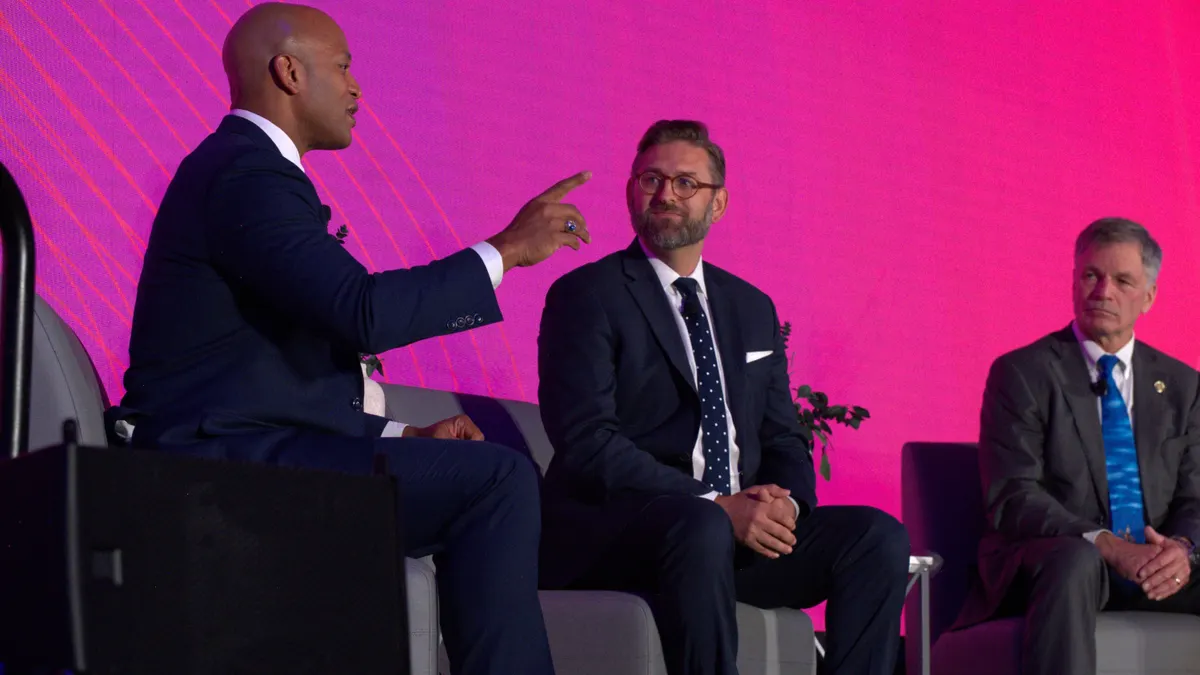
"I really can't think of two states that really have more differences, but we all have the commonality that it's important to listen" to students, families, educators and communities, said Wyoming Gov. Mark Gordon, a Republican. Gordon spoke alongside Maryland Gov. Wes Moore, a Democrat, during the opening session of the Education Commission of the States’ National Forum on Education Policy on July 8.
As the federal role in education shrinks and state flexibility grows, states are gaining autonomy but also greater responsibility for achieving educational success, said Kirsten Baesler, assistant U.S. education secretary for elementary and secondary education. "There has never been a more consequential moment to be a state education leader," Baesler told the ECS forum's 660 attendees.
"States now have an unprecedented opportunity and responsibility to define success on their terms. No one in D.C. can answer the questions that matter most for your children," Baesler said.
The Trump administration has said it is reducing federal bureaucracy in education by giving states and districts more decision-making authority. The administration's ultimate goal is to close the U.S. Department of Education, which can only be done through congressional action.
Driving student engagement
Gordon and Moore didn't directly address the Trump administration's downsizing of the federal role in K-12, but they did talk about initiatives in their states to boost student engagement and outcomes.
Gordon, who also chairs ECS, said education systems should nurture students’ passion, curiosity and understanding of the real world. Through conversations with and input from local communities, he said, Wyoming created the Reimagining and Innovating the Delivery of Education initiative.
That effort has propelled innovative practices and problem-solving in schools across the state, he said. For instance, educators in Upton, Wyoming, revamped class schedules to eliminate conflicts between the required and elective courses students wanted to take.
Another state initiative — the Wyoming Innovation Partnership — seeks to grow and sustain collaboration to support workforce development, including through K-12 career exploration and experiences.
"The trouble with education is it takes a little while for things to kind of catch up, but we're seeing better outcomes. We're seeing lower truancy. We're just seeing a lot of positive outcomes," Gordon said.
The governor said he supports strong accountability in education, but warned against top-down, rigid mandates.
Helping support local solutions
Moore also emphasized the need for local input in solving specific community challenges.
"It's not us saving them. They don't need us to save them," Moore said. "They need us to stop putting things in their way and to provide better supports to allow the type of community development and growth — the sustainable community development growth — that we all hope for."
For example, Moore talked about Maryland's 2024 Engaging Neighborhoods, Organizations, Unions, Governments, and Households Act, which supports community-led efforts to reduce the number of children living in poverty.
The program has led to a drop in truancy and in drug overdoses in the Hagerstown, Maryland, community, Moore said. "You've got to listen to the parents" and make sure that "everybody is at the table, everybody is communicating," Moore said.
Last week, ECS published a playbook to help states support communities in improving outcomes for early childhood through careers.The playbook includes strategies for supporting community-driven solutions and developing authentic and meaningful learning for students.