Dive Brief:
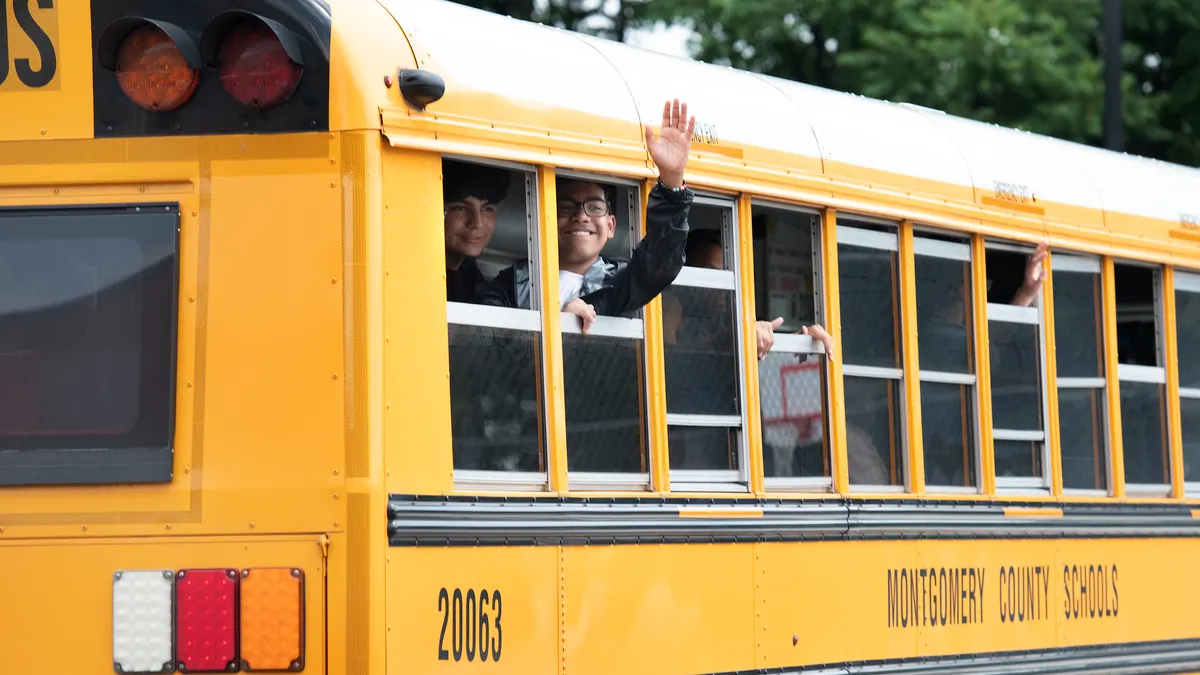
- Another case questioning the role of race in K-12 admissions policies is before the U.S. Supreme Court, with a group representing mostly Asian American parents asking the high court last week to review a case involving Maryland's Montgomery County Board of Education.
- The petition asks justices to answer whether lawsuits challenging K-12 admissions policies nationwide have to first show that such policies reduced certain racial groups' representation in the student body before successfully suing under the 14th Amendment.
- If the Supreme Court decides to take up the case, it could impact a handful of high-profile cases challenging race- or socioeconomic-conscious district policies in major cities, including Boston, Philadelphia and New York.
Dive Insight:
"School districts across the country have overhauled admissions criteria for competitive public schools after concluding that existing systems produced undesirable racial enrollment patterns," said petitioners, represented by Pacific Legal Foundation, in the petition filed last week. "As challenges to those admissions changes have reached the Courts of Appeal, the circuits have divided sharply.”
The case stems from a challenge to Montgomery County Public Schools' admissions policies for its highly competitive magnet middle school STEM programs.
The admissions policy changes came after a 2016 report found that the magnet schools had "significant racial and socioeconomic disparities in the enrollment and acceptance rates" — particularly underrepresentation for Hispanic and Black students and overrepresentation for Asian Americans. The district then sought to change its admissions criteria, field-testing changes and then eventually implementing a lottery system.
Prior to the field test, Asian Americans in one school, for example, represented 45.6% of student seats, and that dropped to 31.5% in the three field test years, according to the complaint.
When the Association for Education Fairness sued, its lawsuit was dismissed in district court because the group could not show that the share of Asian American students admitted under the lottery system was lower than the portion of Asian Americans in the applicant pool.
This standard was set in a separate but similar high-profile case, Coalition for T.J. v. Fairfax County School Board, that also reached the Supreme Court but was turned down in 2024 after it was considered for review multiple times.
When the high court turned down that lawsuit, Justices Samuel Alito and Clarence Thomas indicated that they would have taken up the case, which originated out of the Fourth Circuit after an appeals ruling found that the percentage of Asian American students in that case did not fall below the percentage of Asian American applicants.
"What the Fourth Circuit majority held, in essence, is that intentional racial discrimination is constitutional so long as it is not too severe," they said in their dissent. "This reasoning is indefensible, and it cries out for correction."
There are similar cases rising out of the 1st, 2nd and 3rd Appeals Circuits, with the latter two not requiring those challenging admissions policies to show that they led to underrepresentation of Asian Americans.
"As the circuit split deepens, this Court’s intervention is necessary," petitioners in the Maryland case said. "These cases involve five of the largest school districts in America. Other major cities have either tried or considered similar plans."
Such lawsuits proliferated in light of Students for Fair Admissions v. Harvard, a 2023 Supreme Court case that overturned race-conscious admissions for higher education institutions nationwide. Its impact has trickled into K-12 spaces, with district admissions policies meant to diversify student bodies under particular scrutiny.