Former federal officials who were responsible for overseeing special education implementation in states and districts are urging Congress to reject the U.S. Department of Education's plans to move programs serving students with disabilities to another federal agency, according to a July 13 letter sent to lawmakers.
The letter's authors are 13 former officials who served under every presidential administration since President Richard Nixon, including during the first President Donald Trump administration but not for the second Trump administration. They wrote that efforts to shift special education responsibilities to the U.S. Department of Health and Human Services "dismantles, rather than relocates, the federal infrastructure built over five decades" of the Individuals with Disabilities Education Act.
They also voiced concern that moving special education programs from the U.S. Department of Education's Office of Special Education and Rehabilitative Services to HHS would deprioritize students' educational needs. "Moving IDEA's implementation into a health agency risks substituting medical management for educational access," the letter said.
Others have raised similar concerns. A coalition of 731 civil rights and education organizations sent a June 18 letter to Congress asking lawmakers to revert the OSERS and Office for Civil Rights transfers, saying the agreements "undermine the core foundation of federal disability, education, and civil rights policy and implementation."
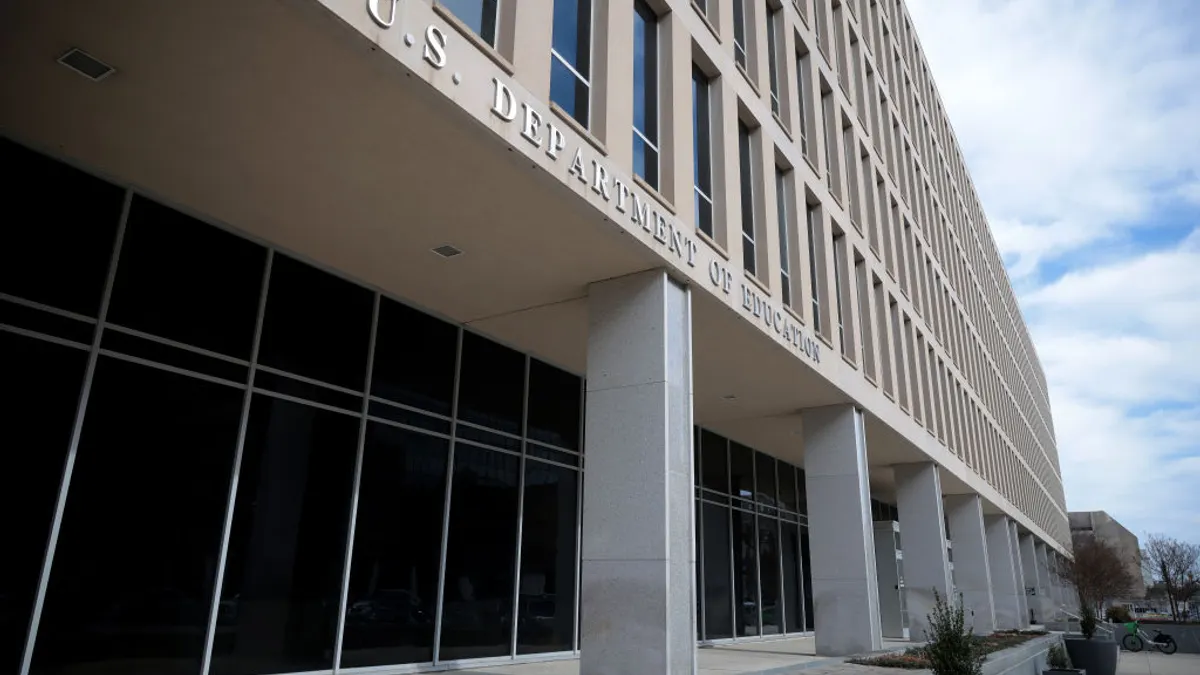
In June, the Education Department announced four interagency agreements, including one to move certain special education activities to HHS. At the same time, the Education Department said it was transferring some civil rights activities from its Office for Civil Rights to the U.S. Department of Justice.
The Education Department has now publicly announced 14 interagency agreements with six other federal agencies. The agreements come as the Trump administration works to eliminate the Education Department, which it says has done little to improve student outcomes despite increased federal funding.
The Education Department said the interagency agreements will cut down on federal red tape and will give more decision-making power to states and districts.
Under the Education Department-HHS interagency agreement for special education, HHS will conduct enforcement, compliance and monitoring activities. HHS will also manage the annual state IDEA performance determinations and formula and discretionary grant programs components for IDEA Part B, Part C and Part D.
Regarding the special education transfer to HHS, U.S. Education Secretary Linda McMahon, in a June 16 letter to parents of children with disabilities, addressed the concerns some have about a medical approach rather than an educational approach for students with disabilities.
"IDEA, as an education law, ensures that a child’s disability isn’t viewed as a medical condition that needs to be treated,” McMahon wrote in the letter.
Three Education Department assistant secretaries — including Kelly Rogers, acting assistant secretary of the Education Department’s Office of Special Education and Rehabilitative Services — told K-12 Dive last month that improving outcomes for all students, including those with disabilities, is the major focus of the agency's partnerships.
Congress to act on transfers
Under the agreements, statutory responsibilities for the transferred activities remain under the bailiwick of the Education Department.
The Trump administration has said it ultimately wants to close the Education Department. However, only Congress can eliminate a federal agency.
On Wednesday, the House Education and Workforce Committee is considering a package of 10 bills that would permanently shift statutory responsibilities for certain K-12 and higher education activities out of the Education Department to other agencies. The transfers of the legal responsibilities for special education and civil rights are not included in that legislative package.
On Tuesday, ahead of Wednesday's committee vote on the legislative package, 93 education, disability and civil rights organizations issued a joint statement condemning the bills, saying the proposals provide "wrongful cover for the Trump administration’s dismantling of the Department of Education."
"The American people support public education and want their leaders to focus on improving educational opportunity, not dissolving the agency tasked with that very mission," the groups' statement said.
Rep. Mark Harris, R-N.C., is sponsor of two of the bills in the legislation package — H.R 9610, the Less Bureaucracy, Better K-12 Education Act, and H.R. 9611, the Less Bureaucracy, Better Higher Education Act.
“Across America, our schools and colleges are preparing the next generation of leaders,” Harris said in a July 9 statement. "The federal government should support that work, not get in the way with unnecessary bureaucracy."
While some of the Education Department's more recent interagency agreements are in the early stages of implementation with logistical details still under development, some advocates say there have been challenges to the agency's partnership with the U.S. Department of Labor for career and technical education activities, which was created last year.
A group of seven former leaders and senior staff in the U.S. Department of Education’s Office of Career and Technical Education — along with labor union American Federation of Government Employees Local 252 and national nonprofit All4Ed — sent a letter on July 13 to the Education Department's inspector general, asking for an investigation into what they say are funding delays and ongoing challenges for CTE programs.
"This agreement flies squarely in the face of bipartisan congressional direction that no authority exists for the Department to transfer its fundamental responsibilities to other federal agencies," said Amy Loyd, CEO of All4Ed, in a Tuesday statement. Loyd served as assistant secretary of the Office of Career, Technical, and Adult Education under the Biden administration.
In response to the letter to the inspector general, Ellen Keast, an Education Department spokesperson, said in an email, “While Obama and Biden-era appointees continue to defend a failing status quo marked by bureaucracy and inefficiency, the Trump Administration is reforming the federal education and workforce systems by streamlining program management and reducing unnecessary bureaucracy to better prepare Americans for fulfilling, meaningful careers that strengthen our nation's workforce.”