
WASHINGTON — When ChatGPT and other generative artificial intelligence tools began emerging in recent years, the Maine Department of Education got panicked emails from teachers and administrators wondering if they should ban or embrace the new technology.
Pretty quickly, Maine's education leaders determined that AI guidance and tools for districts would be grounded in the state's existing computer science structure, said Emma-Marie Banks, coordinator of Learning Through Technology at Maine DOE. Banks spoke during a July 9 session on Maine's AI and computer science framework at the Education Commission of the States’ National Forum on Education Policy.
"Without computer science, you don't actually have AI," Banks said. "It's the foundation of which AI is built on, and I think that that can help to really alleviate some of that fear and concern around it."
Still, in those early months of generative AI, leaders in the Maine DOE felt pressure to quickly and thoughtfully consider the tech’s role in all aspects of education.
"It touched almost everything all at once: teaching and learning, assessment, academic integrity, accessibility and inclusion, student privacy, digital citizenship, even workforce readiness, and computer science education," said Beth Lambert, chief teaching and learning officer at Maine DOE. "That's why this became more than a technology conversation."
Lambert added, "When AI arrived, our philosophy did not have to change. Student success was still the goal."
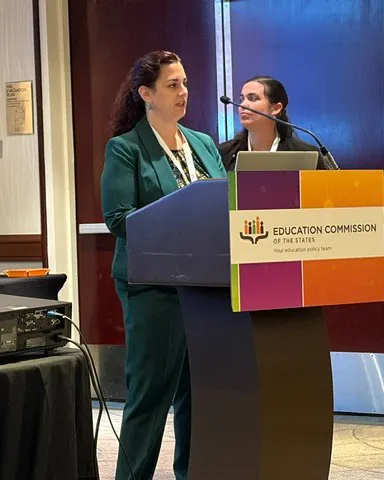
While Maine DOE leaders knew districts needed AI guidance and tools, they also acknowledged that its traditional policy development process would not fit with the urgent demand for district and school supports, Lambert said. The traditional process includes identifying an issue, drafting a policy, and then reviewing, approving and implementing it.
"But with AI, by the time you finish that cycle, the technology had already changed," Lambert said.
So instead of producing one AI policy document, the state took a six-step approach that involved:
- Identifying the needs by listening to education stakeholders, looking at data and studying the issue, including its impact on workforce trends and the risks and opportunities.
- Convening stakeholders to get input from students, teachers and others.
- Establishing principles, such as that AI had to be student-centered; equitable and inclusive; safe, ethical and transparent; human-led and future-focused.
- Aligning AI initiatives with existing work in computer science education, digital literacy instruction and elsewhere.
- Developing guidance and a toolkit for understanding and using AI in schools in ways that are practical, actionable and adaptable.
- Supporting implementation through professional development with multiple entry points, including support for both educators who are resistant to AI and those who are experienced with the technology.
Banks said the state guidance and toolkit are updated as needed, based on feedback from educators. The state is also refining professional development to offer options for shorter modules.
In addition, the state provides technical assistance, district leadership meetings and 1:1 coaching, Banks said. State leaders, meanwhile, continue to learn from the educators who are integrating AI into their classrooms.
"I think that's one of the really exciting things about technology — no one person is really the expert because there's so much to know, and you can learn something new that didn't exist yesterday so it's always emerging," Banks said.