Dive Brief:
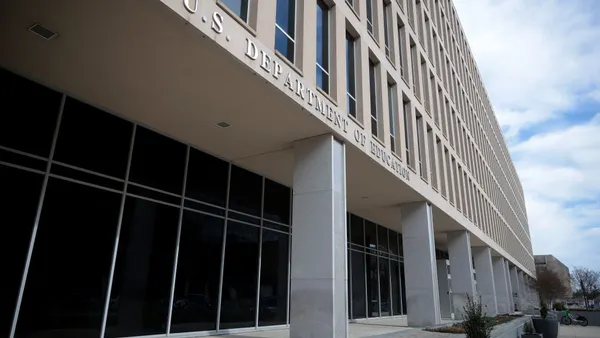
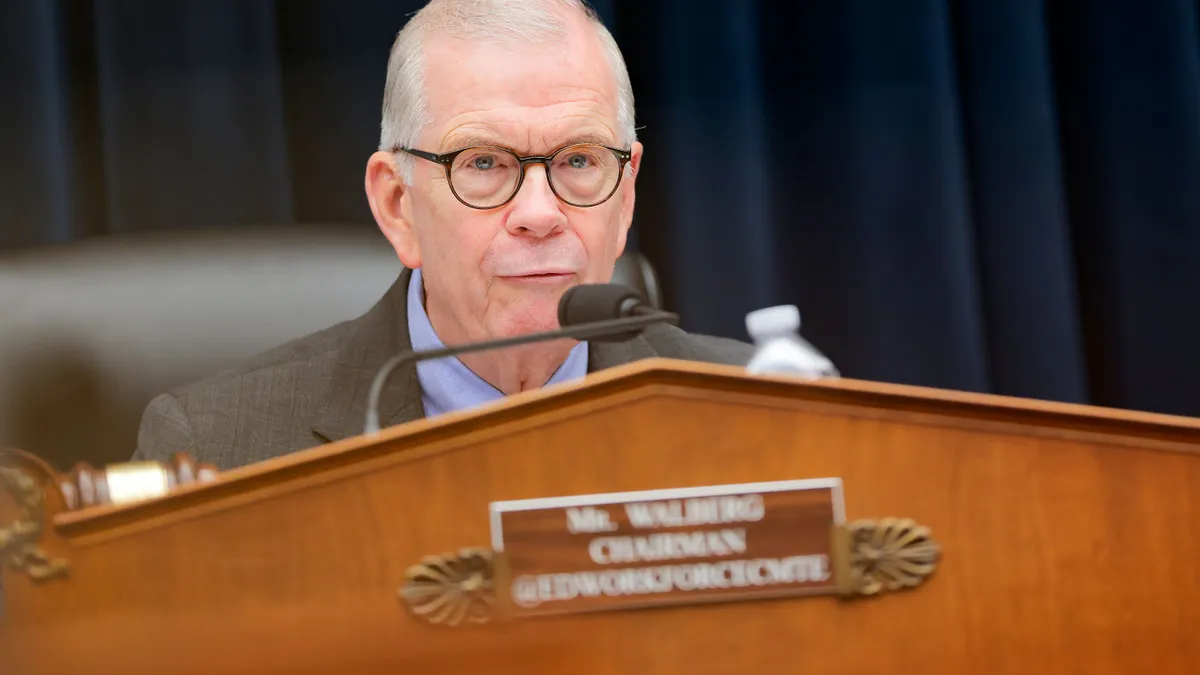
- Ten bills introduced by House Republicans seek to codify most of the U.S. Department of Education’s K-12 and higher education interagency agreements with other federal agencies. The legislative package announced Thursday would help the Trump administration advance its goal to “right-size” the department, according to a statement from the office of Rep. Tim Walberg, R-Mich., chair of the House Education and Workforce Committee.
- The bills, however, do not include the Education Department’s June 16 interagency agreements to transfer some of its special education programming and certain civil rights activities to the U.S. Department of Health and Human Services and the U.S. Department of Justice, respectively.
- Unlike the interagency agreements, the House proposals do take the remaining 10 interagency agreements a step further by transferring the Education Department’s statutory responsibilities for those activities to other federal agencies.
Dive Insight:
The 10 bills signal that some Republicans in the House are looking to seriously back the Trump administration’s efforts to outsource the Education Department’s responsibilities and ultimately shutter the agency.
“The legislative package reflects a simple principle: education policy should be focused on helping students succeed — not preserving a federal bureaucracy for its own sake,” Walberg said in a statement. “Rather than allowing unnecessary layers of Washington bureaucracy stand between families and the services they rely on, the bills would transfer key statutory authorities to agencies better equipped to carry them out while maintaining continuity for students and stakeholders.”
There appears to be no companion legislation in the Senate.
In a July 9 post on X, U.S. Education Secretary Linda McMahon praised the House Education Workforce Committee’s legislation announcement, calling it a “historic step to reduce federal education bureaucracy.”
Legislation to explicitly shutter the Education Department has also been proposed multiple times in Congress without gaining much support. Closing the department would specifically require a Senate supermajority of 60 votes. The July 9 bills that would codify the interagency agreements do not propose the actual shuttering of the Education Department.
Other major efforts to downsize the Education Department came last year when the agency reduced its staff from 3,902 to 1,579 between Jan. 20, 2025, and March 31, 2025 — a 40% cut of its overall workforce, according to a June report from the department’s Office of Inspector General.
The staff downsizing also led to the elimination of several suboffices in 15 of the 17 offices within the Education Department during that same timeframe, OIG said. That includes some that “appear to have been performing statutory functions or oversight and monitoring functions,” said the independent watchdog of the agency.
The OIG report added that the Education Department did not provide “corroborating evidence” that it kept performing certain statutory responsibilities after the March 2025 reduction-in-force, but the Education Department said it remains compliant with its statutory responsibilities.
Rachel Gittleman, president of the American Federation of Government Employees Local 252, which is the union representing current, terminated and retired Education Department employees, said in a June 10 statement that the new Republican legislative package would “create many more layers of red tape” rather than reduce federal bureaucracy.
“States, grantees and taxpayers are already paying the price for education programs being unlawfully transferred to other federal agencies: funding delays, confusion and chaos for both employees and the public, wasted taxpayer dollars, and no accountability or oversight,” Gittleman said. “This new legislation will not make the system more efficient — it will break it.”
Democratic lawmakers have continued to denounce the downsizing efforts by the Trump administration. That includes Rep. Bobby Scott, D-Va., ranking member of the House Education and Workforce Committee, who said in a July 10 statement that the 10 recently introduced bills would “dismantle” the Education Department and “offload critical offices to agencies that are ill-equipped to carry out core duties.”