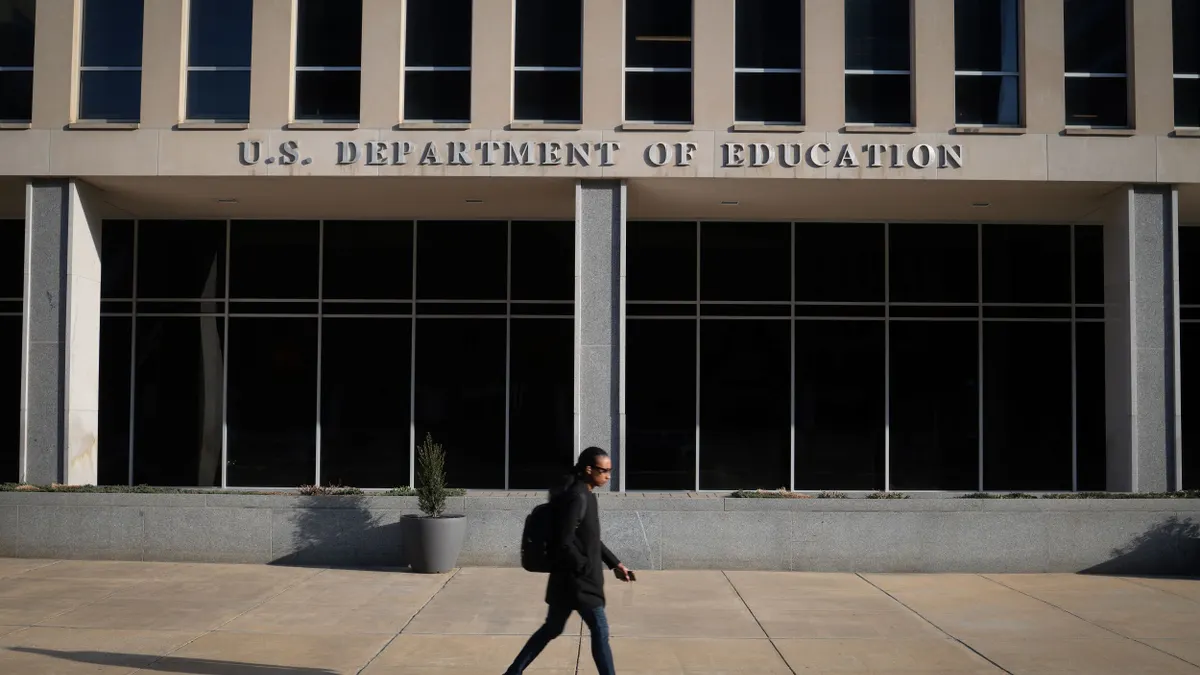
Staffing reductions at the U.S. Department of Education at the beginning of the second Trump administration appear to have impacted units that were performing legal duties, according to a report released Monday by the department's Office of Inspector General.
The staff reduction of at least 1,579 of 3,902 agency employees — or 40% of its overall workforce — between Jan. 20, 2025, and March 31, 2025, resulted in the elimination of several suboffices in 15 of the Education Department’s 17 offices. These included some that "appear to have been performing statutory functions or oversight and monitoring functions," said OIG, an independent arm of the agency.
The Trump administration's downsizing of the Education Department also resulted in the termination of 90 grants with funding totaling $504 million. Teacher training and mental health services were most impacted by the grant terminations, OIG found.
Additionally, the department terminated 129 contracts worth $1.3 billion.
In an example of the Education Department's changes mentioned in the OIG report, the department's Office for Civil Rights had 598 employees at 11 regional offices and 18 suboffices on Jan. 20, 2025. The department's reduction-in-force on March 11, 2025, impacted six regional offices, seven suboffices and 291 employees. Another 55 OCR employees left through other means between Jan. 20, 2025, and March 31, 2025.
The OIG report points out that the statutory or oversight functions performed by the 13 impacted OCR regional offices and suboffices that had no employees by March 31, 2025, included conducting complaint investigations and compliance reviews of preschool, elementary and secondary institutions, colleges and other entities.
In the Office of Special Education and Rehabilitative Services, 14% of the office's 177 staff at three suboffices were impacted by the March 11, 2025, RIF or by other means. This downsizing resulted in no employees in those OSERS suboffices to coordinate, monitor and oversee activities relating to policy formulation, program planning, regulations, evaluation, and grants and contract scheduling activities.
Staff reductions and statutory responsibilities
While the 83-page report does not offer recommendations, it does question the Education Department's move to withhold some of the documents and interviews requested by OIG due to ongoing litigation challenging the downsizing efforts.
"Although the Department has repeatedly cited concerns about ongoing judicial proceedings and court orders, it has not explained how granting us access to requested documents and to staff would place it at risk of noncompliance with those proceedings and court orders," the OIG report summary said.
In a response to a draft of the OIG's report, the Education Department had suggested adding wording to the final report about how binding judicial orders placed on the entire department constrained which documents and interviews the department could share with the OIG.
The Education Department also took issue in the draft report of OIG's suggestion that some of the department changes that took place between Jan. 20, 2025 and March 31, 2025, appear to have impacted statutory functions or oversight and monitoring functions. The department explained that readers of the report may interpret that as the department not following through on its responsibilities under federal laws due to its reduction-in-force efforts.
That "risks confusing the public and stakeholders" and is "inconsistent" with the department's continuation of those responsibilities for more than a year after the March 2025 RIF, the department told OIG.
In the final report, OIG said the Education Department has provided no "corroborating evidence" that it continued performing certain statutory responsibilities referenced in the report since the March 2025 RIF. OIG said it did not make changes to the draft report as a result of the department's comments.
Ellen Keast, the Education Department's press secretary for higher education, said in a statement Tuesday that the OIG report doesn't "accurately account" for the fact that a court ordered OCR employees back to work in December 2025.
"These and other deficiencies were brought to the OIG’s attention numerous times throughout their inquiry," Keast said. "If anything, this ‘report’ demonstrates how effective the Trump Administration is. With nearly half the staff, ED has effectively implemented some of the most sweeping higher education reforms in decades while returning education to the states.”
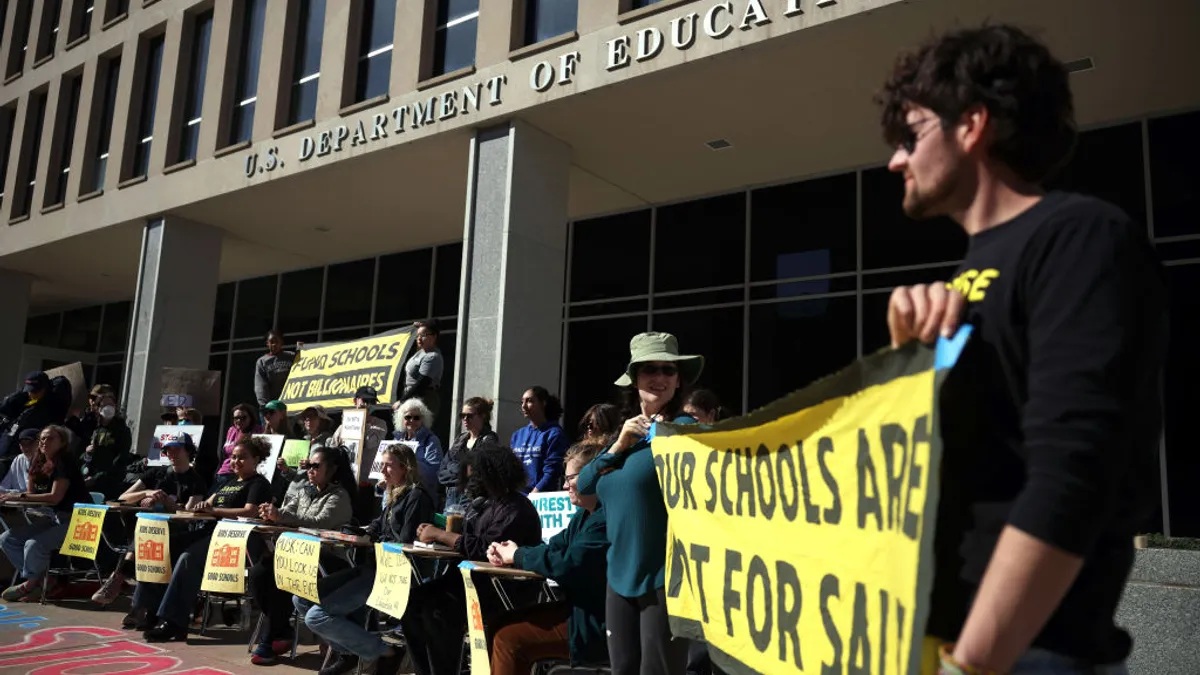
But Rachel Gittleman, president of American Federation of Government Employees Local 252, which represents 2,000 current and former Education Department employees, said in a statement that the report shows the Trump administration has been "systematically destroying" the agency.
"The Inspector General makes clear that the Department can no longer do its job — it cannot fulfill its congressionally mandated duties, prevent waste, fraud and abuse, or follow federal law," Gittleman said.