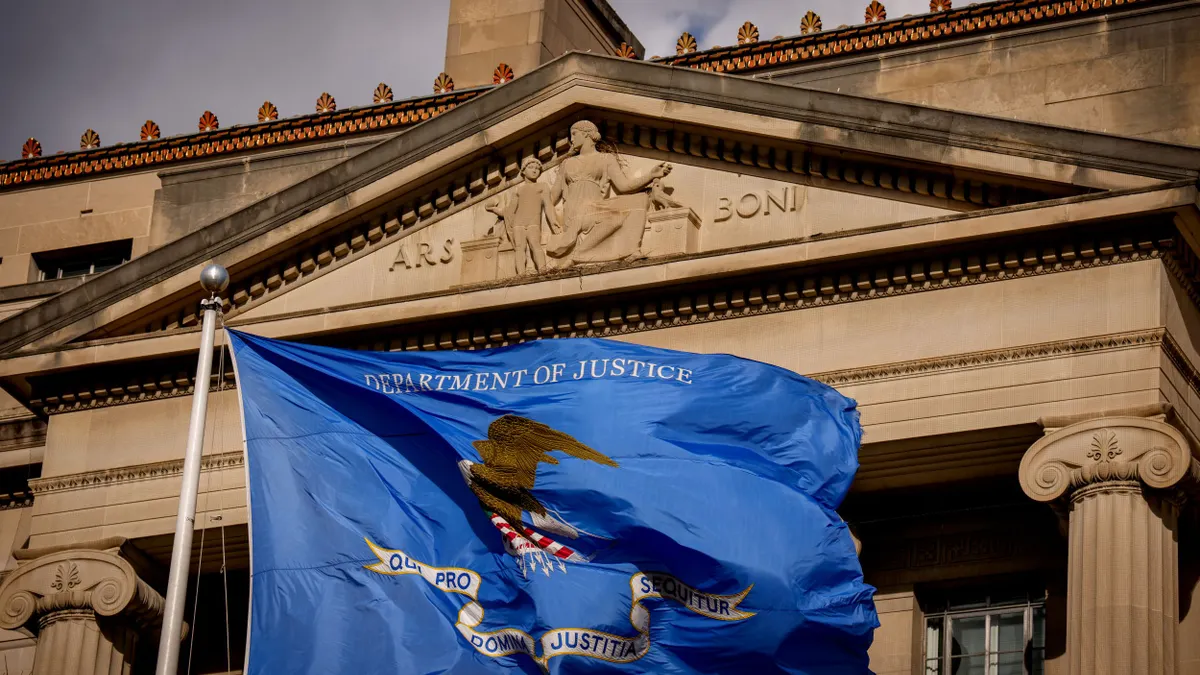
The U.S. Department of Education on Tuesday announced it was moving certain civil rights enforcement functions to the U.S. Department of Justice, heightening anxiety over whether the Education Department's Office for Civil Rights will be able to properly perform its duties.
"A federally coordinated law enforcement mechanism between the two agencies actually strengthens the enforcement of federal civil rights laws," said a senior Education Department official on a press call Tuesday about the forthcoming Justice Department interagency agreement.
The announcement adds to a number of functions that the Education Department is already outsourcing to other government agencies, including certain special education responsibilities, as part of its efforts to downsize the department and reduce bureaucratic bloat.
"The secretary has been very clear about the final mission of the U.S. Department of Education, and she has been clear that our primary goal is to return education to the states," said the official.
As the Justice Department's Civil Rights Division and Education Department's Office for Civil Rights iron out the division of responsibilities, here is what we know so far:
What might move to the Justice Department?
The Education Department entered into three new interagency agreements with the Justice Department in June, shifting some of the following to the latter agency:
- Civil rights investigations processes and enforcement: OCR will be referring civil rights complaints to the Justice Department to evaluate, investigate and resolve them. OCR may also resolve complaints based on the Justice Department's proposed findings and resolutions, the senior department official said.
- Advising and technical support for districts and states, especially for desegregation: DOJ will provide technical assistance to school boards and other local entities, especially related to "the preparation, adoption, and implementation of plans for the desegregation of public schools, and in the development of effective methods of coping with special educational problems occasioned by desegregation," according to a fact sheet provided by the Education Department.
- Ensuring student privacy protections and parental access to education records: DOJ will review complaints alleging privacy act violations, conduct related investigations and recommend resolutions, according to an agreement fact sheet. The Education Department under the second Trump administration has used privacy laws including the Family Educational Rights and Privacy Act and the Protection of Pupil Rights Amendment to investigate schools for civil rights violations related to LGBTQ+ issues like gender support plans.
What will remain with the Education Department?
The Education Department said it will continue to be responsible for statutory and regulatory oversight, and will continue to manage and lead OCR. It will also:
- Make final decisions on whether to pursue civil rights cases for administrative enforcement or refer cases to DOJ for judicial enforcement.
- Facilitate mediation and negotiate settlements.
- Develop policy guidance procedures.
- Provide technical assistance to schools and states.
- Administer the Civil Rights Data Collection.
- Manage and lead the Student Privacy Policy Office.
- Have final say over the resolution of SPPO-related cases.
The Education Department did not specify whether all or specific types of civil rights complaints will be referred to the Justice Department for evaluation, investigation and resolution processes. The agreement made available publicly shows that the Justice Department will be helping OCR with investigations in its core areas, including: Title IX, Title VI, Section 504, Title II of the Americans with Disabilities Act, the Age Discrimination Act, and the Boy Scouts of America Equal Access Act.
The departments are still ironing out much of the details, the senior department official said Tuesday.
"The signing of the IAA is really just the first step of the partnership," the official said. "How to identify staffing needs, how to allocate resources, how to allocate the workload to ensure that students, parents, and families still have relief through OCR is something that we will continue to work closely and strategically with DOJ to solve over the coming weeks."
What has the DOJ been doing until now?
The Justice Department had already been expanding its footprint in K-12 issues leading up to Tuesday's announcement, including in coordination with the Education Department and in areas related to the new agreements.
Over the last year, it overturned a handful of desegregation orders binding school districts across states including Louisiana, Mississippi, Tennessee and Florida. In reference to ending a desegregation order in Louisiana’s Plaquemines Parish School Board, the department said it “righted a historical wrong, freeing the local school district of federal oversight" and was opening up "precious local resources over an integration issue that ended two generations ago.”
The Justice Department has also routinely collaborated with the Education Department as part of its Title IX Special Investigations Team, which the current administration established last year to enforce anti-transgender policies, such as keeping transgender students out of girls' sports and facilities.
The Justice Department launched a slew of Title IX investigations in the last two months, including compliance reviews into four California districts as recently as last week.
The Education Department has also regularly referred completed investigations to the Justice Department for the latter agency to litigate, such as in Maine and Minnesota, after the states refused to enter resolution agreements barring transgender students from teams or facilities aligning with their gender identities.
What are some concerns?
The Tuesday announcement follows a year of staffing turbulence within the Education Department, including regional OCR office closures and significant investigation disruptions resulting from them, as reported by civil rights organizations and complainants.
Critics of Tuesday's agreements, and the Education Department's overall efforts to downsize itself, say that the move will harm oversight and accountability for states and harm student civil rights protections.
Moving some civil rights functions to the Justice Department "fundamentally alters the relationship between federal oversight and local schools," said Verjeana McCotter-Jacobs, executive director and CEO of the National School Boards Association, in a June 17 statement. "It replaces collaborative compliance and vital technical assistance with a purely prosecutorial framework, potentially harming the very students it is meant to protect."
The National Center for Youth Law, which sued to reverse OCR layoffs last year, said the Justice Department may not be equipped with the proper expertise and systems necessary to handle thousands of complaints from students and families filed with the Education Department every year.
"While the Department of Justice's Civil Rights Division plays a vital role in enforcing federal civil rights laws, it is not structured to administer the high-volume, complaint-based enforcement system that OCR operates," said Shakti Belway, executive director of NCYL, in a June 16 statement.
The number of complaints filed with the Education Department had been steadily increasing in recent years, and OCR received over 23,000 complaints in fiscal year 2025. Meanwhile, the number of resolution agreements the office issued reached a 12-year low in 2025, according to a Congressional report released in April by Sen. Bernie Sanders, I-Vt.
"That matters because DOJ is built for litigation," said Nancy Potter, an education attorney and founder of Nancy Potter Law, in an email to K-12 Dive. "OCR has historically been the place where families, students, and schools could seek a civil rights resolution without starting in court."
How will this impact stakeholders?
The Education Department said the new agreements "will not impact students, parents, or families."
"OCR investigations will not be impacted by this partnership, and OCR enforcement staff remain available to answer questions regarding the status of complaints, and remain the points of contact for complainants," the official continued.
Students, parents, or advocates who would like to file discrimination complaints may continue to do so with OCR, the department said in a fact sheet.
States and districts "should not expect to experience any disruptions in accessing technical assistance due to the partnership" the Education Department said about its SPPO partnership. On issues related to desegregation, however, school boards can expect to receive support from the Justice Department instead.
However, some education industry experts disagree.
The National Association of School Psychologists predicts that the agreement "will exacerbate the backlog of civil rights complaints requiring investigation and adjudication, and it will likely weaken the enforcement of civil rights laws protecting students."
Potter said families may also be confused about where to go when a complaint involves disability, race, discipline, language access, or services "that do not fit cleanly into one agency lane."
"For schools, this could mean less of the problem-solving function they have relied on from OCR and more enforcement through agencies with different missions and processes," Potter added.
McCotter-Jacobs said "a structural change of this magnitude would complicate compliance, delay services, bureaucratize the resolution of discrimination complaints, and strain local capacity — at a time when schools are already navigating staffing shortages, rising costs, and increasing student needs."