After taking up major cases in recent terms on LGBTQ+ issues related to school programming access and curriculum, the U.S. Supreme Court has so far denied hearing formal arguments for cases that would have settled whether or how schools can support students' gender transitions.
The justices’ latest refusal to hear a case on the issue comes as more states are taking a stance — and even as some on the bench are pushing for the high court to formally weigh in.
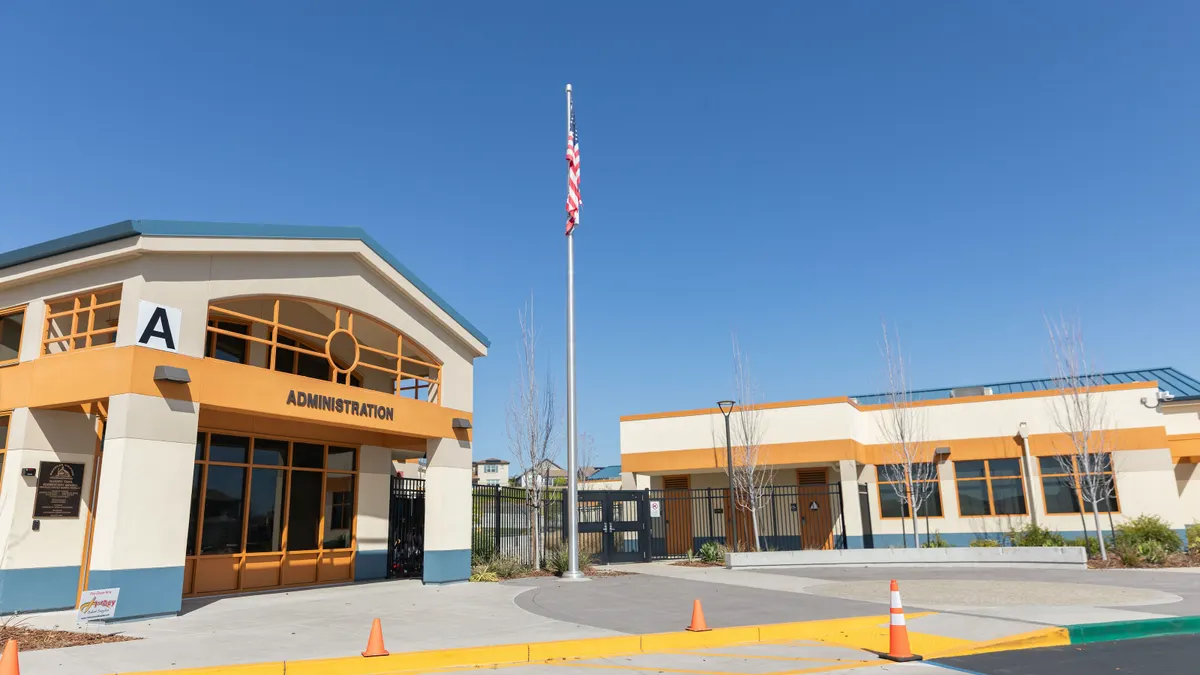
The Supreme Court rejected another such case on Monday, this time filed by California's Rocklin Unified School District. The district filed a petition in April after the state's Public Employment Relations Board decided in 2025 that Rocklin Unified’s policy requiring parental notification of students' gender transitions violated state law.
The district policy had required teachers to notify students' parents within three days of their transgender or nonconforming status.
Members of the Rocklin Teachers Professional Association, the district's teachers union, originally challenged that policy. After the district and its union attempted to bargain over the issue, the labor board ordered the district to rescind its policy, saying it violated the Educational Employment Relations Act by not giving the union adequate advance notice or opportunity to bargain.
The board also noted that a 2024 federal injunction was already in place against Chino Valley Unified School District to prevent a similar policy from being implemented.
Various California policies prohibit parental notification to some extent, with one California law signed in 2024 by Gov. Gavin Newsom — AB 1955 — explicitly prohibiting "forced outing" policies in school districts. While supporters of such laws say they protect LGBTQ+ students from potentially abusive environments at home, those seeking to stop gender support policies say they conceal student information from parents that can be related to their mental health or run counter to parents’ desired religious upbringing for their children.
Court influences policy despite no case
While many have looked to the Supreme Court to formally resolve the controversy, the justices took a roundabout way to weigh in earlier this year in Mirabelli v. Bonta, also out of California.
However, rather than settling the nuances of the debate through traditional oral arguments, the court ruled on the basics of the issue through its emergency, or shadow, docket. That approach has increasingly been used in recent years to quickly settle legal disputes without going down the traditional avenues.
Mirabelli was filed by parents and teachers against the Escondido Union School District and the California State Board of Education in 2023 on the grounds that gender support policies violate their First and 14th Amendment rights.
The Supreme Court put the case on the shadow docket after plaintiffs appealed it in a January emergency request. In an unsigned opinion issued in March, which struck down the policies, justices wrote that "parents who assert a free exercise claim have sincere religious beliefs about sex and gender, and they feel a religious obligation to raise their children in accordance with those beliefs."
However, in a dissenting opinion, Justice Elena Kagan said the case “shows, not for the first time, how our emergency docket can malfunction,” saying the court had “scant and, frankly, inadequate briefing about the legal issues in dispute.”
Kagan, whose dissent was joined by Justice Ketanji Brown Jackson, criticized the decision to rule on a case “raising novel legal questions and arousing strong views” without oral arguments or deliberation in conference — the usual methods for deciding cases.
“It considers the request on a short fuse — a matter of weeks,” Kagan wrote. “The Court is impatient: It already knows what it thinks, and insists on getting everything over quickly.”
Kagan said the court could have taken up another similar case for formal arguments. Almost 40 such cases were working their way through lower courts at the time.
Since then, and in addition to the case the justices rejected Monday, the court has denied petitions in at least two similar cases.
In late April, it rejected a case against a Massachusetts district, Foote v. Ludlow School Committee, — and quickly followed that by denying another against a Florida district, Littlejohn v. School Board of Leon County.
In the meantime, school systems and federal agencies are relying on the Supreme Court's decision in Mirabelli to set or influence policy.
In late April, for example, the U.S. Department of Justice launched investigations into 36 Illinois school districts over whether the districts had LGBTQ+-inclusive content in classrooms and if they allowed parental opt-outs, partly citing the Mirabelli decision.
In a June 2 warning letter to California Attorney General Rob Bonta, the Liberty Justice Center, a nonprofit litigation firm in favor of parental rights, said that approximately 600 California school districts were actively violating federal law and the U.S. Constitution by implementing the state’s forced outing prevention law, AB 1955.
Despite no formal opinion from the Supreme Court, the group said that the "recent order in Mirabelli v. Bonta makes clear that a conflict with California law does not justify policies that violate parents’ federal rights."
"In light of that ruling, the Liberty Justice Center is urging Attorney General Bonta, who was a named party in the Mirabelli case, to advise California school districts to comply with federal law and the United States Constitution."
The group said that while its efforts will initially be focused in California, it plans to expand its reach nationwide.