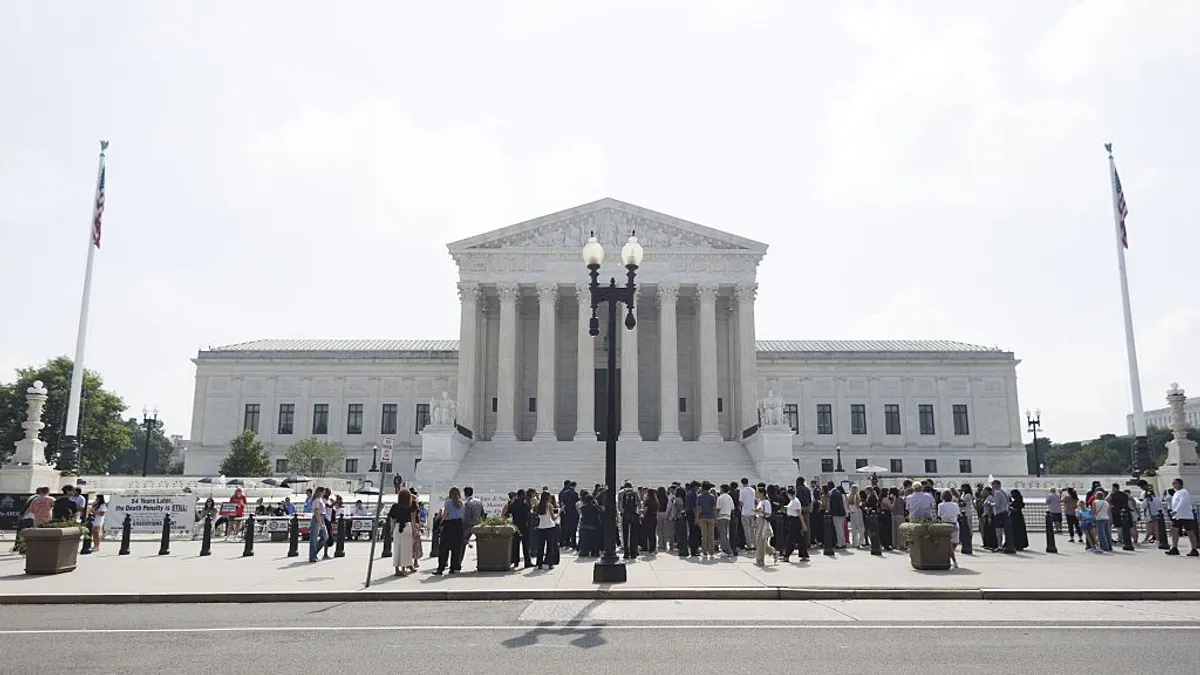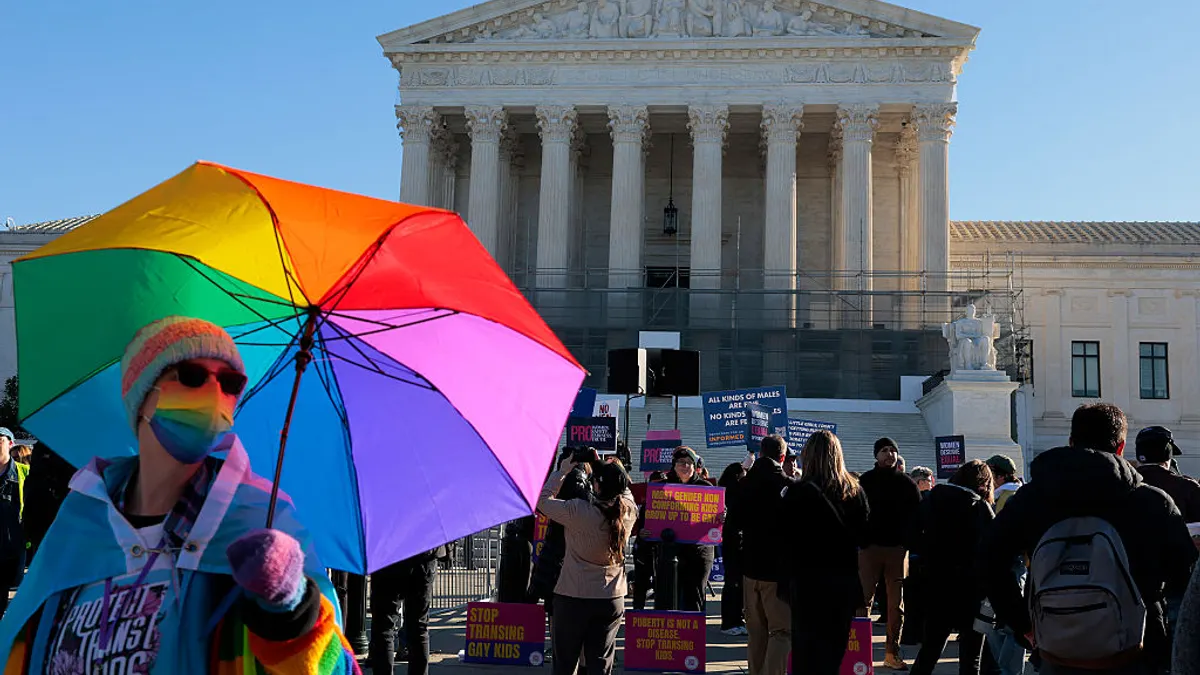
Girls' and boys' sports teams can be separated based on "biological sex," according to a U.S. Supreme Court decision handed down Tuesday.
The landmark ruling in a pair of related Title IX cases deals a major blow to transgender student inclusion in schools and colleges, especially in athletics. It's an issue that in recent years has increasingly divided states, many of which have adopted opposing policies on whether transgender students are allowed to play on teams aligning with their gender identities and on other issues such as pronoun and facility usage.
"The Title IX regulations allowed separate sports teams precisely because of the inherent physical differences between biological men and biological women," according to the majority opinion authored by Justice Brett Kavanaugh and joined by five other ideologically conservative justices.
The decision partly answers questions that have sparked a number of civil rights investigations and lawsuits against states and districts, initiated both by the U.S. Department of Education and parents who say trangender student inclusion discriminates against and jeopardizes the safety of cisgender girls.
It also allows state laws separating athletics based on "biological sex" — which have proliferated in over half of the nation in recent years — to remain in place.
"The Constitution and Title IX do not require an overhaul of women’s and girls’ sports throughout America," the majority opinion said.
A tale of two cases
Last summer, the Supreme Court agreed to take on the pair of cases — West Virginia v. B.P.J. and Little v. Hecox — that arose in West Virginia and Idaho, and addressed K-12 and college sports respectively. Justices heard oral arguments in January.
Together, the cases questioned whether Title IX of the Education Amendments of 1972 and the 14th Amendment prevent a state from requiring participation in girls’ and boys’ sports teams to be based on sex assigned at birth.
“Schools have long separated sports into boys’ and girls’ teams,” said West Virginia in its petition for the case. “More recently, though, the lines have begun to blur.”
Since 2020, 27 states have banned transgender youth from playing on school sports teams aligning with their gender identities, according to the American Civil Liberties Union, which is representing respondents in the cases. Idaho was the first state to enact such a ban.
The West Virginia case was filed on behalf of a teen assigned male at birth but who has publicly identified as a girl since 3rd grade. The student took medication to stave off male puberty and also began estrogen hormone therapy, according to court documents.
As an 11-year-old rising middle schooler in 2021, B.P.J. — as the student is known in court papers — was barred by state law from trying out for and playing on the girls' cross country team. West Virginia's 2021 state law, similar to many other Republican state laws, barred transgender students’ participation on sports teams based on their gender identity.
Prior to 2021, West Virginia schools allowed transgender students to play on teams aligning with their gender identity on a case-by-case basis, according to court documents.
What does this mean for athletic programs?
In their decision Tuesday, justices in the majority opinion said the 2021 West Virginia law and others similar to it nationwide "are reasonable" because of physical differences between men and women such as height, weight, strength, speed, endurance and jumping ability — even in cases where hormones and puberty blockers are involved.
"Therefore, in contact sports, forcing female athletes to compete against males can create significant safety risks," said Kavanaugh in the majority opinion. "And in virtually all competitive sports, forcing female athletes to compete against males can undermine competitive fairness."
Justices who are typically considered liberal in their ideologies — Justices Sonia Sotomayor, Elena Kagan and Ketanji Brown Jackson — partly agreed with the majority opinion, but also veered from it in part.
Sotomayor, for example, said in her dissent that the court should not have allowed states to move forward with preventing all transgender students from playing on teams aligning with their gender identity even if some transgender students may not have a physical advantage.
"States do have some room to legislate around issues when there exists significant, and genuine, scientific debate," she said, but agreed with the majority that Title IX still allows separation based on "biological sex."
"This litigation implicates deeply sensitive, contentious, and evolving issues," said Sotomayor. "Because of the Court’s decision today, West Virginia, and any other state actor, can deny B. P. J. and others like her these experiences simply because it thinks they have an inherent athletic advantage, even if the facts show that they do not."
The divide between justices about whether transgender students may be prohibited from playing on sports teams aligning with their gender identity in all cases or whether there should be some exceptions to that prohibition reflects a broader one nationwide among lawmakers, families, educators, education leaders and the general public.
It's also one that has taken center stage under the Trump administration, which has increasingly cracked down on state policies in blue states allowing transgender students to play on girls' sports teams.
The Education Department has launched many investigations into K-12 entities under the second Trump administration, ranging from school districts and athletic associations to large education state systems like those in New York, California and Hawaii, into the issue. In many of these cases, the administration has threatened to withhold federal funds if the school systems or sports associations do not comply.
In the last month alone, the Education Department has opened or advanced investigations in a number of districts or states nationwide, including in Kentucky, Kansas, Maryland, Michigan, North Carolina, and Colorado.
In a handful of instances, the department has also referred such cases to the U.S. Justice Department for enforcement.
On March 30, the Justice Department sued the Minnesota Department of Education after an Education Department referral for enforcement in January. Minnesota has about $3 billion in federal funding, of which some $680 million was available for drawdown in March.
On June 8, the Justice Department also launched compliance review investigations into four California districts, including San Francisco Unified School District, partly over whether the districts allowed transgender students to play on girls’ sports teams.
The Supreme Court decision in the Idaho and West Virginia cases will likely impact the outcome of the administration's investigations, as well as district policies nationwide on transgender athletic participation in public schools and colleges.
"In so ruling, we emphasize one last point," the majority said Tuesday. "No student-athlete on either side of the issue, whether a biological female or transgender, deserves to be ostracized or vilified."