PITTSBURGH — As school districts work to improve lagging student outcomes, there’s very limited information on whether those investments are proving successful, experts say.
“As a result, sometimes budget decisions are based on our best guesses about what's working in our system, the loudest voices in the room, or compliance with specific funding requirements, but not necessarily what we know about the impact on student performance,” said Kelsey Krausen, director of education finance at WestEd.
Delaware’s Christina School District has partnered with WestEd to develop a way to measure student outcomes from specific district programs and initiatives.
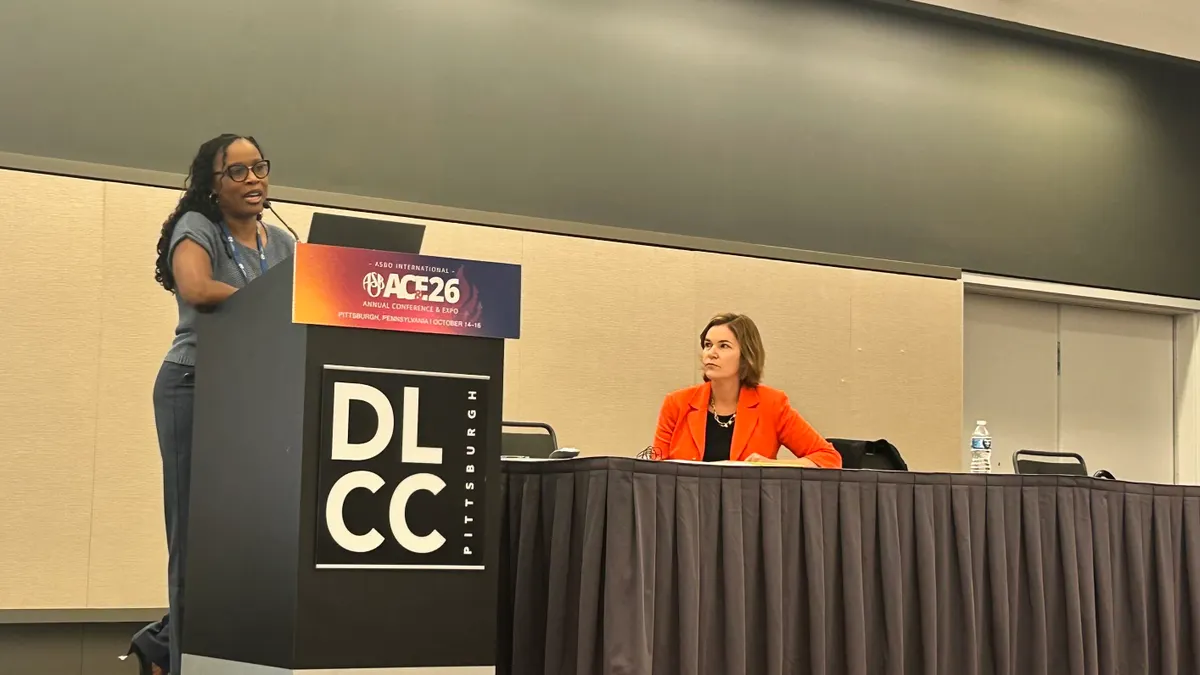
Krausen and Nathalie Princilus, supervisor of grants and unique programs at the 13,000-student district, discussed how to implement such a practice and tool to ensure academic return on investments during a Thursday session at the Association of School Business Officials International’s 2026 Annual Conference & Expo in Pittsburgh.
Christina School District worked with WestEd to develop an academic ROI dashboard that allows district leaders to consistently evaluate student performance from programmatic investments. The dashboard, which launched in July, can show the cost of a program alongside data measuring students’ academic outcomes from those programs, Princilus said.
The dashboard can also compare different programs and their outcomes, and it includes a reflection section for leaders to answer why a program did or didn’t work.
How to engage in academic ROI
Before Christina School District engaged in its academic ROI evaluation, about half of the district’s programming had no clear methods to measure student outcomes, Princilus said. Measuring ROI is especially important for the district as it experiences enrollment shifts and financial instability following pandemic-era investments, she said. The number of students attending Christina School District has fallen from 13,553 in fall 2022 to 12,799 in fall 2026 — a 5.6% drop.
During the surge of federal COVID-19 recovery funds, Princilus said, the district invested a lot of its dollars into staffing. Christina School District has also made significant investments in programs across multiple funding streams as student needs and operational costs both continue to increase.
While Christina School District had access to ample data to measure student outcomes from all of its investments, Princilus said, the district still needed a data measurement system that was consistently implemented across all of its schools.
That would require more ownership and fidelity in data entry districtwide to help better track student outcomes, because otherwise the goals of certain programs would be difficult to measure, she said.
Prior to the dashboard, one way the district began to measure academic ROI was by examining its in-school suspension program, which is an unfunded, state-mandated initiative meant to reduce out-of-school suspensions. Princilus said the district has spent $1 million in contracts to facilitate the program, which requires a tiered intervention support system for students.
Although the Christina School District has used this strategy for the past four years, ultimately, the district realized that its implementation of the in-school suspension program didn’t have a strong academic ROI, Princilus said. The district discovered this after digging into questions about the rate of student recidivism among participants, data on academic and behavioral interventions, students’ GPAs and attendance rates over time, and student demographic data.
“So we have been spending, for some time, a huge portion of some grant budget on a strategy that's mandated. However, we did not do the authentic work of ensuring that the implementation and the program evaluation” were underway, Princilus said.
This process helped the district understand and communicate to its school leaders that there needs to be stronger and more consistent implementation strategies for its in-school suspension program, she said.
Best practices for implementation
Now, the academic ROI dashboard is a useful tool for Christina School District leaders to communicate with their superintendent, school board or local taxpayers about why a program may need to sunset or change in its implementation, Princilus said.
Krausen said the goal of academic ROI analysis is to “help our leaders within the system define a set of small priorities, understand the programs and services that are supporting those priorities with defined outcomes, and be able to measure their impact on students, on specific student groups over time, and ultimately lead to better outcomes for students.”
Sometimes, it can be difficult to cut programs that are not showing promising results for students, because some educators are attached to certain initiatives, Princilus said.
Even when school leaders face pushback on proposed cuts because of that emotional attachment to some programs, Princilus said she encourages school leaders to keep focusing on student outcomes and ensuring investments match that.
Other advice Princilus gave to district leaders looking to implement an academic ROI model included:
- Start small and build a team before developing a tool such as a dashboard.
- Don’t wait for the perfect data to start an academic ROI analysis. Christina School District is still sifting through its data.
- Define questions first in order to know how to best design a tool.
- Ensure that the tool is implemented and embedded in people’s everyday work across the district.