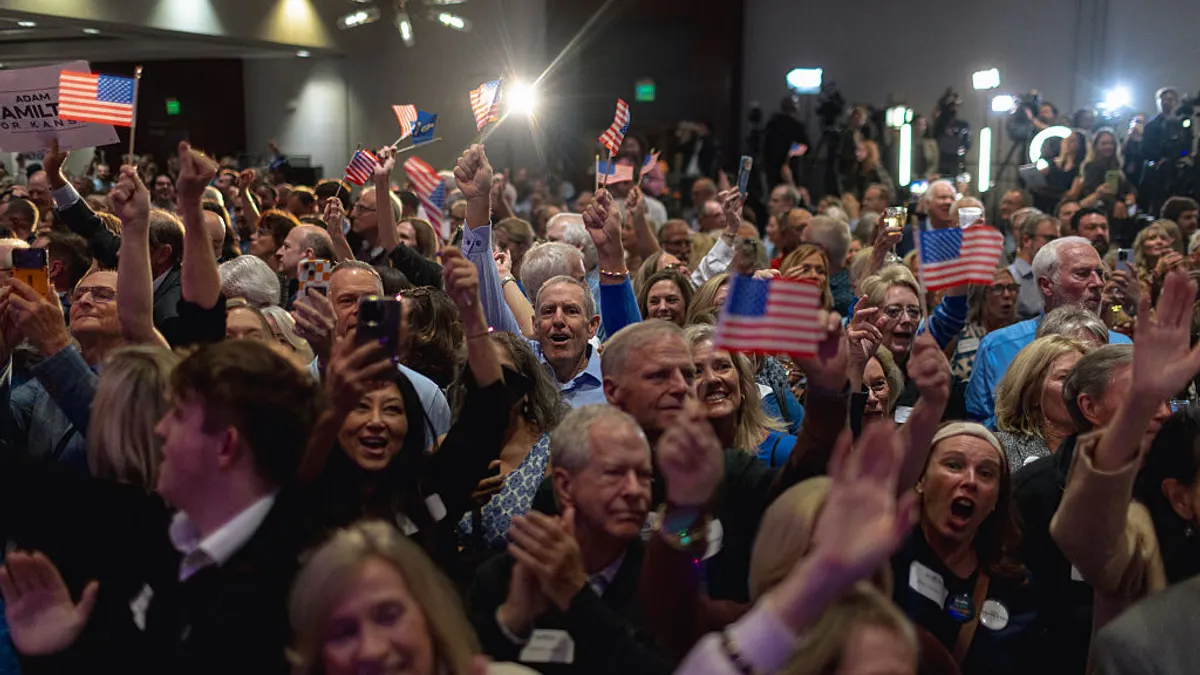
Voters handed a sweeping victory to Democrats during the 2026 midterm elections, with the party flipping five states in gubernatorial races and taking control of Congress with a majority in both the House and Senate.
The outcome is expected to trigger changes at the federal and state levels on issues related to education, ranging from resistance to the Trump administration's stance on diversity, equity and inclusion issues to more teachers union involvement on policy issues.
"What likely won’t change much is the day-to-day operation of schooling," said Jonathan Collins, assistant professor at Columbia University's Teachers College and the executive director of the Center for Educational Equity, in an email. "Don’t expect your child’s homework assignments to suddenly change, at least not nationally. But the major shifts in governors could mean changes to testing and supplemental funding allocations in specific states led by Democrats.”
Here are some changes to anticipate.
Resistance to the anti-DEI, anti-LGBTQ pressure
Over the last two years, the Trump administration — through changes to the U.S. Department of Education and other agencies’ handling of grant funds and investigations — has pressured states and districts to comply with a number of anti-DEI and anti-LGBTQ+ measures.
“The biggest change is Congress pressuring the President to retreat on the anti-DEI initiatives, many of which have targeted college and university programs as well as K-12 teacher training, curricula and library book offerings," said Collins. "Look for Democrats to draw a hard line on supporting the President’s next budget proposal (or debt ceiling raise), and for these types of policy positions to be part of the conditions."
The National LGBTQ Task Force said in a Nov. 4 statement that it hopes federal lawmakers "stop the relentless attacks our communities have endured" over the past two years and "continue to focus on public education."
Federal oversight changes
Abe Saffer, director of government relations for the Council of Administrators of Special Education, said he expects the incoming Democrat-controlled Congress to challenge the U.S. Department of Education's interagency agreements.
The Education Department began outsourcing parts of its day-to-day operations in 2025 with agreements that have included areas such as special education, literacy and teacher preparation. There are now 14 such K-12 and higher education agreements that include the management and oversight of grants, compliance with civil rights laws and technical assistance in areas like statewide family engagement centers and career and technical education.
Supporters say the transfer of responsibilities reduces federal bureaucracy and improves services. But opponents, including a few Republican lawmakers, voiced concerns that some agreements would actually cause more confusion for grantees and a siloing of Education Department responsibilities.
The issue has caused deep divisions among congressional lawmakers as the Education Department touts the agreements as progress toward dismantling and eventually closing the agency.
Bobby Scott, ranking member of the House Education and Workforce Committee, said in a statement to K-12 Dive that he intends to investigate the Trump administration's approach to education policy. Scott said he has sent letters to the heads of agencies including the Department of Education directing them to preserve "records, documents, data, or information" related to operations.
"I will use Congress’ oversight tools and leave no stone unturned as I fight for policies that actually deliver for the American public," he said.
State changes increase union influence
Democrats’ wins on Tuesday may mean more teachers' union influence over education policies, according to Michael Petrilli, president of the Thomas B. Fordham Institute, a conservative-leaning education think tank.
"Now the unions will expect something in return," he said in a statement to K-12 Dive. "In some places, that may [mean] additional funding for public education — which is fine. But they might also want to curb the growth of parental choice (both private school choice and charter schools), or eliminate differential pay programs, or add new collective bargaining requirements. None of those moves would be good for kids."
Randi Weingarten, president of the American Federation of Teachers, the nation's largest teachers union, said in a Nov. 3 statement that the election results show that those "who supported public schools and rejected private school vouchers triumphed — statewide in Texas, Iowa, Michigan and Ohio, and in countless congressional districts and school board races."
"That means strengthening public education and higher education, increasing wages, making healthcare affordable and accessible, and rebuilding our democracy. And after the sea change at the state level, there must also be progress in the priorities of governors and representatives," Weingarten said in a Nov. 3 statement. “We will act on these priorities starting tomorrow."
What won't change?
One Republican-led K-12 education program that Democratic lawmakers may have a harder time unraveling, Saffer said, is the Education Freedom Tax Credit, which was included in2025's One Big Beautiful Bill Act.
The program, set to launch Jan. 1, 2027, will allow families to use taxpayer-supported scholarships for private school tuition and public school expenses like tutoring, services for students with disabilities, books, computers and other costs, the proposed rule said. States must opt in to participate, and 30 have indicated their interest to the IRS as of Oct. 22.
The program allows taxpayer-donors to contribute money to scholarships for both private and public school students.
Jeanne Allen, founder and CEO of the Center for Education Reform, said in an Oct. 30 article in Forbes that the expansion of school choice is not due to President Donald Trump or the Republican party, but because of "parents demanding something better for their children, educators determined to create it, and leaders willing to challenge a system that too often puts institutions ahead of students."
Saffer said his hope is that the tax credit program will eventually be eliminated or reformed to better support public schools, noting that students with disabilities have lower rates of enrollment in private schools overall compared to public schools.
"Frankly, using public money to fund private schools that don't accept kids with disabilities is just untenable for us," he said.