Dive Brief:
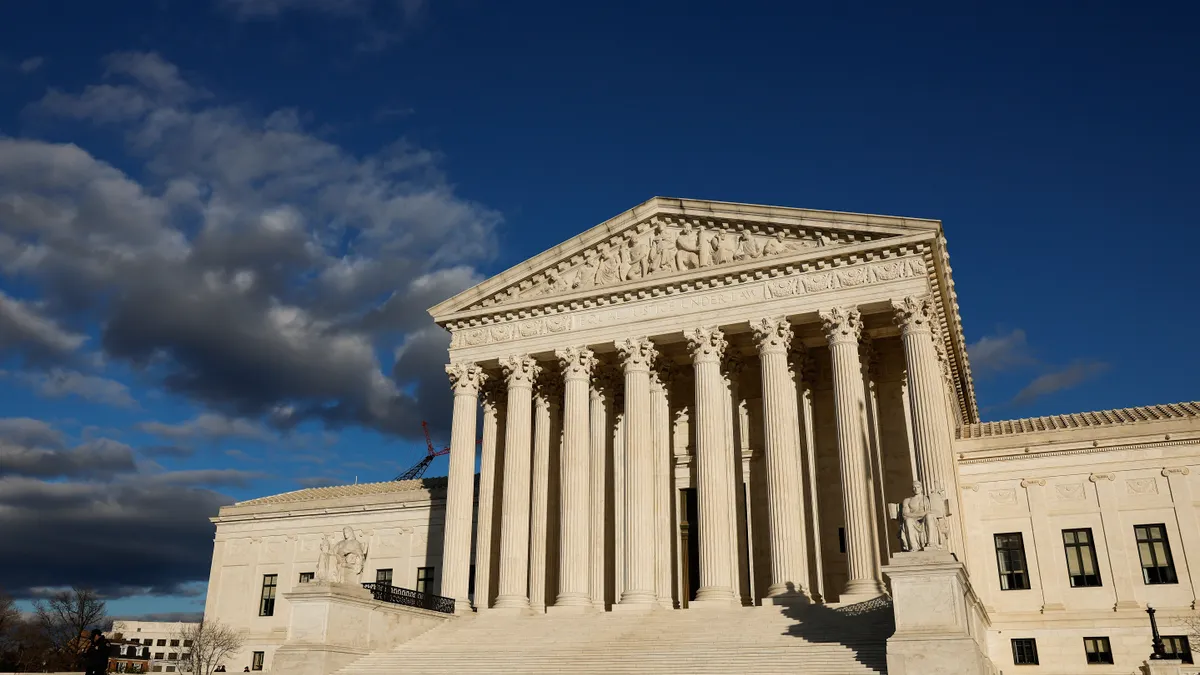
- The U.S. Supreme Court on Monday agreed to hear a case on the legal standards parents or others challenging school admissions policies as racially discriminatory must meet to win their lawsuits.
- In the Maryland case involving highly competitive magnet middle school STEM programs, the justices will consider whether someone alleging that a school district's admissions policy is racially discriminatory under the 14th amendment must first show that the policies harmed a specific racial group's enrollment rate in comparison to its applicant pool size.
- The case, Association for Education Fairness v. Montgomery County Board of Education, is to be heard during the October 2026 term. It comes as lawsuits in multiple high-profile districts challenge prestigious public schools' decisions to admit students from certain zip codes or socioeconomic backgrounds, which White and Asian students say have impacted their enrollment at selective schools.
Dive Insight:
In the newly accepted case, the 4th U.S. Circuit Court of Appeals ruled against the parents who had sued Maryland's Montgomery County Board of Education in 2020.
The case arose after MCPS changed its admissions policies at highly competitive magnet middle school STEM programs to diversify the student body by eliminating an entrance exam requirement, among other changes, such as a later lottery system.
Asian American parents claimed the policy changes "tank[ed]" their children's enrollment in the district’s magnet programs. For example, MCPS allegedly lowered Asian American student representation in one sought-after school, Takoma Park Downcounty STEM program, from 45.6% in pre-field test years to 31.5% in the three years the field test policy was underway, according to court documents.
Similar claims have been made in cases filed against school systems in Boston, New York, Virginia’s Fairfax County, and Philadelphia, and the Montgomery County case's outcome would impact those.
In 2024, the Supreme Court refused to hear one of those high profile cases, TJ v. Fairfax County School Board. That case concerned Virginia's highly ranked Thomas Jefferson High School for Science and Technology, which also changed its policies in 2020 in a move aimed at diversifying incoming classes.
The Fairfax school board agreed to weigh "experience factors" and drop entrance exam and teacher recommendation requirements, resulting in what plaintiffs alleged to be an intentional and discriminatory drop in Asian American enrollment. Asian American students made up 73% of enrollment prior to the change, but fell to 54% in 2021. The 4th Circuit decided that case in favor of the school board.
In the Montgomery County case, the high court justices will decide whether plaintiffs can move forward with their lawsuits alleging intentional discrimination without pleading that the challenged policy reduces the targeted racial group’s representation below a certain percentage.
"School districts across the country have overhauled admissions criteria for competitive public schools after concluding that existing systems produced undesirable racial enrollment patterns," petitioners said in the Montgomery case. "As challenges to those admissions changes have reached the Courts of Appeal, the circuits have divided sharply.”
In the 1st and 4th appellate courts, judges required parents or others challenging admissions policies to first show that the new policies reduced Asian American or other student pools below the group's share of the applicant pool. But in the 2nd and 3rd circuits, plaintiffs can prove intentional discrimination without first proving the impact on applicant pools.
"As the circuit split deepens, this Court’s intervention is necessary," plaintiffs in the Montgomery case said in their petition. "These cases involve five of the largest school districts in America."
The Supreme Court's decision will come several years after a higher education case, Students for Fair Admissions v. Harvard, ended race-conscious admissions for colleges and left the door open for striking down similar policies in K-12 admissions.
The decision will be the second one by the high court for the Montgomery school district, which — with over 156,000 students — is Maryland's largest. In 2025, the district lost a battle with parents over opt-out policies for LGBTQ+-related curriculum materials. The high court ruled in Mahmoud v. Taylor that schools must allow parents, based on religious objections, to opt their children out of instructional materials in certain scenarios.
The Supreme Court hasn't yet set a date for oral arguments in the admissions case, but it is expected to be heard this term, which kicked off in October. Supreme Court terms typically end in late June or early July.