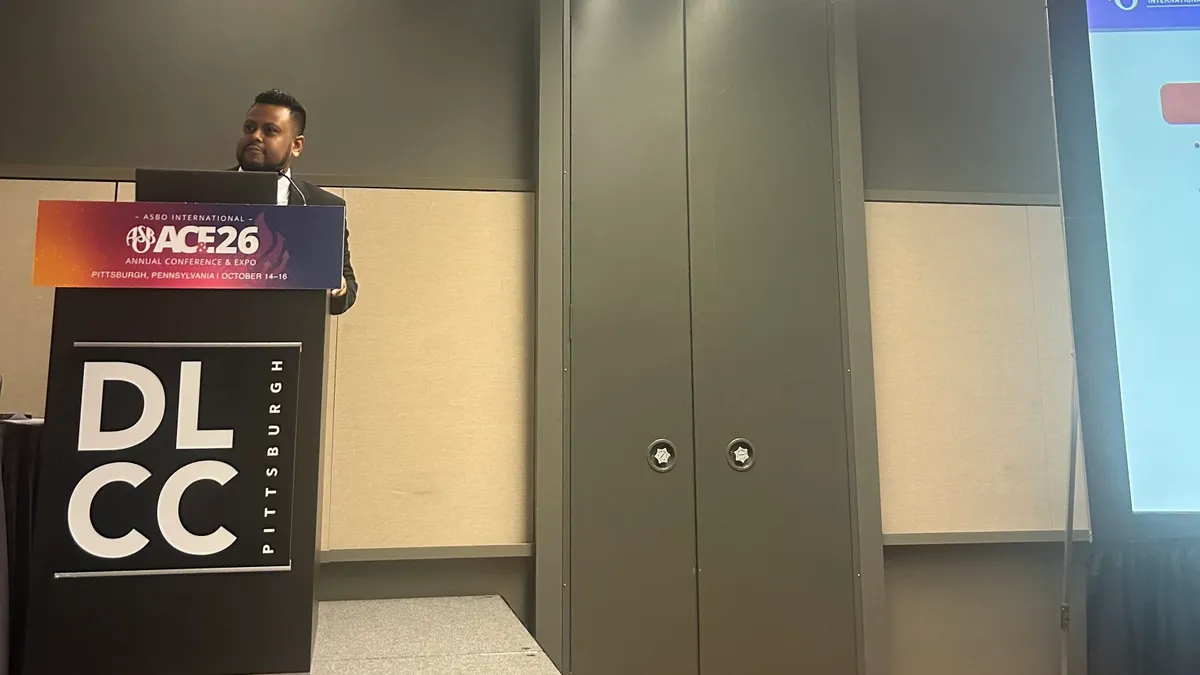
PITTSBURGH — In school finance leadership, district business officials can choose to either lead with an accountant's mindset of book keeping and compliance — or proactively zero in on financial strategy, Ahnaf Tahmid, chief financial officer at South Bend Community School Corp. in Indiana, told attendees at the Association of School Business Officials International’s 2026 annual conference.
While accounting responsibilities are still crucial, he said, a financial strategist will go further by also building capacity, finding data-driven efficiencies and leading with a strategic vision that considers students, teachers and taxpayers.
During a Thursday ASBO session, Tahmid shared how leading with a financial strategist approach translated into $20 million in savings for his more than 13,000-student district.
South Bend saved about $20 million a year beginning with the 2026 budget cycle by changing healthcare providers and shifting some outsourced services back to the district, among other things, Tahmid said.
The change in healthcare providers was prompted by a 15% jump in 2025 for its share of employees' health insurance premiums, he said. And the premiums were expected to increase by another 13.5% — or about $3 million — in 2026.
When this kind of thing happens, district business officials can either “accept the fate” and make budget cuts to accommodate rising costs, or they can ask strategic questions about alternatives, Tahmid said. That questioning revealed that it had been decades since South Bend had considered switching health insurance providers, he said.
“Why? Because our benefit consultant would always say, ‘Hey, you are getting the best price, man. I mean, why do you want to switch insurance and mess around with people's health?’” Tahmid said. “So no one batted an eye, and we just followed the status quo.”
In the end, the district did decide to switch its insurance provider and netted lower premiums and deductibles — leading to $10 million in savings for 2026 over what staying with its previous provider would have cost, he added.
In another strategic move, South Bend saved money by terminating a contract with a third-party service provider to manage the district's facilities, Tahmid said. By pivoting to in-house management, the district is saving $5 million annually.
Tahmid added that the district saved another $5 million from consolidating administrative roles, terminating contracts for services that weren't being used, and employing artificial intelligence to reduce administrative costs.
For instance, he said, the district was spending $75,000 per year for a financial dashboard service that only two employees actually logged into in the last year — making it an easy choice to cancel the contract. South Bend also consolidated its transportation routes to save district funds.
Meanwhile, the district was struggling to retain teachers, Tahmid said. Though the district has the fifth-largest teacher workforce out of the state's districts, he said, South Bend ranked 203 of the state's 340 districts for average teacher pay.
“That was shameful, in my opinion,” Tahmid said.
To help remedy the situation, the district used $12 million of its $20 million in savings to give all teachers a one-time $9,000 raise. Not only did that make the district the highest paying one in the region, he said, but teacher vacancies fell to zero at the start of the 2026-27 school year.
The savings — and the resulting bump in teacher pay and retention — were possible because the district embraced a strategic mindset. Leaders asked questions and didn't accept “an inevitable fate” that public school education is automatically “doomed” even when funds are dwindling and enrollment is on the decline, Tahmid said.