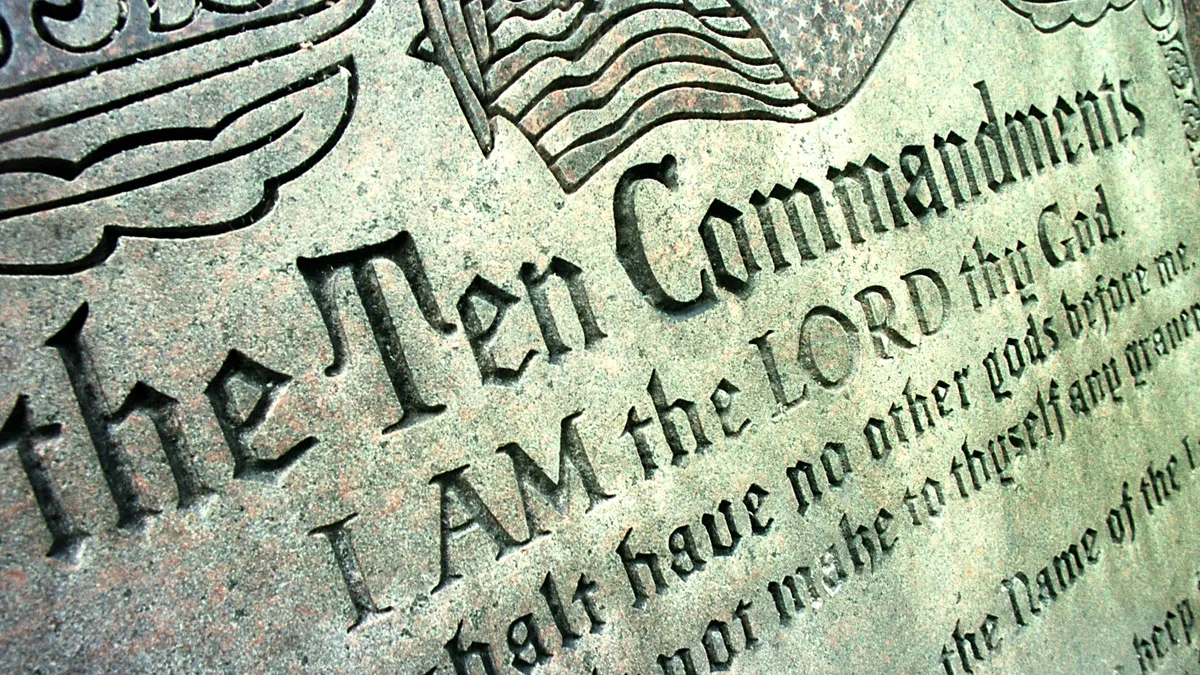
As the 2026-27 school year draws near, some schools across the nation will be reopening their doors with the Ten Commandments on their walls after high-profile lawsuits seeking to stop such displays have been relatively unsuccessful thus far.
Since 2021, nine bills have reached a governor's desk related to Ten Commandment displays or student instruction in public school classrooms. Out of those bills, eight were signed and one was vetoed, according to an analysis of legislation by the Education Commission of the States. Out of those eight bills signed into law, Arkansas, Texas, Louisiana, and Alabama — which was enacted most recently and goes into effect in January — have required Ten Commandment displays in schools.
While only four states require religious displays, others allow them, according to ECS, such as Tennessee and North Dakota.
North Dakota, in 2021, for example, permitted district boards to display the Ten Commandments alongside other historical documents in schools and classrooms. The law also excuses superintendents, administrators and other education employees or board members from liability for any damages resulting from a school's decision to display them.
Nationwide since 2021, there have been a total of 82 bills in 26 states that relate to Ten Commandments in schools in some way, marking a "sharp uptick" in the years following, said Jennifer Thomsen, principal and researcher for ECS, in an email.
Supporters of Ten Commandment laws, including their displays, have said the text is integral to U.S. history and literature, especially considering its influence on the Founding Fathers.
“Including the Ten Commandments in the education of our children is part of our state and national history, culture, and tradition,” according to Louisiana's law, the first such one to be passed in 2024.
Legislators have also openly cited a need to bring Christianity into the classroom.
“A lot of people, their children, are not attending churches," said Louisiana Rep. Sylvia Taylor, co-author of the legislation, according to a 2025 article in The Center Square. "We need to do something in the schools to bring people back to where they need to be.”
However, opponents take issue with the posters' potential religious influence on students and say they discriminate against the First Amendment rights of non-Christian religious groups.
As schools prepare for students to return, here is where Ten Commandment laws stand:
Embroiled in controversy from the start
In 2024, Louisiana became the first state to require public schools to display Ten Commandments in every classroom. The same day the Louisiana law was signed, the American Civil Liberties Union and other civil liberties groups vowed to sue the state, saying the law violated the First Amendment and U.S. Supreme Court precedent.
The law, they said, “would require school officials to promote specific religious beliefs to which people of many faiths, and those of no faith, do not subscribe."
After a lower federal court temporarily paused the Louisiana law in Roake v. Brumley, about a month after it was signed, the 5th U.S. Circuit Court of Appeals reversed that decision earlier this year. The appeals court judges said that classrooms had not posted the displays yet and, as such, it was too early for the courts to decide whether the displays violate the First Amendment.
The reversal marked a blow to those hoping to challenge the Ten Commandments' movement.
In April, the same circuit court also narrowly let Texas' version of the law through in Nathan v. Alamo Heights Independent School District, saying that the law "looks nothing like a historical religious establishment" under the First Amendment because "it punishes no one who rejects the Ten Commandments, no matter the reason.”
Supreme Court and other attempts to stymie laws
Following those losses in court, the ACLU said it plans to appeal the Texas decision in the coming weeks.
In the Louisiana case, the state told the Supreme Court in May as "a purely protective measure" to not take up the Louisiana case and that, if it does, to take it up alongside the Texas case. Justices are expected to deliberate on Louisiana's request in late September.
"After the Fifth Circuit’s rulings this Spring, parents and children in Louisiana and Texas are likely to return to public schools next month and be confronted with religious texts in their classrooms," said Heather Weaver, senior counsel for the ACLU Program on Freedom of Religion and Belief, in an email to K-12 Dive.
A separate lawsuit in Arkansas, Stinson v. Fayetteville School District No. 1, has been appealed by Arkansas to the 8th U.S. Circuit Court of Appeals, but has not yet been scheduled for an argument, ACLU said.
In the meantime, parents in opposition of the Ten Commandment displays are seeking another way to stop the laws.
In Harris County, Texas, three parents from various non-Christian faiths filed a lawsuit last week, this time challenging Texas' Ten Commandments law under the Texas constitution and state law, rather than the First Amendment. The lawsuit was filed against Texas Attorney General Ken Paxton, Texas Commissioner of Education Mike Morath, and three school districts, including Houston Independent School District.
Parents in the lawsuit say that the Ten Commandment displays "will cause their children to feel pressured," to join the Christian religion and “sends a message to the Plaintiffs' children that there is only one religion — Christianity — with teachings worth making visible."
Posters have already been displayed in classrooms of at least one of those school districts, Spring Branch Independent School District, according to the court documents.
The parents are asking the court to issue a temporary pause on the Texas law until the case proceeds and then eventually permanently block the state from enforcing the law.