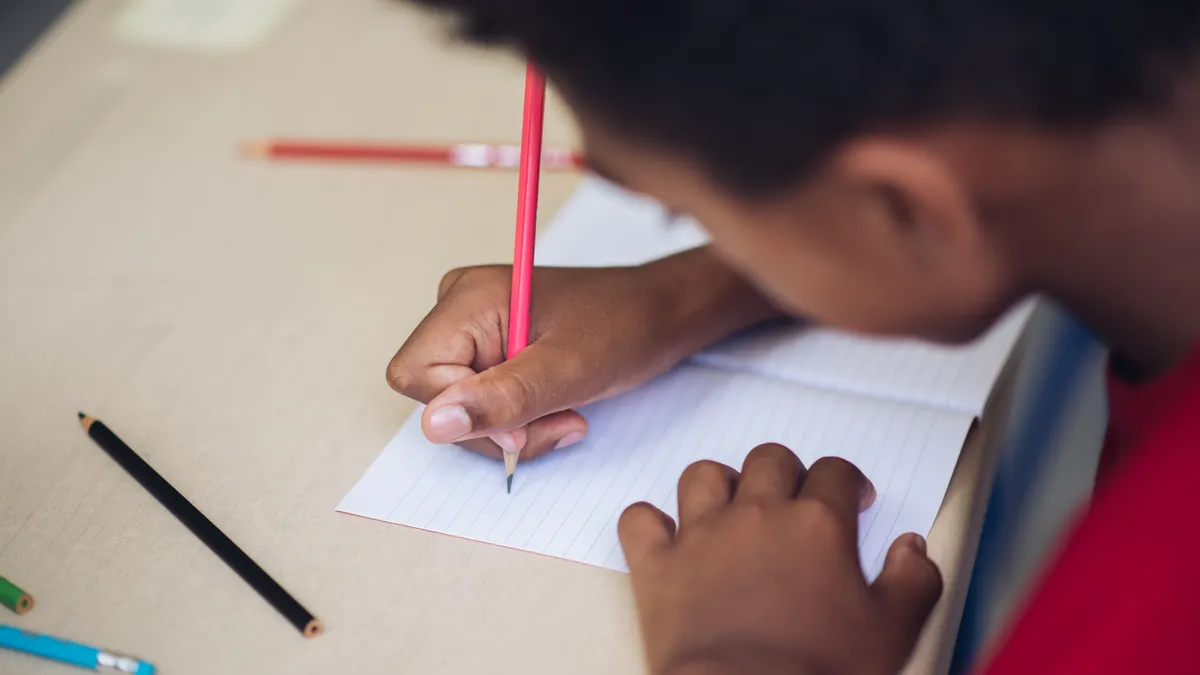
The ability to transfer thoughts to the written word varies widely among K-12 students. But using verbal rehearsal to have students think out loud about what they want to write is usually an effective device to expedite the process, writing educators say.
As a middle school classroom teacher, Tanya Baker, executive director of the National Writing Project, said verbal rehearsal was a practice that worked well for all students, but especially those who had difficulty getting their thoughts on paper.
“It’s not just seen as a way to start or prewrite, but you can also use verbal rehearsal during the process of writing,” said Baker.
The literature around verbal rehearsal originated in the multilingual learning space, said Cami Condie, professor in the McKeown School of Education at Salem State University and an adjunct at Harvard Graduate School of Education. “It’s a tool to help [students] solidify the language they want to use in their writing,” she said.
When a student has thoughts they can’t seem to get out of their heads, educators have several options, Baker said. Students can talk and write down what they say, or they can record themselves, replay the recording, and recapture their ideas at that point. Their teacher can also take notes on what they are saying.
“I’ve seen real benefits in increased independence over time, and confidence from a student. It’s frustrating as a writer not to have anything to say, or believe you have anything to say, or get it from your mind to paper,” she said. “That gives them the confidence in their ability to do that.”
“There’s an empowerment that happens when students are able to learn and use these strategies,” Baker said.
Verbal rehearsal can also be used to fill in gaps in students’ understanding or knowledge, she said.
“Students will talk to me about a topic,” Baker said, and she asks, “Is there anything else you want to talk about? What about this? You just said you were interested in this.”
She added, “I can extend their understanding or knowledge, asking those follow-up questions. Me talking or a peer talking, and eventually themselves — they can start to hear where the gaps are.”
The techniques can work for any age, from K-2 all the way through graduate studies, Condie said.
“Particularly for young writers, whether they’re young in age or young in development, they write like they speak. It’s almost verbatim,” she said. “If there’s any speech growth, you’ll see it in their writing.”
When working with her graduate students, Condie said, “I can just say, ‘Talk about what you’re thinking about.’ That can be enough of a prompt. But for younger children, it needs to be more focused. Sometimes, it’s repeating exactly what the teacher said.”
Pairing students with the same partner for long periods of time can be a useful practice because the pairs get to know how one another thinks and can prompt them more knowingly, she said.
In middle and high school, Condie gives more of an open-ended prompt when following up: “What did you talk to your partner about? How did talking to your partner help you? Have them be more reflective, and build meta-cognitive skills. How did that solidify your idea? What changed because you talked to your partner? It helps them name why they’re stuck.”
Younger students require more hand-holding and more time with the teacher in general, while older students and those with more developed writing abilities become independent more quickly, Baker said.
But grade level alone doesn’t predict how much time students will need, she said.
“You can have a student in high school who doesn’t have confidence in their ability to put something on the page, and may need additional time. Whereas you may have a middle-school student who may have lots of practice and may not need verbal rehearsal,” Baker said. “It has to be scaffolded based on what the student needs.”