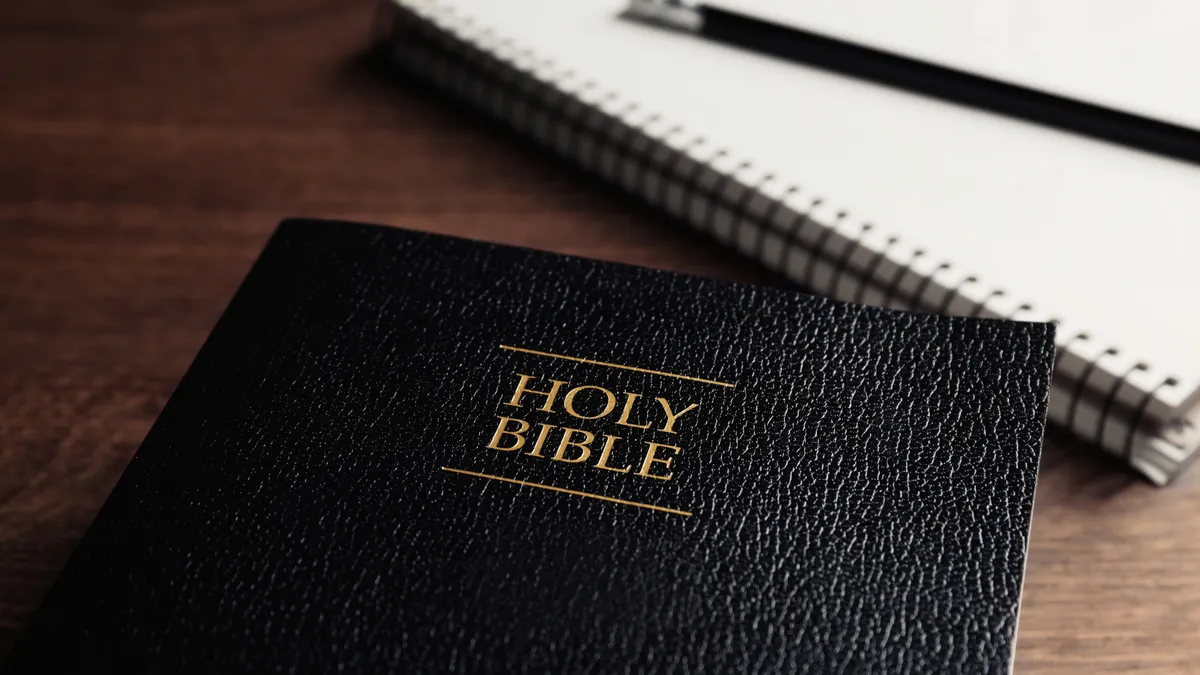
Policymakers in some states are working to infuse the Bible in social studies, civics or English public school coursework, setting up what may become the next wave of Republican-backed curriculum policies sweeping through the nation.
"It's still a soft wave," said Nik Nartowicz, lead policy counsel for Americans United for Separation of Church and State, which advocates against teaching religion in public schools.
In Utah, Gov. Spencer Cox signed a law in late March allowing districts to adopt "a thorough study of historical documents" — including the Bible's Hebrew Scriptures and New Testament — beginning in the 2028-29 school year.
Last week, the Texas State Board of Education gave preliminary approval to controversial new social studies standards and required reading lists that include Biblical references and stories, according to local reports. The tentative green light for the reading lists, which still must go through another approval process in June, came after passage of House Bill 1605, a 2023 law directing the state board to create the curriculum and incentivizing districts to adopt to the curriculum.
Meanwhile, under a Texas law enacted last year, Senate Bill 11, schools can set aside daily time for prayer and reading the Bible or other religious texts. Districts were required to decide whether they wanted to opt into that practice by March 1.
In Kentucky, a Republican-controlled state legislature enacted Senate Bill 19 in 2025, overriding Democratic Gov. Andy Beshear’s veto on legislation allowing boards of education to permit students to leave campus with parent permission during school hours for up to an hour to attend "moral instruction."
The law triggered LifeWise Academy — an Ohio-based nonprofit launched in 2019 that teaches public school students about the Bible during school hours — to pitch Kentucky school boards about bringing its program there, according to the Kentucky Lantern. Some accepted the request, while others rejected it, the Lantern reported.
However, a follow-up Kentucky bill introduced in March would require districts to approve such proposals. The measure would also extend the duration of the instruction time allowed in addition to letting it be offered on school campuses by providers like LifeWise Academy.
In Tennessee, lawmakers in January proposed House Bill 1491 and a sister Senate bill to establish a school day period dedicated to prayer and Bible or religious text reading that parents could opt into for their children. The legislation would also mandate that public schools teach parts of the Bible in their curriculum.
"Age-appropriate instruction would include the history of Israel, stories and ethical teachings from the Old and New Testaments, the life of Jesus, early Christian church history, and the Bible’s impact on Western civilization," according to a Jan. 12 statement by Republican State Rep. Gino Bulso, who sponsored the Protecting Religious Liberty and Expression in Public Schools Act.
Literature, history or unconstitutional?
At least 3,500 schools in 41 states allow Bible courses to be taught as a high school elective for credit, according to the National Council on Bible Curriculum in Public Schools. The council advocates for its state-certified elective Bible courses to be adopted by public high schools nationwide.
And while proposed state measures to allocate curriculum resources, school time or other resources toward Bible instruction or prayer are not new, they have been reinvigorated under recent state and federal Republican leadership.
In 2024, Oklahoma's top education official at the time, state Superintendent Ryan Walters, required Oklahoma schools to teach the Bible and have a copy in every classroom. The directive, which has since been reversed, also required that schools incorporate the Bible, including the Ten Commandments, as instructional support for grades 5-12 starting in the 2024-25 school year.
In a similar push, Walters and the Oklahoma state board of education championed controversial social studies standards that included lessons on the Bible. That curriculum would have been in effect for the 2025-26 school year had it not been struck down by the state Supreme Court late last year.
In Oklahoma and other states allowing or requiring infusing the Bible into the curriculum, Republican state leaders say the religious text is an important part of American history given that it influenced the nation's founders.
For example, Walters, who resigned in 2025 to become the CEO of anti-union organization the Teacher Freedom Alliance, defended his measures, saying, “It is not possible for our students to understand American history and culture without understanding the Biblical principles from which they came.”
Likewise, Tennessee lawmaker Bulso said in a January statement that his proposal would allow students to learn the Bible "as literature in a historical context."
"It puts the Bible back in school to be taught K-12 as history and as literature," he said during a February subcommittee session. "Not as inspired word or as devotional."
In Utah's legislation, the Bible is listed as part of "literary and historical texts that have influenced American constitutional history, civic thought, and cultural development."
However, opponents of legislation or policies allowing Bible instruction say it could harm the separation of church and state, and could promote certain religious groups over others.
"There is a way to teach about the Bible in public schools that is constitutional," said Nartowicz. "Schools can teach about religion, they can't teach religion."
The context and ways in which the Bible is referenced, the age group being instructed, and the discussions stemming from the curriculum — as well as how the curriculum is being legislated — can all impact whether Bible-related instruction actually violates the Constitution, he added.
New wave follows Ten Commandments laws
The proliferation of measures calling for including the Bible in school curriculum or instruction follow a parental rights movement — also backed by Republican lawmakers — that removed LGBTQ+-inclusive and race-related materials from schools based on allegations that they were sexually explicit or "divisive."
This also comes on the heels of Ten Commandments laws that spread to a handful of the same states in the last year. Louisiana, Texas and Arkansas all enacted such measures since 2024. And more recently, Alabama Gov. Kay Ivey last week signed the state's own iteration of a Ten Commandments law.
The Alabama bill, Senate Bill 99, would require schools to display Ten Commandment posters in every 5th-12th grade classroom where U.S. history is routinely taught and within common areas, such as cafeterias and school libraries, in every public school in the district.
Similar to Bible curriculum laws, Ten Commandments measures have also spread in Republican-led states as a "foundational" or "historical" text influencing the nation's birth.
“The Ten Commandments are a key part of the Judeo-Christian religious and moral tradition that shaped Western Civilization and ultimately the founding of the United States," the text of SB 99 reads. "Teaching students about the Ten Commandments promotes historical understanding and helps to foster a common cultural heritage and awareness."
However, civil rights organizations who say the Ten Commandments laws violate the separation of church and state have sued over the measures. Decisions are still pending in some of those cases, and the issue is ultimately expected to reach the U.S. Supreme Court.