Dive Brief:
- The House advanced two bills last week that would restrict schools nationwide from classroom discussions and materials related to LGBTQ+ identities and race. If they become laws, they would codify President Donald Trump's controversial executive orders.
- The Civics and History Advancement to Restore Learning, Integrity, and Education Act, or CHARLIE Act, which passed the House Education and Workforce Committee last week, would prohibit federally funded American History and Civics programs — a discretionary grant funded by the U.S. Department of Education — from using funds for "discriminatory equity ideology or gender ideology" when teaching American history and civics.
- The second bill, Stopping Indoctrination and Protecting Kids Act, passed the full House and would require public schools to obtain parental consent before changing a student's gender on school forms or changing a student's sex-based accommodations.
Dive Insight:
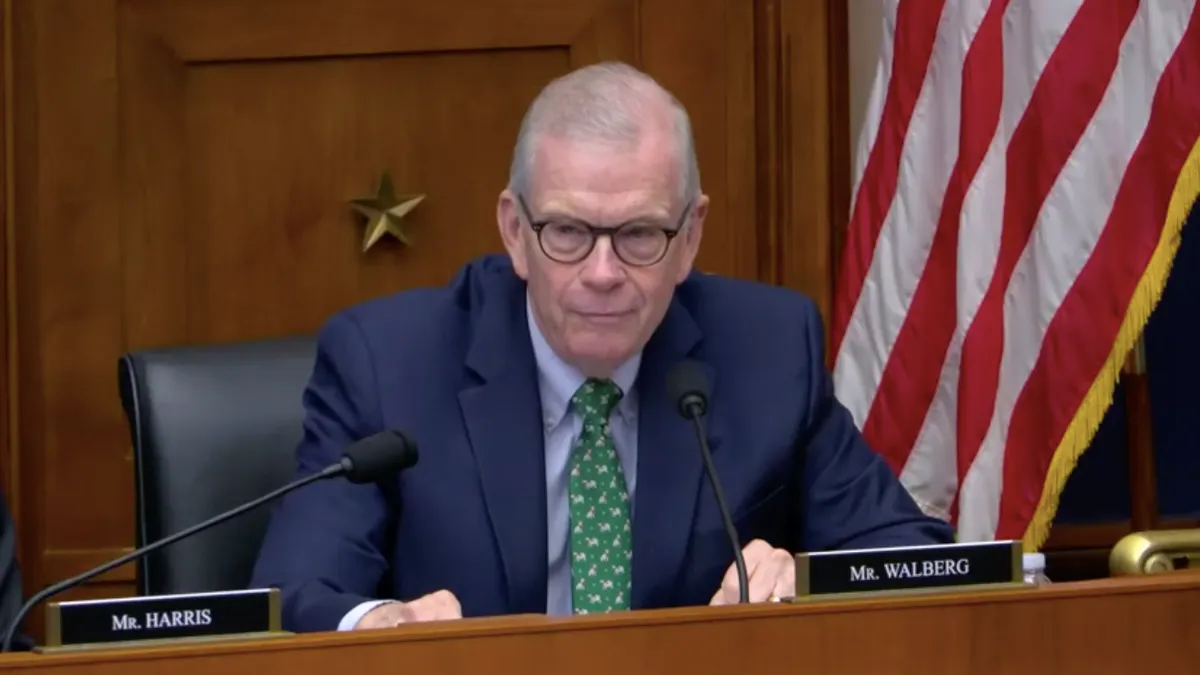
The two separate bills — the CHARLIE Act, or H.R. 8705, as well as the Stopping Indoctrination and Protecting Kids Act, or H.R. 2616 — were pushed by Rep. Burgess Owens, R-Utah. The latter was also co-led by Rep. Tim Walberg, R-Mich., who is chair of the House Education and Workforce Committee.
They echo two executive orders signed by Trump that use the same terms — such as "discriminatory equity ideology" and "gender ideology" — to limit transgender student access to programs and facilities aligned with their choosing and to prohibit certain race-related policies or topics in school.
The orders have led to federal civil rights investigations by the Education Department that challenge, for example, transgender student participation in women’s and girls' athletics across various states.
“There are only two sexes: male and female. Sex is a biological fact, not an ideological whim," said Owens in a May 20 statement referencing H.R. 2616. "Yet across the country, school districts are actively pushing radical gender ideology on children and, in some cases, facilitating social transitions without parental knowledge or consent."
The White House Office of Management and Budget signaled its support last week for the Stopping Indoctrination and Protecting Kids Act, saying in a memo that Trump's advisors would recommend he sign it into law if it were to be passed by the House and Senate.
According to Congress.gov, there does not appear to be companion legislation for either bill in the Senate.
The executive orders that partially inspired the legislation are being litigated by the American Civil Liberties Union for allegedly violating students' First Amendment rights. The ACLU filed a lawsuit last year against Executive Orders 14168, 14185, and 14190, on behalf of 12 students who attend Department of Defense Education Activity schools.
The lawsuit claims DoDEA schools systematically removed books, canceled events and changed curriculum in response to the orders. Topics changed include those related to slavery, Native American history, LGBTQ identities and history, and preventing sexual harassment and abuse, as well as portions of the Advanced Placement Psychology curriculum, the ACLU said.
In October, a federal judge for the U.S. District Court for the Eastern District of Virginia's Alexandria Division temporarily paused the order for the schools involved in the case. The broader question of the orders' constitutionality, however, is ongoing.
While the ACLU and other critics of the president's executive orders say they chill student speech and lead to censorship of important topics, supporters of the legislation passed last week said those orders would restore a focus on academics that they say has been lost.
Similar legislation has also spread to Republican-led states in recent years, with state-level policies already restricting "divisive concepts," "woke ideology," and "pornography" in the classroom — or certain LGBTQ+ and race-related topics.