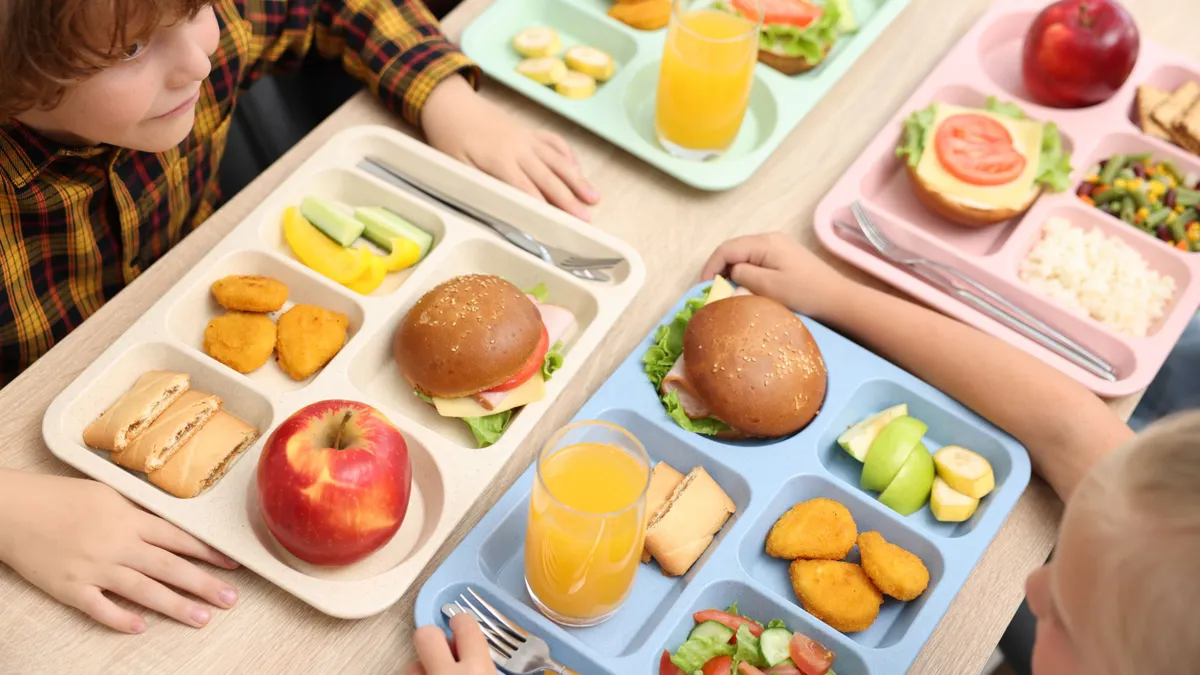
Federal reimbursement rates will increase by 3.54% for school breakfasts and lunches in the upcoming school year compared to 2025-26, the U.S. Department of Agriculture announced last week.
The national average reimbursement rates are adjusted annually based on the Food Away from Home series Consumer Price Index for All Urban Consumers, which is overseen by the Bureau of Labor Statistics. The latest update applies from July 1, 2026, through June 30, 2027.
Here’s how the new rates break down for schools, depending on the portion of free and reduced-price meals served, for the National School Lunch Program and the School Breakfast Program in the 2026-27 school year:
- For schools that served fewer than 60% of free and reduced-price lunches in the 2024-25 school year, the reimbursement is 45 cents — a 1 cent increase — per paid or free and reduced-priced lunch. For schools that served 60% or more free and reduced-price lunches in the 2024-25 school year, reimbursements are also rising by 1 cent, to 47 cents per paid or free and reduced-priced lunch.
- Schools certified to receive performance-based cash assistance by meeting certain meal pattern and nutrition standards will receive another 9 cents per reimbursable lunch served in addition to the federal reimbursement payments.
- For schools “not in severe need,” the rate for a paid breakfast is 42 cents (a 2 cent increase), for a reduced-price breakfast is $2.24 (an 8 cent increase) and for a free breakfast $2.54 (an 8 cent increase).
- For schools in “severe need,” the rate for a paid breakfast is 42 cents (2 cent increase), reduced-price breakfast $2.75 (11 cent increase) and free breakfast $3.05 (11 cent increase).
In Alaska, Guam, Hawaii, Puerto Rico and the Virgin Islands, schools get higher reimbursement rates due to their higher costs of providing meals, USDA said.
The updated reimbursements issued July 16 also cover the Special Milk Program for Children and the Afterschool Snack Payments in Afterschool Care Programs.
Overall, the increase in federal reimbursement rates are minimal compared to what school nutrition leaders have sought. Earlier this year, the School Nutrition Association asked Congress to pass the Healthy Meals Help Kids Learn Act, which would increase the federal reimbursement rate for school lunches by an additional 45 cents and breakfasts by an extra 28 cents. The bill was referred to the House Committee on Education and Workforce in October and has not advanced since.
In a survey released by SNA in January, 95% of school nutrition leaders said they had serious or moderate concerns over the financial sustainability of their school nutrition programs for three years from now.