Dive Brief:
- A civil rights complaint filed Tuesday alleges that the Pittsburgh Public Schools plan to close and consolidate schools discriminates against Black students. The closure plan, approved in May, calls for closing 12 schools and nine facilities.
- The complaint, filed with the Pennsylvania Human Relations Commission on behalf of five students being reassigned to new schools under the plan, says Black students will be disproportionately impacted when at least 6,000 students are displaced.
- The district depended on unreliable utilization rates that "serve no legitimate educational purpose" in deciding the closures, according to the complaint. A district spokesperson said it had not received the complaint and declined to comment.
Dive Insight:
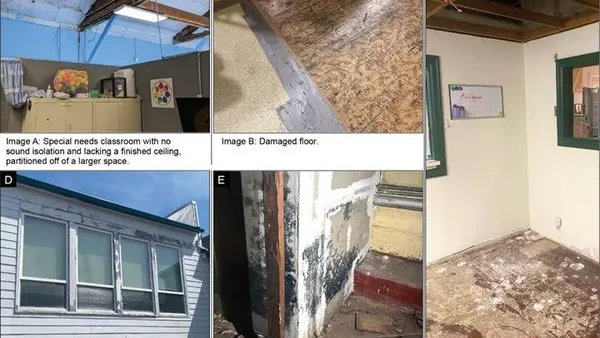
In May, the Pennsylvania district approved a plan to close 12 underused schools to address declining enrollment and aging infrastructure. The changes are expected to save $4 million in 2027 and double that amount in 2028.
However, the complaint says the district's reliance on utilization rates — or the ratio of enrolled students to building capacity — discriminated against Black students. Districts often rely on utilization rates when deciding to close or consolidate buildings.
"On average, the lower a school’s utilization rate, the higher the share of Black student enrollment," the complaint said. "The inverse relationship between utilization rate and Black student enrollment in PPS indicates that basing school closure decisions primarily on utilization rates will disproportionately affect schools serving higher shares of Black students."
The complaint cited 2024 research published in Harvard Educational Review showing that relying on utilization rates leads to majority Black schools being disproportionately closed. It also cited research from 2023 published by Policy Analysis for California Education showing that White families entering Black and Latinx neighborhoods often opted not to send their children to the local schools — especially when they viewed them as unsafe or low-performing.
"The school district may eventually identify these schools as underutilized and therefore potential sites for closure," the research said.
The complaint alleges "education discrimination based on race in violation of the Pennsylvania Human Relations Act." Once the district is served with the complaint, it is required to respond within 60 days.
Pittsburgh is not new to school closures leading to racial discrimination allegations. In 2006, the school board reached a settlement that required the district to "assure an equitable needs-based allocation of resources." That settlement was also reached under the Pennsylvania commission's purview where the new complaint was filed this week.
When the commission evaluated compliance with the settlement in 2012, the commission decided it was “not prepared to conclude that the District had achieved sufficient progress to justify termination” of the agreement. This was again the case in 2015, according to the complaint.
Pittsburgh's decision earlier this year to close schools came as part of a nationwide trend where districts both large and small are contending with tighter budgets and dwindling enrollment as a result of lower birth rates, stricter immigration policies and expanding school choice.
To stave off pushback against school closures, experts recommend strengthening community engagement and building stakeholder trust.
“This plan is about far more than buildings,” said Pittsburgh Public Schools Superintendent Wayne Walters in a May 27 statement following the board's school closure vote. “It is about creating equitable opportunities, strengthening academic experiences, and ensuring every student has access to learning environments that support success in college, career, and life.”
The district said its plan had been developed over multiple years with community engagement as well as facility assessments, enrollment and demographic analyses, educational adequacy reviews and financial evaluations. Notably, the distinct also said the process included input from students, families, staff and local residents.
Throughout the transition, the district plans to continue communicating with affected school communities.
However, the groups filing the civil rights complaint this week suggested otherwise.
“The Board and the Pittsburgh Public School District were repeatedly put on notice that basing school closures on utilization is flawed, serves no educational purpose, and would disproportionately harm Black students," said Adaku Onyeka-Crawford, a director at Advancement Project, one of three groups to file the complaint.
"Despite this notice and clear advocacy from the community, the Board voted to plow ahead with its discriminatory plan and endanger the education of thousands of children in Pittsburgh," Onyeka-Crawford said in a July 14 statement.