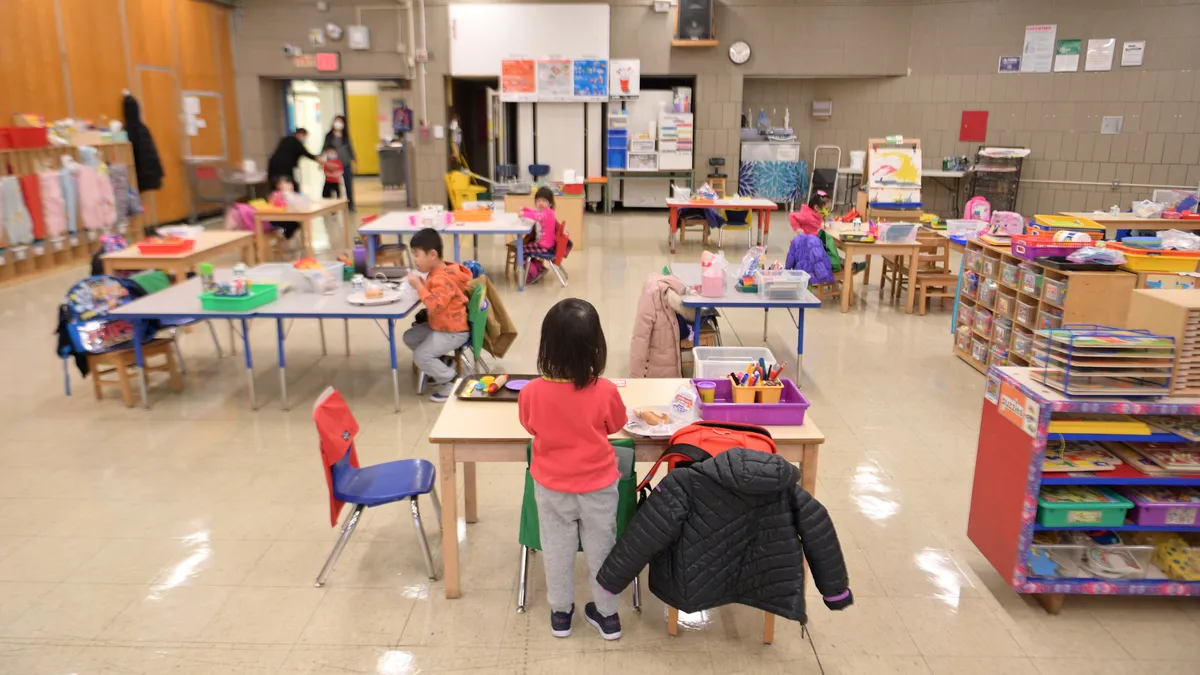
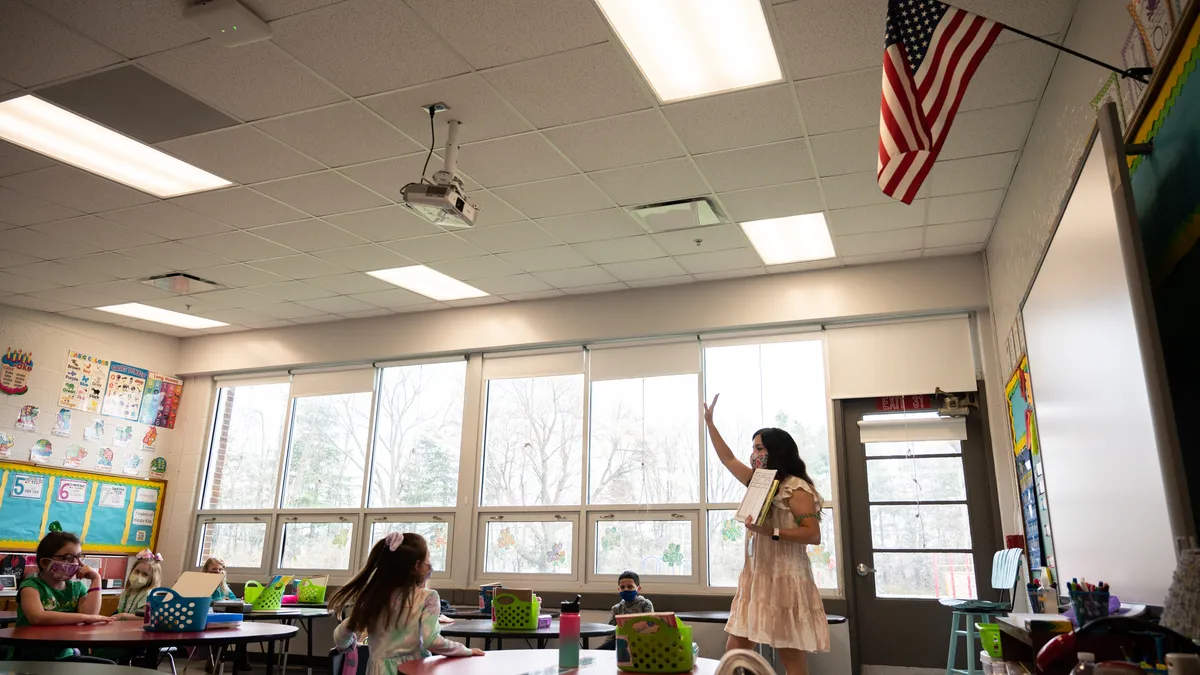
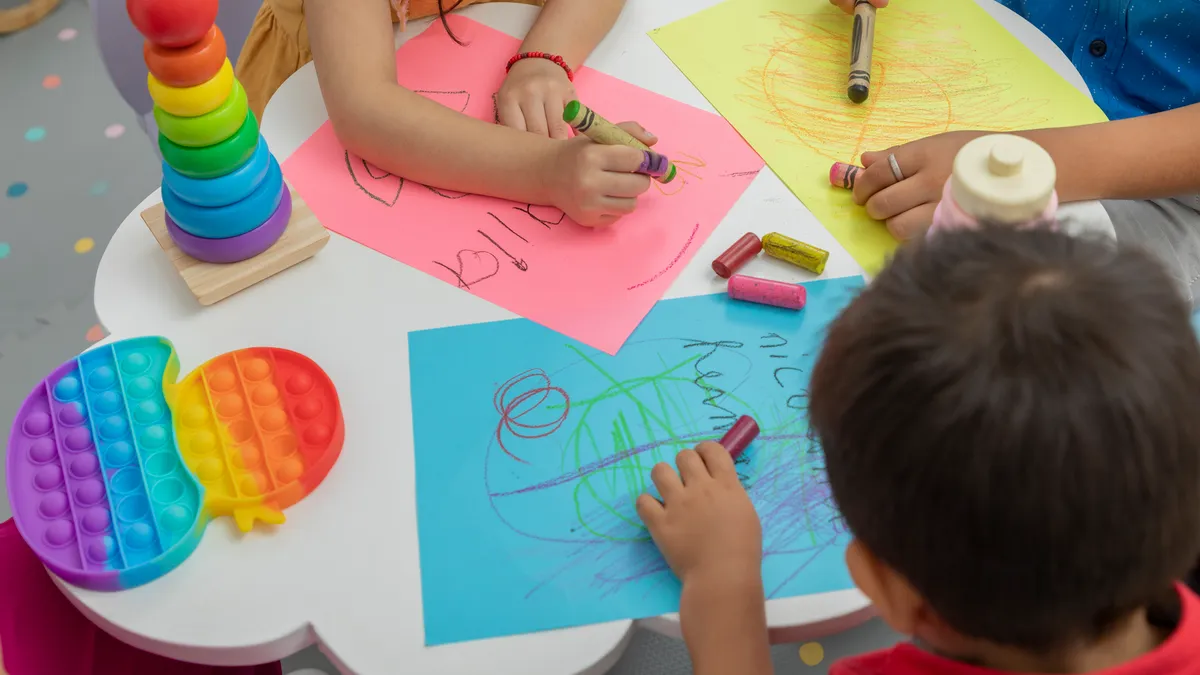
Preschool students are pictured at Yung Wing School P.S. 124 on Jan. 13, 2021, in New York, N.Y. The COVID-19 pandemic impacted public school enrollment, but those numbers are rebounding among the nation's youngest students, according to data from the National Center for Education Statistics.
Michael Loccisano / Staff via Getty Images
This audio is auto-generated. Please let us know if you have feedback.
Public education enrollment in the U.S. continues to lag behind prepandemic levels — though figures for 3- to 5-year-olds have rebounded, according to the U.S. Department of Education's most recent Condition of Education report.
The congressionally mandated report overseen by the National Center for Education Statistics appears to be back on track, with the release of the 2026 Condition of Education in May coming roughly a month after its long-delayed 2025 installment. The report has a June 1 deadline each year.
In lieu of the full report last year, NCES had uploaded data to an online dashboard, worrying education researchers and policymakers who said it contained old analysis and few new data figures.
The 2026 and 2025 Condition of Education reports contain information as recent as 2024 for enrollment, with data from 2023 still the most recent available in other areas of K-12 like spending.
"Following a precipitous drop in 2021, school enrollment rates in 2024 for both 3 to 4-year-olds as well as 5-year-olds are no longer measurably different than they were in 2019," said Matthew Soldner, acting director of the Institute of Education Sciences and acting commissioner for National Center for Education Statistics, in a June 2 email to K-12 Dive. "This is a major win for students, parents, and local educators."
The reports are the first in the series to be issued under Soldner after longtime NCES commissioner Peggy Carr was ousted last year in the Trump administration's push for a smaller Education Department.
Last year, under Soldner's leadership, the Education Department released an online webpage that it said it would be updating "on a rolling basis” due to its “emphasis on timeliness.” The dashboard that had included significantly less information than contained in reports in previous years. The lack of a report meant that the department had missed its June 1 deadline “for the first time ever,” according to Sen. Patty Murray, D-Wash.
Together, the two reports — both over 90 pages long — include a slew of new data analysis on the state of U.S. public education. Here are nine things you need to know:
By the numbers
49.4 million
U.S. public elementary and secondary school enrollment in fall 2024. The number still trails the prepandemic level of 50.8 million, as well as the 2013 count of 50.3 million and last year's 49.5 million.
8
The number of states where fall 2024 enrollment exceeded levels from a decade prior by 5% or more. Those states include Delaware, South Carolina, Texas, Nebraska, South Dakota, North Dakota, Utah and Idaho.
25
The number of states, in addition to the District of Columbia, where enrollment was higher in fall 2024 than during the pandemic in 2020, indicating enrollment has rebounded after a drop across all 50 states.
62
The percentage of 3- to 5-year-olds enrolled in school overall, including private and public, suggesting that enrollment for this age group has rebounded after falling behind during the pandemic. In 2021 — the data year that largely overlaps the first full school year of the COVID-19 pandemic –- the enrollment rate fell to 53%.
14 in 1,000
The ratio of violent victimizations per 1,000 students decreased from 37 to 14 victimizations per 1,000 students over a decade, from 2013 to 2023. The violent victimization rate at schools in 2023 did not differ significantly from prior to the pandemic.
2.1 million
The number of status dropouts — 16- to 24-year-olds who aren’t enrolled in school and haven’t earned a high school credential — in 2024. The rate of status dropouts declined across ethnicities between 2014 and 2024.
2
The percentage of students with no home internet access. In 2023, about 98% of 3- to 18-year-olds had home internet access, according to the American Community Survey.
2 million
The number of 2024 high school graduates who were immediately enrolled in college in October of that year. Out of 3.2 million total high school completers, that indicates a 63% immediate college going rate. Though not "measurably different" from 2023’s rate, it’s a drop from 68% a decade prior.
$1 trillion
Total expenditures for public elementary and secondary schools in the U.S. in the 2022–23 school year. That's about an average of $20,039 per public school pupil enrolled in the fall of that school year. Total per-pupil spending was lowest in Idaho and Utah, and highest in the District of Columbia and New York.