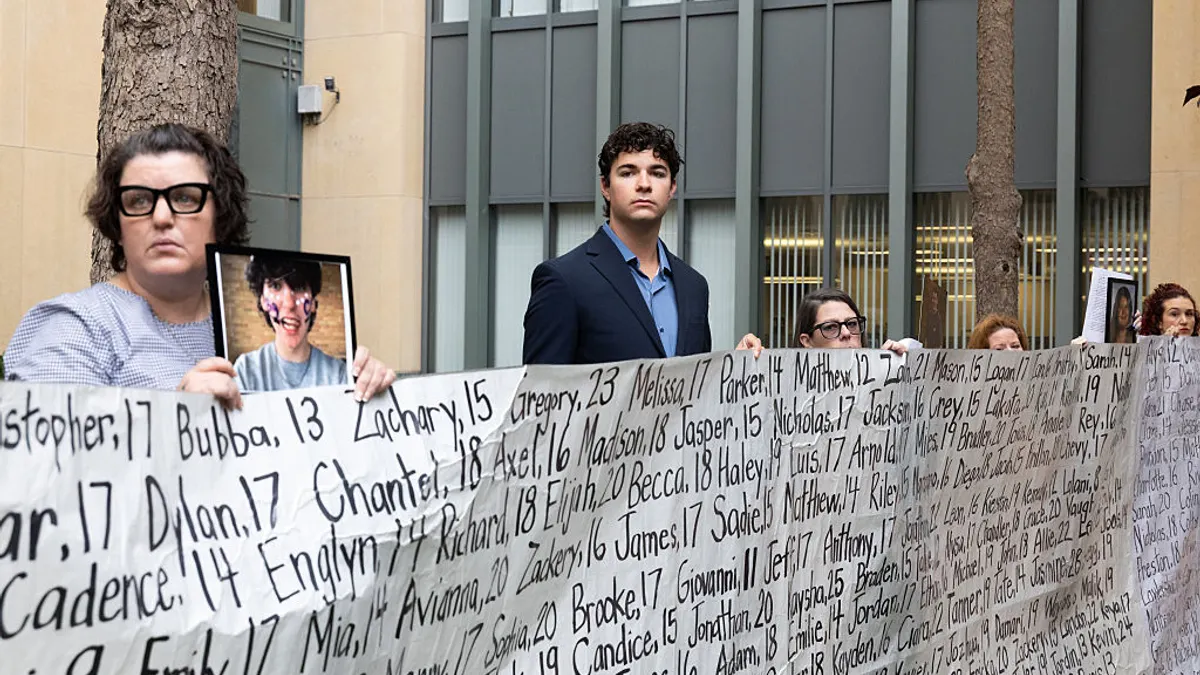
A historic social media litigation settlement between Meta and 52 states and territories announced Aug. 26 promises to make sweeping changes to how youth interact with these platforms in efforts to reduce harms to youth mental health.
The $17 billion settlement is one of the largest state consumer protection settlements in U.S. history, aside from the Big Tobacco settlements in the 1990s, said several state attorneys general in statements. In addition to settlement monies, Meta, the parent company behind Facebook and Instagram, said it would take several steps to give parents stronger app controls and to provide protections for youth under the age of 18, including muting app notifications during the school hours.
"The framework we’ve negotiated will empower parents to easily manage how their children access our platforms," said C.J. Mahoney, chief legal officer at Meta, in an Aug. 26 statement. Meta is calling for an industrywide solution and that other social media companies, like YouTube and TikTok, put similar measures in place.
The states' lawsuit, filed in 2023, claimed Meta illegally collected and used data from children under the age of 13 who used its platforms. The states also claimed the company made platform design decisions that drove excessive use and lied to users, their families, and the public about the safety of Facebook and Instagram. Those actions, the states said, violated federal and state laws, including the Children’s Online Privacy Protection Act.
Here's what schools should know about the settlement agreement.
School-day notifications will be turned off
Under the agreement, Meta apps will mute push notifications — except for direct messages and alerts about account security or safety — between 8 a.m. and 3 p.m. on weekdays during the school year. There will also be a default two-hour daily time limit for access across Facebook and Instagram that teens can only turn off with a parent’s permission.
“The idea that maybe, just maybe, our children can get through the school day without being interrupted by notifications is a tremendous relief to us,” said Kate Dias, president of the Connecticut Education Association, during an Aug. 26 press conference with Connecticut Attorney General William Tong.
Many states and school districts have set policies over the past few years that limit or ban student cellphone use in schools. Several school leaders have said anecdotally that since cellphone limits were implemented, there have been notable decreases in classroom distractions and increases in student face-to-face interactions.
Schoolday cellphone restrictions led to a broader debate about overall screen use in schools. A U.S. Surgeon General's advisory earlier this year said harmful screen use by children and teens has become a “public health concern." An accompanying toolkit called for schools to “limit screen use by assigning work in books or on paper whenever possible.”
However, U.S. Department of Education guidance issued last month said schools and communities should make school screentime decisions based on whether ed tech is improving learning and student outcomes — not just whether students and teachers should or shouldn't use the technology.
Mike Parent, principal researcher at Hopelab, a nonprofit that works to improve the mental health and well-being of young people, said the social media protections resulting from the settlement are positive steps, particularly Meta's agreement to have a default block from its apps between midnight and 6 a.m.
In a soon-to-be published Hopelab poll of 500 high school students, some respondents said they engage in late night "doomscrolling" for an hour or more. That length of time looking at content that can be upsetting can adversely impact students' brain development and make them less productive the next day at school, Parent said.
Additionally, he said, cellphone policies should be made in collaboration with students, with the aim to understand why youth want or need to use their phones at schools. Knowing if there are other factors at play, such as teacher shortages or underfunded schools, can help address systemic barriers to student engagement, Parent said.
Other promised changes Meta is making include youth receiving prompts every 15 minutes of continuous screen time on Facebook or Instagram and a block for teens using extreme makeup filters.
Some settlement funds could go to schools
While many states are still making determinations about how to spend their settlement funds, some states have already shared initial priorities.
According to the Connecticut Education Association, the state could receive up to $265.4 million over a 10-year period. At least half of all funds will be dedicated to remediating youth social media harms, including support for mental health and crisis intervention, after-school and summer school programming, and implementation of phone-free school zones, the association said.
New York Attorney General Letitia James said in an Aug. 26 statement that the state's $819 million to $1.15 billion payout could go toward grants to schools to implement phone-free classrooms, training for mental health professionals to serve students, after-school or summer programming for youth, and public health programs.
Jodi Grant, executive director of Afterschool Alliance, said in an Aug. 26 statement that the alliance was "thrilled" to see several state leaders reference after-school and summer learning in their comments on this settlement.
"We encourage all states to use some of this settlement money to fund these essential programs, which give children and youth alternatives to screens and access to the real-life experiences they need to thrive," Grant said.
Elizabeth Gaines, founder and CEO of Children's Funding Project, said in an Aug. 26 statement that "No dollar amount can fully capture the impact that years of addictive platform design and excessive screen time have had on a generation of young people."
The Children's Funding Project is a national nonprofit that helps communities expand equitable opportunities for children through public financing. The group's Fund IRL initiative helps communities plan for and invest payouts from social media litigation into activities that promote children’s well-being.
Gaines said states now have an "extraordinary opportunity, and a responsibility" to determine how to spend the settlement funds. Gaines recommends investments that involve students in real life experiences, such as after-school programs, sports, arts, mentoring, outdoor activities, community organizations and experiences that support youth mental well-being.
Parent said if schools and communities receive settlement funds, "what would be most important is asking the students of the schools what they think would be helpful."
There is ongoing litigation against social media companies
The settlement announced last week does not resolve separate litigation brought by school districts across the country against Meta, Snap Inc., YouTube and TikTok. That case involving about 1,400 school districts is ongoing. The participating school districts claim the companies' apps contributed to a youth mental health crisis that caused schools to invest in counselors, security staff and other remedies.
The next school district cases are scheduled for trial on Feb. 8, 2027, and involve Arizona’s Tucson Unified School District and South Carolina’s Charleston County School District. The first school district case in this multidistrict litigation, from Kentucky’s Breathitt County Schools, was settled in May for a reported $27 million.
"Thousands of young people and public school districts still have claims pending in the MDL against Meta, as well as TikTok, Snap and YouTube, and we stand ready to continue that fight," said lawyers for the school district plaintiffs in a joint Aug. 28 statement. "We will not rest until every one of these plaintiffs sees justice for the harms caused by all of the defendants’ platforms.”