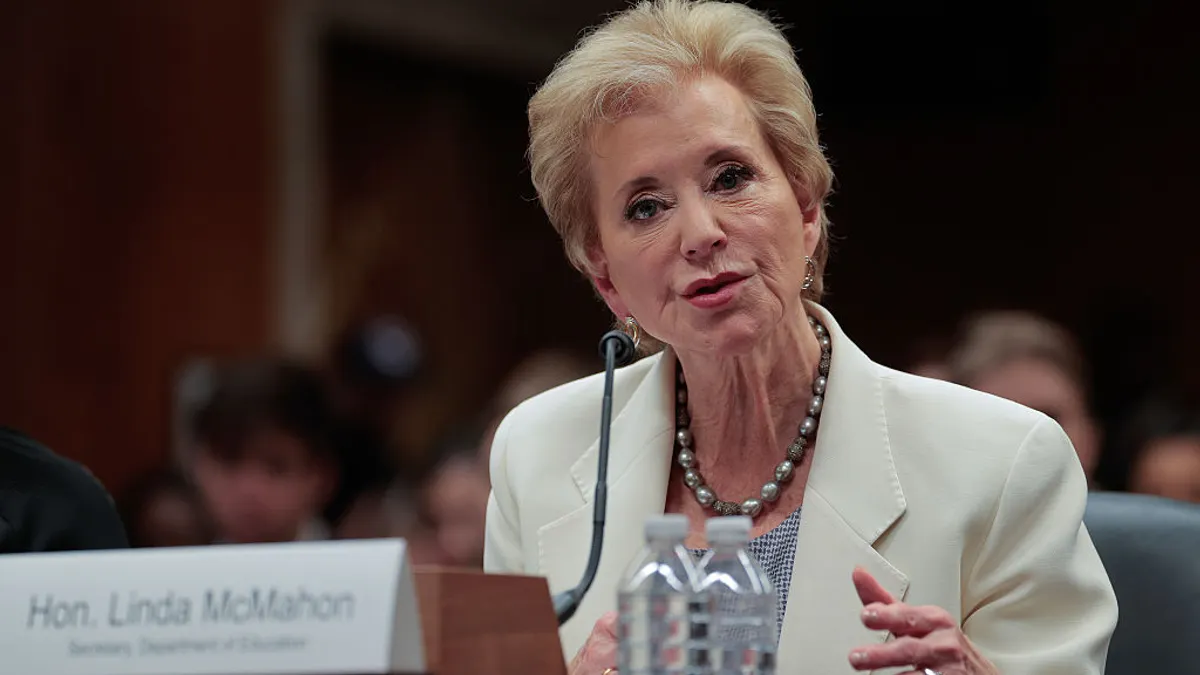
A group of senators sent a letter to U.S. Secretary of Education Linda McMahon on Tuesday, demanding answers over the U.S. Department of Education’s closure of the Office of English Language Acquisition last month.
The Democratic and Independent senators said in their letter that the decision "will have devastating and lasting consequences for the education of more than five million English learner students nationwide."
Twenty-two lawmakers — led by U.S. Sens. Alex Padilla, D-Calif., Catherine Cortez Masto, D-Nev., and Brian Schatz, D-Hawaii — said portions of the Department of Education Organization Act, which established the agency in 1979, also "require the establishment of OELA."
"Federal law is not optional," the senators said. "School districts and states are obligated to serve English learners," according to Title III-A of the Elementary and Secondary Education Act, and "to protect them from discrimination under Title VI of the Civil Rights Act of 1964."
The letter also said the Education Department "remains statutorily responsible for administering the programs that Congress has assigned to OELA through multiple authorization and appropriations laws."
The office was the only arm of the federal agency dedicated to ensuring that English learners and immigrant students gained English proficiency and academic success, that schools preserved students’ heritage languages and cultures, and that all students had the chance to develop biliteracy or multiliteracy skills.
OELA managed Title III funding — which, in fiscal year 2026, was appropriated at $890 million — for the office to distribute through professional development grants and other resources to help educators.
However, in a letter on Feb. 13, the Education Department notified Congress that it intended to move OELA’s functions to the Office of Elementary and Secondary Education. “This relocation will ensure better alignment of programs within OELA to their intended purposes and to programs with similar purposes, streamlining efficiency of program administration,” according to the February letter from Mary Christina Riley, assistant secretary for legislation and congressional affairs at the Education Department.
The OESE to which many OELA's functions are being moved is in an interagency agreement with the U.S. Department of Labor for many K-12 activities, including the provision of services administered under Title III-A.
According to Riley’s February letter and information shared by the Education Department with K-12 Dive, the English Language acquisition office’s functions have been redistributed to other agency units. Some of those redistributions include:
- The Title III-A formula grant program will go to the department’s Division of State Support and Accountability.
- The Native American and Alaska Native Children in School Program will move to the Office of Indian Education.
- The National Professional Development Program will be housed in the Office of Effective Educator Development Programs.
However, the letter sent to McMahon on Tuesday warned that, "Distributing OELA’s functions across multiple offices and to another agency with limited experience with these statutory responsibilities creates a significant risk of funding disruptions, inefficiencies, gaps in oversight, and diminished quality of technical assistance."
Echoing concerns from public education advocates prior to the office's closure, the lawmakers anticipated that the program may become "fragmented, inconsistent, and less responsive to the needs of states, school districts, and students."
The department told K-12 Dive in a June 3 statement that the office’s closure reduces “unnecessary bureaucracy that can slow support to students and families.”
"English Learners should never be treated as a siloed program, set aside as an afterthought,” said Kirsten Baesler, assistant secretary of the Office of Elementary and Secondary Education, in the statement. “When English language acquisition is embedded across core priorities like literacy, academic content, educator preparation, and accountability, it receives the seriousness and sustained focus it deserves.”
The senators, in their letter Tuesday, asked the department to respond within 30 days with information, including what role the Labor Department will play in administering Title III programs, what steps the department has taken to ensure compliance with all statutory requirements, and whether the department will publicly release a transition and implementation plan.
The senators' Tuesday letter follows another sent by many of the same lawmakers in December to McMahon, as well as to former U.S. Attorney General Pam Bondi.
That letter was sent after the department in August quietly rescinded longstanding guidance regarding English learners, issued in conjunction with the U.S. Department of Justice under the Obama administration in 2015.
The rescinded guidance, from a 40-page Dear Colleague letter, called on states and districts to ensure English learners “can participate meaningfully and equally” in school and “have equal access to a high-quality education and the opportunity to achieve their full academic potential.”
That guidance commended districts for “creating programs that recognize the heritage languages of EL students as valuable assets to preserve.”
The department said in a statement to K-12 Dive last year that it rescinded the guidance because “it is not aligned with [Trump] Administration priorities.”