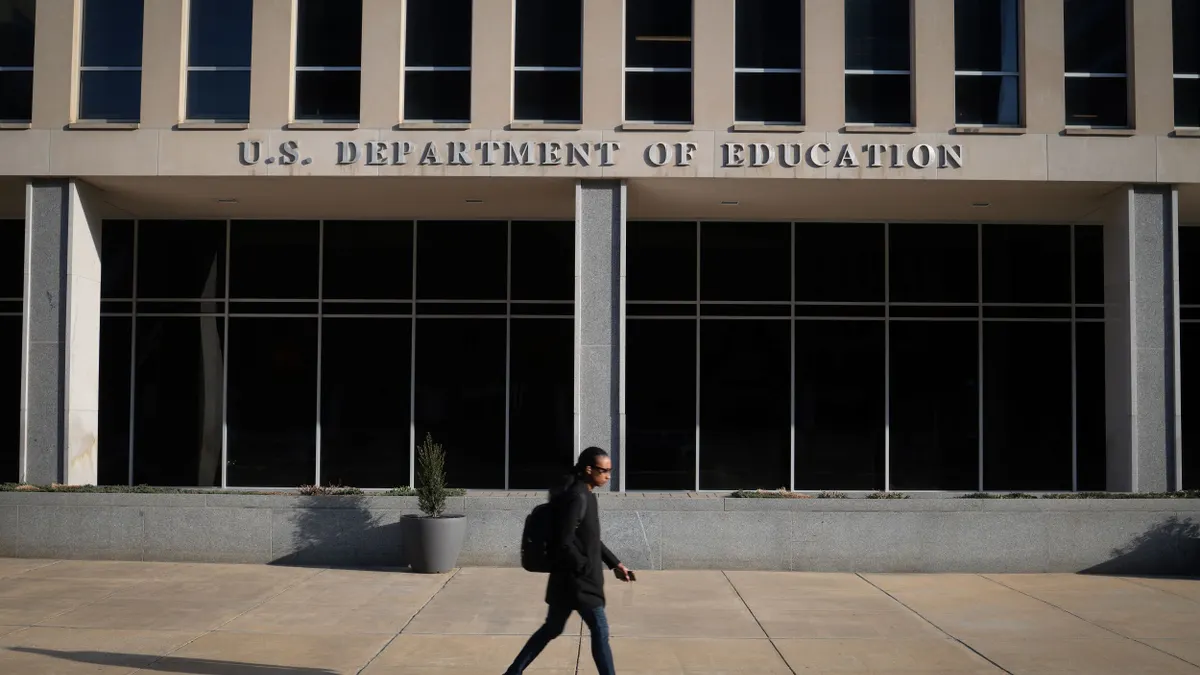
The U.S. Department of Education shuttered the Office of English Language Acquisition on Thursday, over a year after gutting its staff to just one. The office reportedly had around 15 employees.
In doing so, the agency is compromising school districts' ability to provide instruction to English learners, according to public education advocates who oppose the move. The Trump administration, however, defends the action as one that will cut red tape and ultimately provide more focus on the topic.
The office was the only arm of the federal agency dedicated to ensuring that English learners and immigrant students gained English proficiency and academic success, that schools preserved students’ heritage languages and cultures, and that all students had the chance to develop biliteracy or multiliteracy skills.
Congress appropriated $890 million in Title III funding in fiscal year 2026 for the office to support over 5 million English language learners in U.S. schools, including through professional development grants and other resources to help educators support these students. While the funding will remain, its administrative responsibilities will be moved elsewhere.
The Education Department notified Congress in a letter on Feb. 13 that it intended to move OELA's functions to the Office of Elementary and Secondary Education. "This relocation will ensure better alignment of programs within OELA to their intended purposes and to programs with similar purposes, streamlining efficiency of program administration," according to the letter from Mary Christina Riley, assistant secretary for legislation and congressional affairs at the Education Department.
An interagency agreement currently places many OESE functions within the U.S. Department of Labor. The department did not provide information on whether DOL will also administer Title III or English learner supports going forward.
As the Office of English Language Acquisition shutters, here are five things to know:
What was happening with the office until now?
Following mass layoffs at the Education Department in March 2025, an updated organizational chart shared with the agency’s employee union showed OELA had been almost completely decimated.
In a May 13 email to K-12 Dive, an Education Department spokesperson said one staff member — out of an initial 15, according to the Association of Latino Administrators and Superintendents — had been left in place to support English learner programs with assistance from the Office of Elementary and Secondary Education.
Riley’s Feb. 13 letter notified key members of Congress, as required by the Department of Education Organization Act, of the department’s plan to dissolve the English Language Acquisition office and redistribute its duties. That triggered a 90-day waiting period, after which the closure would take place, according to Ulysses Navarrete, executive director of ALAS, a nonprofit that works on leadership development for school leaders serving Latino youth.
With Thursday's complete shutdown, the sole remaining staffer will take on a new role at the Education Department, according to the agency.
How have stakeholders reacted?
Advocates and lawmakers have warned that the move could compromise English language support for students nationwide.
"Congress created OELA to ensure that English learners and immigrant students develop English proficiency," wrote House Education and Workforce Committee Ranking Member Bobby Scott, D-Va., and over 50 other Democrats in a letter to McMahon on May 12. "It stretches credulity that the Department could determine whether such proficiency was occurring without having an office specifically designed to assess the learning of English. The Department’s decision will undoubtedly disrupt the administration of programs designed to support English learners."
Advocates and former OELA employees are also raising concerns that the closure will lead to reduced accountability and expertise for districts.
"Funding alone is not enough," said José Viana, a former OELA director, during a May 13 press briefing. "Schools need expertise that guides them."
However, the U.S. Department of Education said in a May 13 statement to K-12 Dive that the office's closure reduces "unnecessary bureaucracy that can slow support to students and families."
"English Learners should never be treated as a siloed program, set aside as an afterthought," said Kirsten Baesler, assistant secretary in the Office of Elementary and Secondary Education, in the statement. "When English language acquisition is embedded across core priorities like literacy, academic content, educator preparation, and accountability, it receives the seriousness and sustained focus it deserves."
What will happen now?
According to Riley’s February letter and information shared by the Education Department with K-12 Dive, the English Language Acquisition office's functions will be redistributed to other agency units. Some of those redistributions include:
- The Title III-A formula grant program will go to the department's Division of State Support and Accountability.
- The Native American and Alaska Native Children in School Program will move to the Office of Indian Education.
- The National Professional Development Program will be housed in the Office of Effective Educator Development Programs.
What will the impact on states and districts be?
Baesler said the restructuring will embed ELA supports across academic priority areas.
However, former OELA employees and English learner advocates say the office’s closure will reduce coordinated support for school districts and the English learners they serve.
"What’s at stake is that school building and district leaders still have legal obligations to provide resources to students, but they no longer have a dedicated office (the OELA) to ask for help, tools, or funding for programs to deliver on these obligations," said Navarrete in an email to K-12 Dive. "There will no longer be a consistent and clear direction to support our language learners."
Investments in teacher preparation and training programs, instructional materials and family outreach for EL families will likely also be impacted, said Montserrat Garibay, former OELA assistant deputy secretary and director, during the May 13 press briefing.
"The impact is immediate," she said.
States with larger populations of English learners — such as Florida and Texas — will be particularly impacted, Garibay said.
However, Tim Walberg, R-Mich., chair of the Education and Workforce Committee, supported the closure of OELA. “Transitioning OELA’s functions to OESE simply streamlines these programs, making it possible for them to more efficiently serve the needs of English learners,” Walberg said in a statement to Education Week.
What other supports for English learners have been affected?
Last year's decimation of the Office of English Language Acquisition came less than two weeks after President Donald Trump signed an order designating English as the official language of the U.S.
Since then, the department has rescinded Obama-era guidance that called on states and districts to ensure English learners “can participate meaningfully and equally” in school and “have equal access to a high-quality education and the opportunity to achieve their full academic potential.” That language came in a 40-page Dear Colleague letter, issued in 2015, that commended districts for “creating programs that recognize the heritage languages of EL students as valuable assets to preserve.”
The Education Department said in a statement to K-12 Dive in August that it rescinded the guidance because “it is not aligned with [Trump] Administration priorities.”