States and districts will receive an additional $144 million this year for services to infants, toddlers, children and young adults with disabilities, according to an announcement by the U.S. Department of Education on Wednesday.
In the same announcement, the Education Department released guidance on how states can use funds from the Individuals with Disabilities Education Act to help expectant parents of children with disabilities prepare for their child's birth and plan for services after the birth.
This represents a major departure from traditionally allocated early intervention funding, which supports children with disabilities and their families after a child's birth.
Language included in the fiscal year 2026 appropriations legislation allows states to expand IDEA Part C services to people expecting to become a parent to a child with disabilities. The appropriations language did not, however, create any new requirements for Part C programs.
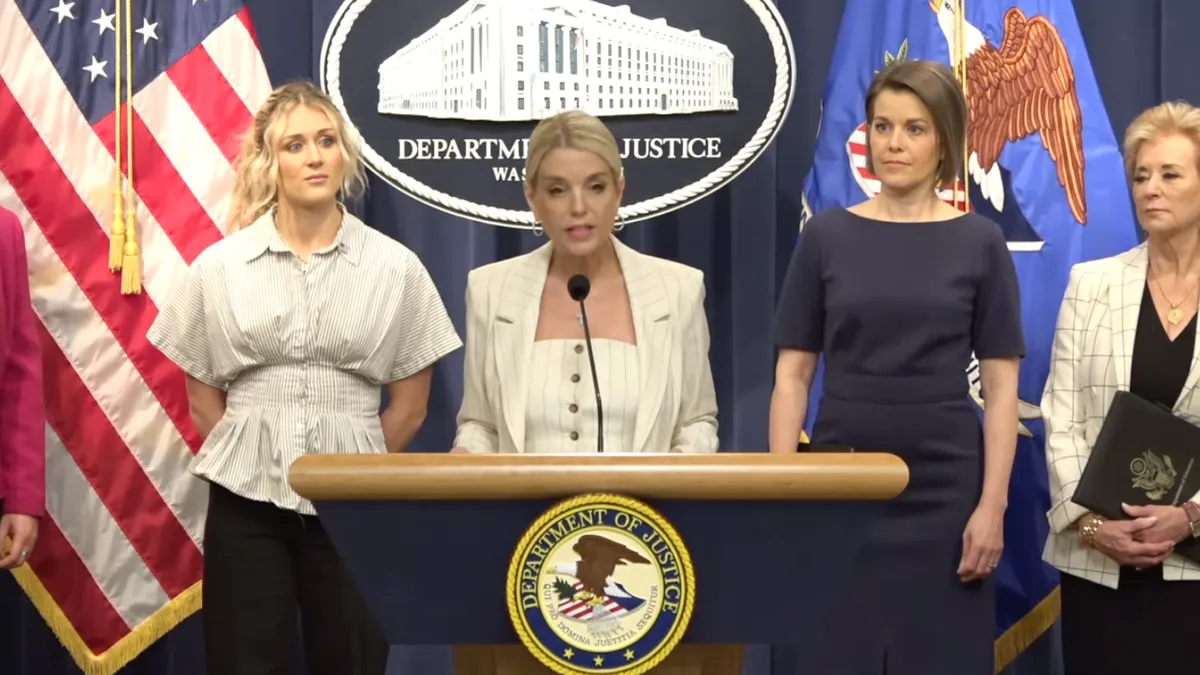
“For the first time, states can allocate funds to help parents receive support even before their child with disabilities is born, giving them accurate information and a direct path to the services their child will need on day one," U.S. Education Secretary Linda McMahon said in a Wednesday statement.
McMahon called the $144 million in additional funding "a substantial expansion of resources for students with disabilities and their families.”
She added that this shows the Trump administration's "relentless commitment to standing with families, empowering states with more flexibility, and advancing the potential of every student.”
More funding for Part B and Part C
The additional funding will go to IDEA Part B services for students ages 3 through 21 and to Part C early intervention services for newborns through age 2. Special education programs also receive money from states and localities, as well as other federal sources like Medicaid.
The $144 million being released by the Education Department is significant. In FY26, IDEA Part B was funded at $14.2 billion, which topped the previous year’s allocation by $20 million. Part C received $540 million in FY26 — the same amount as the year before, according to the Committee for Education Funding, a nonprofit that supports increased federal investment in education.
On Wednesday, an Education Department spokesperson said by email that the $144 million for special education comes from non-expiring funds that have been returned to the agency in recent years. It will be distributed through formula grants to states and territories on July 1 and Oct. 1. About $123.6 million will go toward Part B grants, and $20.5 million to Part C grants.
The Education Department — over the past 16 months under the Trump administration — has made drastic cuts to its overall workforce and transferred significant oversight for programs in its effort to downsize the agency and give more decision-making authority to state and local school systems.
About half of the agency's workforce was laid off in the first 10 months of 2025, including staffers working on special education activities. For FY27, President Donald Trump's budget proposal calls for reducing full-time staff from 163 in FY25 to just 31 next year for the Office of Special Education and Rehabilitative Services, which includes the Office of Special Education Programs that monitors state and district compliance with IDEA.
Future oversight for federal special education programming remains uncertain, as McMahon has voiced interest in transferring some of those responsibilities to another agency. No plans have been finalized, however. The Education Department currently has 10 interagency agreements with five other federal agencies for managing education programs.
Supporters say the changes will help bring down bloat and redundancies in the Education Department.
But education administrative groups, disability right advocacy organizations and Democratic lawmakers say the actions have created confusion, inefficiencies and resulted in a decrease in the funding and support needed to serve all students, including those with disabilities. Various lawsuits have challenged the Trump administration's Education Department changes.
The downsizing at the federal special education office comes as there have been an increasing number of children and students qualifying for special education services.
About 8.2 million students ages 3-21 qualified for services under IDEA in 2024. That represents a 12.6% increase between 2019 and 2024, according to The Advocacy Institute’s analysis of data collected by the U.S. Department of Education.
Overall public school enrollment dropped slightly by 0.3% in the 2024-25 school year compared to the year before, according to separate Education Department data.
Expansion of Part C services
The seven-page guidance to expand Part C funding and supports for expectant parents says states could use this money to conduct child find, public awareness and referral activities for individuals who expect to become parents of an infant with a disability.
The guidance offers the example of a mother who learns through genetic testing that her child will be born with Down syndrome. A state could use Part C funds to help that mother understand how the IDEA Part C system operates, refer her for services, and, within 45 days of the child’s birth, help the mother and child receive individualized services under Part C.
"Numerous studies have found that expectant parents often want more access to prenatal support and that providing children with EI [early intervention] services as quickly as possible improves long term outcomes," the guidance said.
About 458,920 infants and toddlers were served under Part C in 2024, representing a 1% decrease from the year before, according to The Advocacy Institute's analysis.
Many state Part C programs are spread thin financially, according to a 2025 survey of Part C state coordinators conducted by the Infant and Toddler Coordinators Association. Part C state coordinators say Part C funding does not keep pace with growing early intervention needs of enrolled children and is insufficient to meet federal regulatory requirements.
"The challenges exist for many [states and jurisdictions], not because of the lack of political will or the lack of evidence-based approaches to service delivery or the need for better cost-effectiveness data," but because of the lack of funding and personnel, as well as increasing needs of babies and their families, the ITCA survey report said.