The U.S. Department of Education on Tuesday announced a third Returning Education to the States Waiver, this time for Indiana. The department says the waiver will allow the state more discretion to prioritize college and career readiness for its high schoolers.
The waiver will consolidate about $50 million in separate federal funding streams into one block of funds. It will also allow some Indiana school districts to combine federal monies for Elementary and Secondary Education Act Titles II-A and IV-A, which, separately, fund educator development and student academic enrichment.
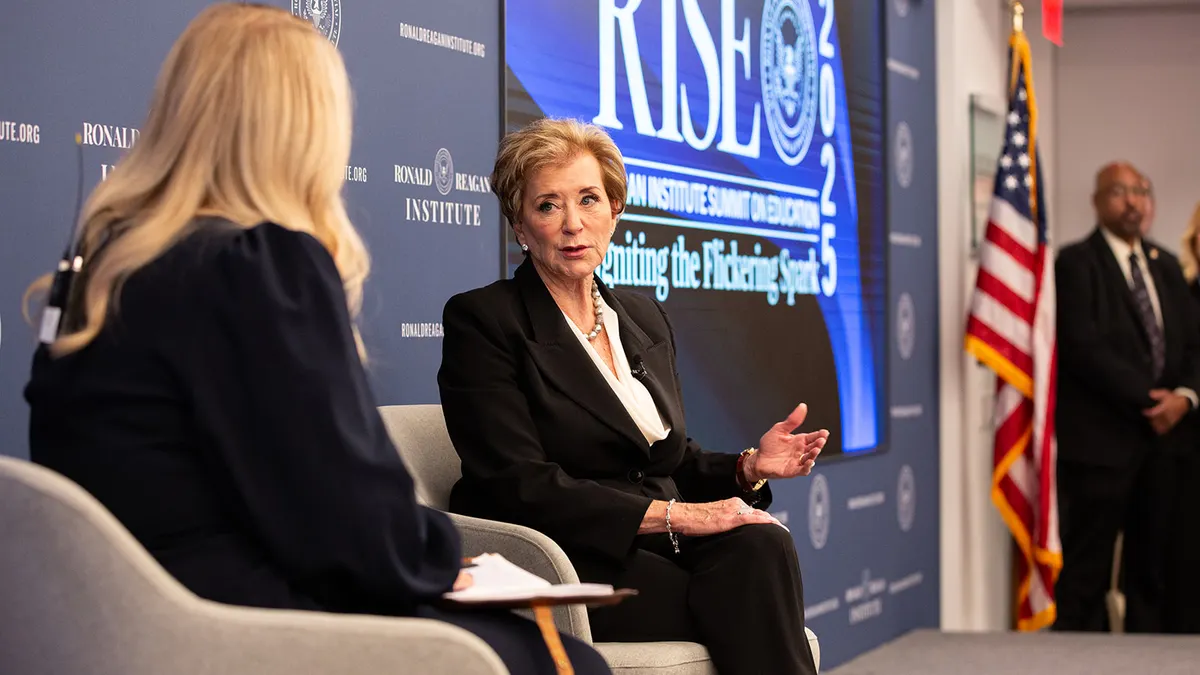
“Not only does this waiver provide greater flexibility for Indiana to serve its students the way it knows best, but it also helps to align education with the evolving needs of the workforce," said U.S. Secretary of Education Linda McMahon in a Tuesday statement.
The state's education secretary, Katie Jenner, said the state’s waiver is focused on "maximizing every federal dollar to make it better for students" and reducing red tape to allow for "innovative solutions.”
The announcement follows similar ones for Louisiana in May and Iowa in January, when that state became the first to receive such a waiver.
In May, Kirsten Baesler, the U.S. Education Department’s assistant secretary for elementary and secondary education, told K-12 Dive that the agency was in talks with 10 states about ESEA federal education funding waivers. States can also seek flexibility for federal accountability and assessment requirements in addition to funding waivers.
Innovation or lack of transparency?
Feelings about ESEA waivers are mixed. Supporters say they allow for innovation and a focus on student outcomes rather than federal compliance, while critics argue that they loosen accountability for equitable spending of federal dollars.
In Indiana's case, the waiver removes the accountability requirement that academic indicators receive much greater weight than other school quality measures. That means a high school’s accountability scores could be based as much on students passing classes, for example, as on statewide assessment scores, according to EdTrust, a public education advocacy organization.
"Instead, the Department of Education will allow Indiana to rewrite its accountability system in a way that will mask student performance and move millions of dollars in dedicated funding away from students who need it most," said Denise Forte, EdTrust president and CEO, in a Tuesday statement. "Most concerning, Indiana’s plan appears to vary standards across student groups in a way that will allow the state to say, ‘Everyone is doing just fine.’"