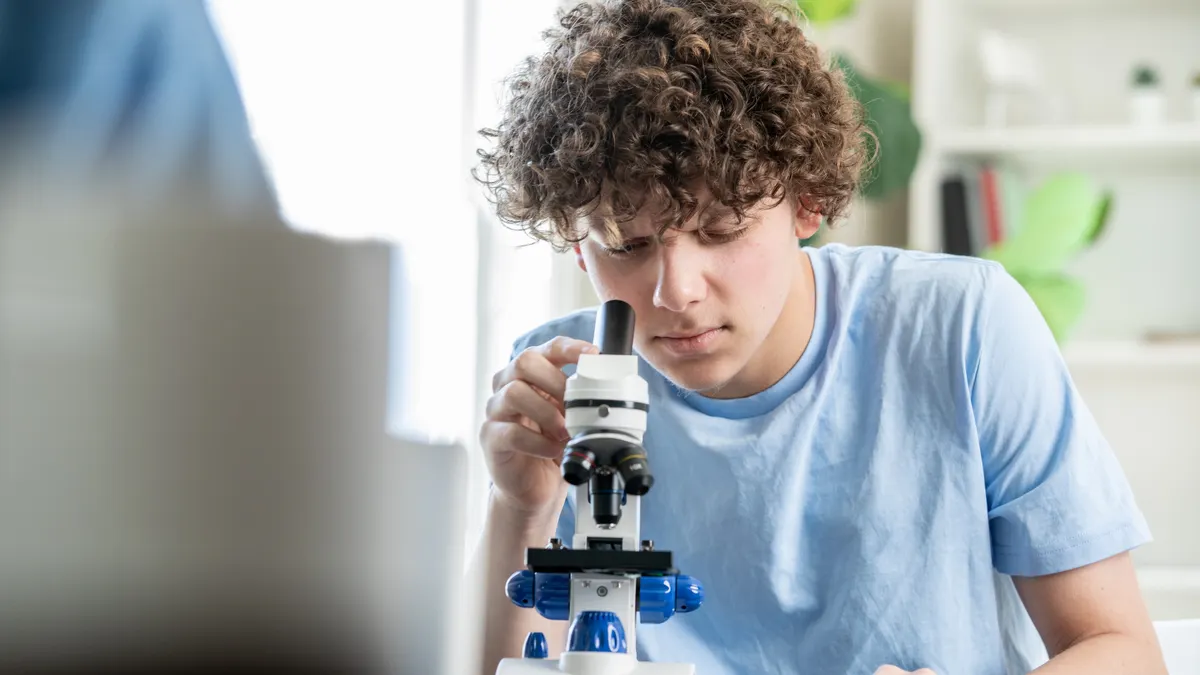
For 67 years, the nonprofit Summer Science Program International has offered five weeks of study to high school juniors with interests in science — all in a collaborative spirit and to an intentionally diverse population, the organization says.
This year, 720 students will participate in the program, which is offered at 13 college campuses from Colby College in Maine to Albion College in Michigan, and from Hendrix College in Arkansas to University of Guelph in Ontario, Canada. This year’s class is the largest in the program’s history.
The program has seen somewhere between 65% and 80% of past participants in any given year continue on to pursue STEM fields, according to data SSPI has collected.
Topics include astrophysics, bacterial genomics, biochemistry and cell biology.
“We are not a competition model. We identify students, and they come and participate as a team,” said Amy Kim, chief program officer at SSPI. “It’s not about what [college] you’re going to go to after high school. It’s about ‘Throw them in a lab, give them the tools they need, and let them experience failure.’”
As such, SSPI tries to bridge the equity gap in the STEM field by casting a wide net in selecting students, Kim said. “We try to service students who have never had this opportunity. Students who are smart, want to work hard and are interested in science exist everywhere.”
That includes, for example, students from low-income communities and from rural communities, she said.
Looking for solutions
A chemist by training, Kim said that she and her husband, a physicist, often discuss the fact that successful scientists do not have to be extremely intelligent.
“The most important trait, in my opinion, is that you need to be willing to do something really hard,” she said. “You’re going to be faced with a lot of failure. You’re going to have to be OK with it, and find other resources to solve the problem. Science is hard, but you can learn the tools, form teams and get help to solve the problem. Very rarely do scientists do something by themselves.”
Although a high percentage of students who have gone through the program have entered the STEM field, that’s not necessarily the goal — and it has benefits for those who don’t, too, Kim said.
“What we recognize is that doing a science program like ours gives them an opportunity to practice problem-solving skills that they may not have had,” she said. “That is a valuable skill for them to have, regardless of what they become in their future. It’s something we try to do, and it’s something that a lot of our underrepresented students are drawn toward.”
Understanding artificial intelligence
Like educational programs everywhere, SSPI has needed to adjust to the age of artificial intelligence — which, like the internet itself, has created research opportunities but also spawned false information, Kim said.
“Our message shouldn’t be that you should never use [AI],” she said. “You should understand how it works, what are its limitations, and what are the best-case scenarios.”
Promising use cases for AI include a doctor doing diagnostic work, Kim said. “No human brain can maintain millions of scientific articles on rare cases,” she said. “AI will be excellent for that. It can store a lot of information.”
To do outreach to prospective students, SSPI often partners with its university campus hosts to encourage those in the community and around the state to apply, Kim said.
“There are a couple ways they can [help spread the word],” she said. “If there are Title I school districts, that can help because we want to serve students of need. … One other thing we try to do is hire undergraduate and graduate students as faculty, to build a knowledge base and infrastructure in local communities. With different partnerships and agreements, it’s our goal to reach students who haven’t had an opportunity like this before.”