Dive Brief:
- Learning geography remains important for a variety of reasons, despite students living in a world where Google Maps and other GPS-based directions are at their fingertips, according to geography educators.
- Even with GPS access, students need to know the right questions to ask to access needed information, based on a reasonably accurate and ever-expanding model of the world, said Thomas Herman, executive director of the National Council for Geographic Education.
- From a career perspective, the ever-increasing interconnection of the globe requires students to be more sophisticated problem-solvers in areas like the economy, environment and political diplomacy, Herman said.
Dive Insight:
The ubiquity of GPS makes it even more vital that students know how to read maps and understand their symbology, and it’s also critical that students make connections between the digital world and the real world, said Michael Mewborne, director of the South Carolina Geographic Alliance and board secretary for NCGE.
“Geographers have struggled to communicate concisely why geography is important, which is why it often falls by the wayside,” he said. “So many folks imagine geography education to be place names, states, capitals, things like that. Which are important.”
But rote memorization alone doesn’t accomplish what geography education should be aimed to do, which is drawing the broader interconnections, Mewborne said.
“If places matter, how do I learn to be more connected?” he said. “How do I learn to reconnect to the physical world around me, whether natural and environmental, or whether the human world through political boundaries, urban systems and economic connections?”
Students who can read maps well can better understand the meaning of county-by-county election results, for example, Mewborne said.
“The news is filled with maps,” he said. “There’s a ton of geo-spatial information being presented.”
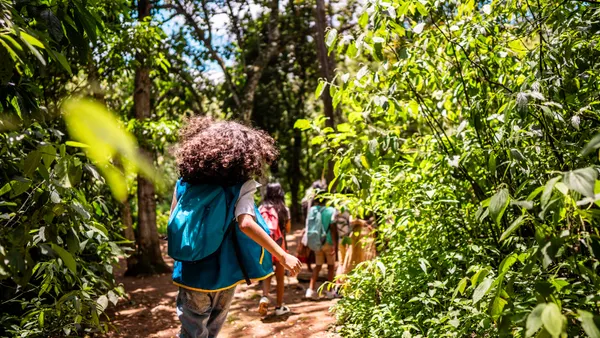
From an environmental perspective, geography education prompts students to engage with the woods and streams in their backyards, he added. “If I don’t explore the urban or suburban landscape near where I live, that makes it much more difficult for me to care what happens to it,” Mewborne said.
Herman sees the concept of a “mental map” as crucial to understanding how the world outside one’s door connects to the rest of the planet.
"A lot of what we ask students to do in formal education is to hold onto a bunch of amorphous concepts that we feel are important, but students have a hard time attaching to their everyday experience," Herman said. "Geography can be that sticky, expansive infrastructure.”
Geography also can be a bridge to learning other topics, Herman said. “It’s a connective tissue,” he said. “It’s not about becoming a skilled geographer in the sense that it’s a career track development.”
Civics education is one area of connection, Herman added.
“If you want students to be connected to the nation, be responsible, they need to know the territory, and know what’s inside the territory and what’s outside,” he said. “All that knowledge you can look up after you’ve formulated the questions. And you might not formulate a very good question if you haven’t done the advanced work to build a good mental map.”
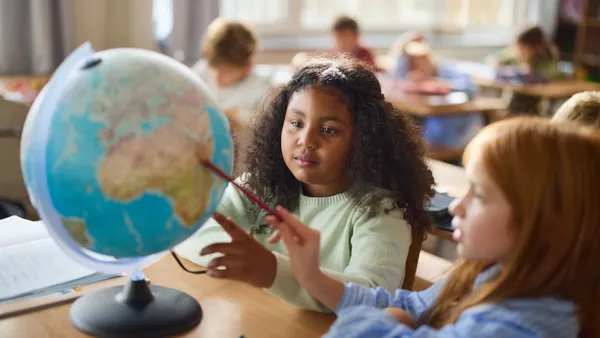
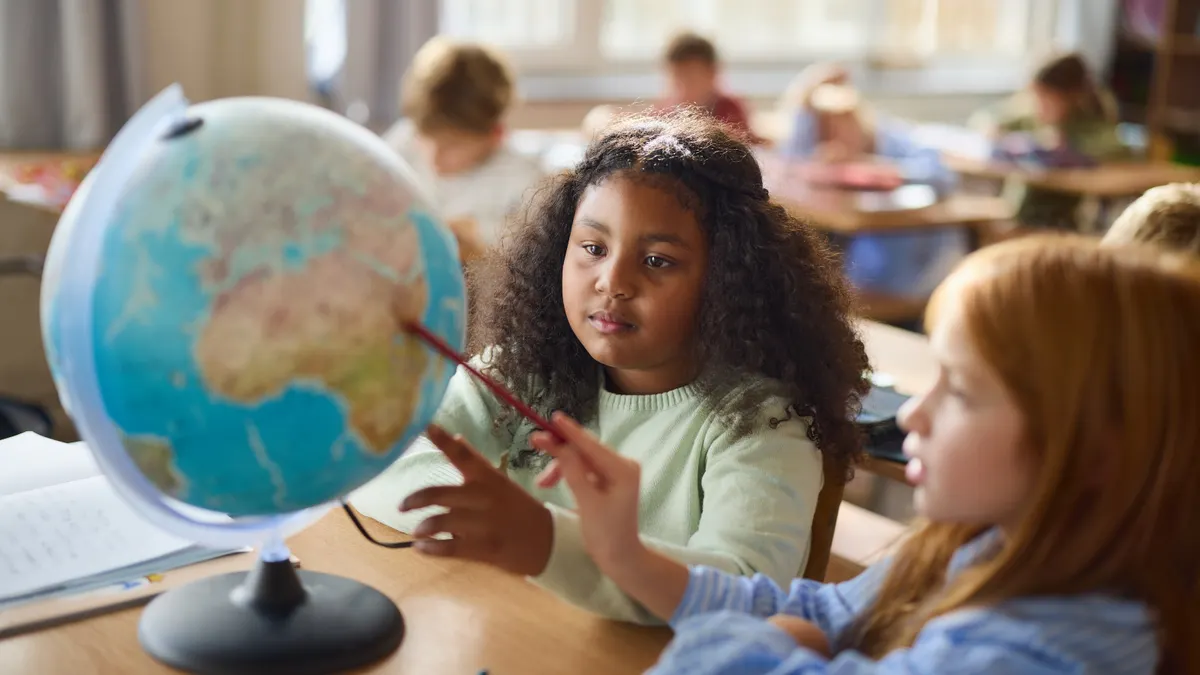
To more effectively teach geography, Mewborne, whose organization creates and curates resources for school districts, suggests going beyond putting a blank map of the U.S. on the wall and asking students to point to the state of Georgia.
Instead, teachers should delve into what different states and other locations are best known for, such as asking which state produces the most pecans (hint: Georgia).
“Giving kids a larger, inquiry-based system helps them go into spatial thinking,” he said. “That is a much more effective way to teach geographic skills like not only how to read maps but how to place information on maps.”
Geography teachers need to tap into students’ curiosity and develop an inquiry-based approach, Herman said.
“We shouldn’t teach it just through maps and at a scale bigger than students see,” he said. “They do see their neighborhood, and the park they go to. We should make use of that, and help teachers do that. … A lot of our mapping has gone digital. On the other hand, geography can be taught out in the field. It can be a way to counterbalance the screen focus.”