A U.S. Department of Education notice of final priorities on promoting patriotic education in discretionary grant programs, set to be published Friday, raised concerns among commenters over the inclusion of Judeo-Christianity in its definition of "American political tradition."
That definition will inform the agency’s preferences in funding for certain projects.
Along with the influence of Judeo-Christianity and "the founders' religious beliefs on their conceptions of liberty and government," the definition of American political tradition also includes founding documents, key literary and artistic works, and the influence of ancient Greece and Rome.
Under the priority, religious organizations also won't be excluded from partnering with funded programs.
The department originally proposed its priority for promoting a patriotic education last September. The proposal received over 5,000 public comments, which the department was required to sift through before finalizing its priorities.
Many commenters highlighted the mention of Judeo-Christianity in the priorities, the department noted in the final notice. Those who were concerned cited the separation of church and state under the First Amendment, the secularity of public schools, the exclusion of other religions, and “religious indoctrination.”
However, the department said it was moving forward with the priority regardless.
"The priority and definitions are focused on an accurate and honest study of American history and government grounded in the text of primary sources, particularly at the time of the American founding," the department said in its Friday notice. "Therefore, in order to understand the American founding, it is essential that students possess a modicum of familiarity with the influence of religions such as Judeo-Christianity in American history, as well as the principles of government the founders held in common."
The department said, "This broad inclusion does not violate the separation of church and state."
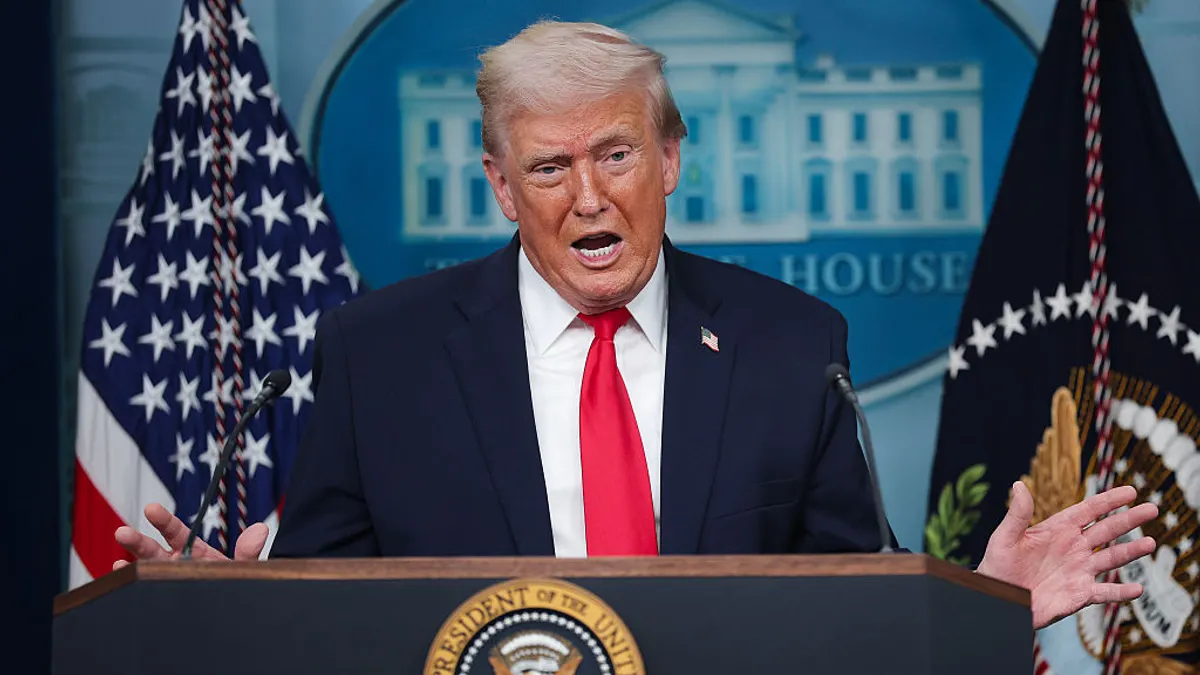
The push for a patriotic education that incorporates Judeo-Christian teachings and influence began under the first Trump administration, when President Donald Trump launched a 1776 Commission that encouraged communities "reasserting control of how children receive patriotic education in their schools.”
The commission was a response to The 1619 Project, a long-form journalism project published by The New York Times in 2019 that explores the impact of slavery and contributions of Black Americans to the formation and growth of the United States.
By the time of the second Trump administration, state-level "divisive concepts" laws prohibiting certain race-related content had proliferated. And in 2025, Trump issued an order titled "Ending Radical Indoctrination in K-12 School" shortly after entering the White House for the second time.
That order prohibited "discriminatory equity ideology" from being taught in schools, which included a prohibition on teaching that an "individual’s moral character or status as privileged, oppressing, or oppressed is primarily determined by the individual’s race, color, sex, or national origin."
"Parents have witnessed schools indoctrinate their children in radical, anti-American ideologies while deliberately blocking parental oversight," the order read. "In many cases, innocent children are compelled to adopt identities as either victims or oppressors solely based on their skin color and other immutable characteristics."
The order also reinstated the President’s Advisory 1776 Commission and efforts to promote patriotic education.
The Education Department's inclusion of Judeo-Christianity in its final priorities advancing a patriotic education is in line with that executive order and comes alongside a growing push in Republican states that have adopted Ten Commandments displays and Bible instruction laws in recent years.
Politicians backing laws or proposals incorporating the Bible or other Judeo-Christian materials — including the Bible’s Hebrew Scriptures and New Testament — in curriculum also cite their influence on America's founding and say it is an important part of American literature, history or both.
In some cases, these state-level laws and proposals also call for schools to allow time for prayer.
The Education Department's final priority, however, bars "any grantee from using its grant to pay for religious instruction, religious worship, or proselytization." It will take effect in late June.