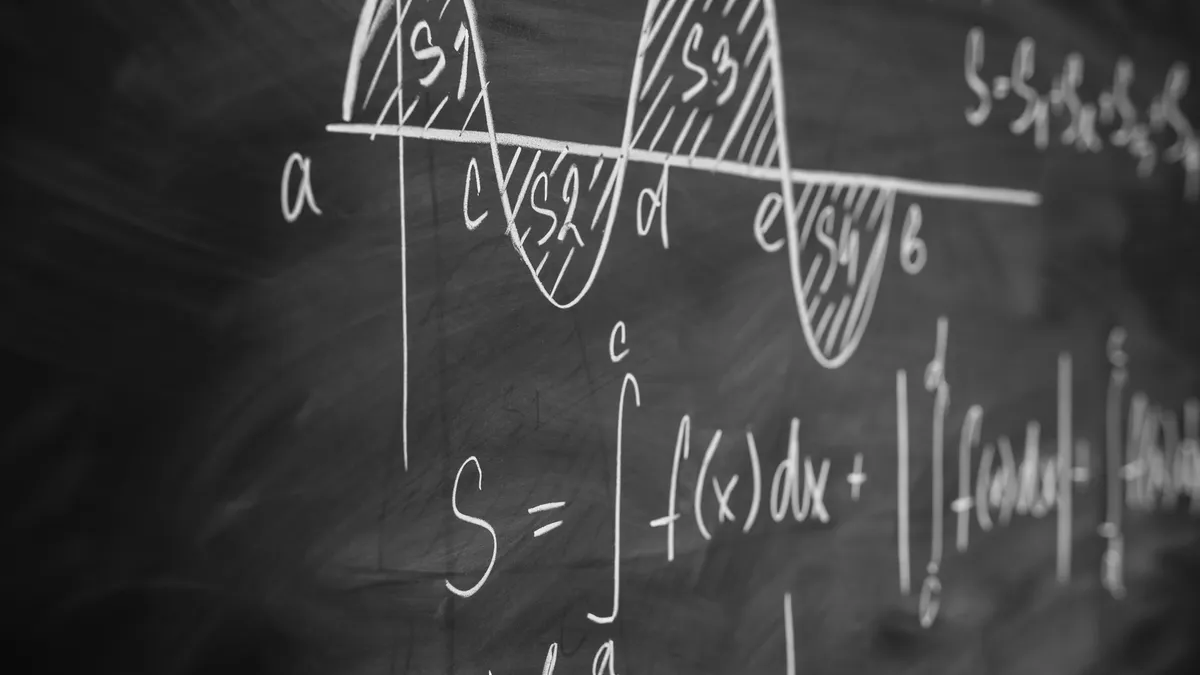
Does Advanced Placement Calculus carry too much weight in college admissions decisions? Some math experts are questioning the weight the course carries in lieu of other measures of math achievement such as alternative pathways in the subject.
“Generally, I think too many students are being pushed into AP Calculus,” David Bressoud, professor emeritus of mathematics at Macalester College in Minnesota. “Partly because of this, the competition to get into the best universities is extremely high. A lot of students feel that anything they can do to get into the best universities is worth doing.”
A December 2024 report from the nonprofit Just Equations found that while calculus was required for incoming students by fewer than 5% of colleges, 89% of admissions officers surveyed said that students who take the course were more likely to succeed in college.
In fact, AP Calculus and calculus were ranked in the top four most important math courses by 74% and 72% of admissions officers, respectively — outpacing precalculus (49%), AP Statistics (37%), AP Precalculus (29%), and advanced algebra/trigonometry (26%).
“There are too many students taking it for the sake of their transcripts, not because it’s something they want to learn,” Bressoud said.
The National Council of Teachers of Mathematics has been talking about the importance of multiple mathematics pathways at least since the release of its 2017 report “Catalyzing Change in High School Mathematics: Initiating Critical Conversations,” said Latrenda Knigthen, NCTM president.
“While there is a place for AP Calculus in someone’s high school plan, it’s not the end-all, be-all if you’re going to a four-year college,” she said. “If they’re planning a career in one of the STEM fields, it’s a good foundation for them to have. But there are other things that are important, depending on their [planned] major.”
A more recent report from NCTM, “High School Mathematics Reimagined, Revitalized and Relevant,” examined alternative pathways and asked employers what types of math they need students to be able to do, Knighten says.
“People are looking for workers who can apply statistics, data science and quantitative reasoning,” she said. “We provided some suggestions and structures as to how to infuse those things into high school courses. In the last few years, we’ve noticed that some of the selective colleges no longer require a student to have AP Calculus.”
Selective colleges might give an application with calculus higher priority, but more important is whether a student has taken four full years of mathematics, which NCTM strongly recommends, Knighten said.
“I don’t think [AP Calculus] is the barrier it was for people of my generation,” she said.
Bobson Wong, an AP Statistics, Algebra II and geometry teacher at Bayside High School in Queens, New York, said the main benefit of calculus is for STEM work.
“The downside is that high school math has become, over the decades, a march to calculus,” he said. “In a lot of ways, statistics is actually harder than calculus. And it’s something that people see more often in everyday life.”
But statistics is often an afterthought, taught at the end of the school year or to students seen as weaker in math skills, Wong said.
“Statistics is viewed as a consolation prize for people who can’t do calculus, or don’t have the ability to do the quick calculations and pencil-pushing that’s required in so much of the algebra that we do,” he said. “Statistics is a lot harder because it requires … the verbal rigor of a law course, where if you don’t say things in precisely the right way, it can be misinterpreted. Students who do well in courses like calculus aren’t used to that.”
Knighten said too many students take AP Calculus to place out of entry level math requirements, or because they feel compelled to have it on their transcript.
“It’s helpful for those students who need it based on the types of things they’re going to explore,” she said. But for other students, she added, maybe that’s not the right pathway. “I would not want someone to use it as a rigid pathway.”