
Solar power purchase agreements (PPAs), in which districts purchase energy from a third-party-owned solar array, allow schools to pursue solar and its associated energy cost savings without upfront capital investment. New Jersey school districts were early leaders in public sector solar PPAs, supported by state policies and incentives that accelerated adoption. For school districts considering PPAs now, New Jersey’s early adopters offer useful lessons about what these agreements deliver over time and what requires closer review as contracts mature.
New Jersey districts are managing solar agreements signed a decade or more ago—many structured around 15-year terms—while others are actively evaluating new PPAs to support budget planning, facility needs, and sustainability goals. As these districts revisit older agreements or evaluate new ones, the same issues are coming into focus:
- Is our PPA still saving money?
- Is the system performing as expected?
- How should we plan for the end of this agreement?
School districts throughout the country should consider these questions as well. Because school districts do not own the solar production equipment in a PPA, long‑term value depends on more than the initial price. Performance, contract terms, and how agreements age relative to utility rates all determine whether savings persist. Whether district leaders are considering entering a new PPA or are evaluating their existing agreement, they should plan to reassess their PPAs at mid-contract and when nearing end of term to ensure the PPA is still delivering the value originally expected.
How a Solar PPA Works
The structure is simple, but long-term value requires active review:
- A solar system is installed on district owned land (or roofs)
- A third party owns and maintains the solar system
- The district pays no upfront cost
- Instead, the district buys the electricity the system produces at a set rate (the PPA rate)
- That rate typically increases slightly each year (the escalator)
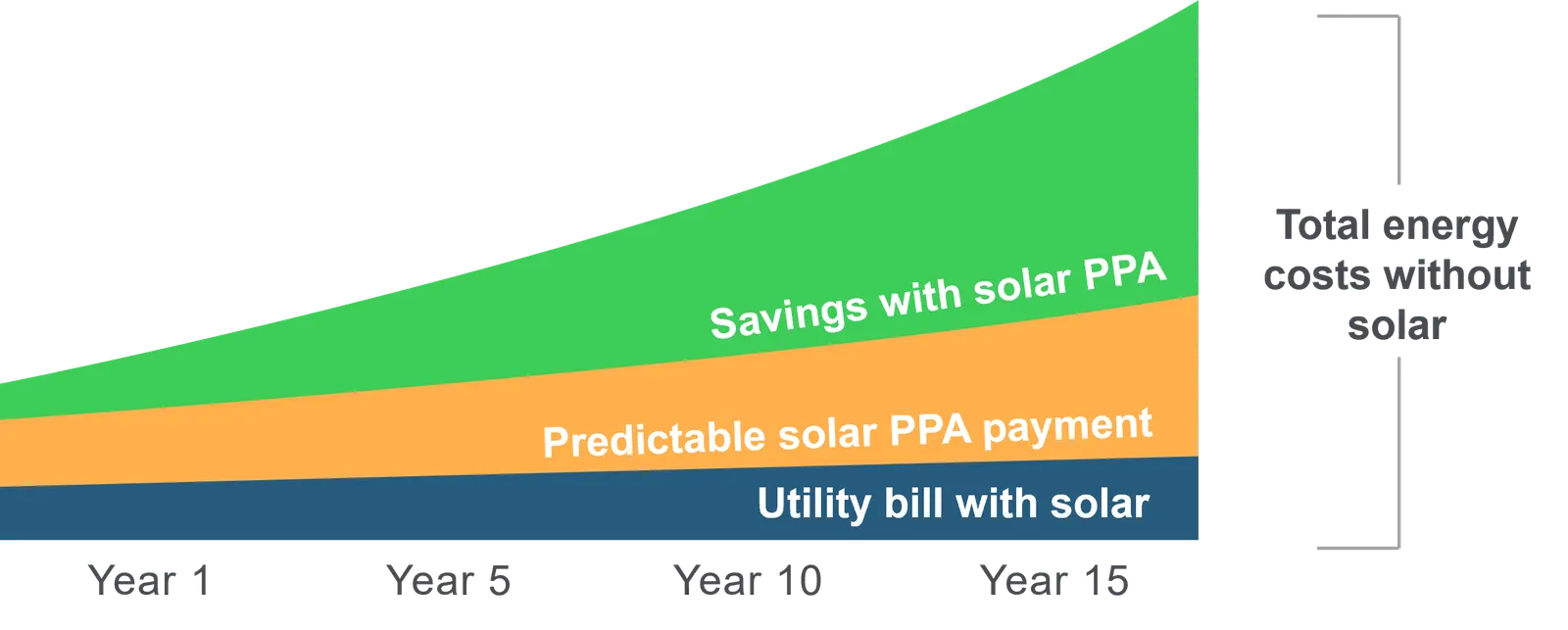
A PPA works when the system performs as expected and the rate stays competitive over time. Their long-term price predictability is what initially helped drive widespread adoption across New Jersey in the late 2000s and 2010s. For school districts today, price predictability has become an even more important upside as growing energy demand makes energy prices more volatile.
Is Our PPA Still Saving Money and Performing as Expected?
As districts move further into a PPA, the assumptions used when the agreement was signed begin to differ from reality. Utility rates may rise differently than expected, system output gradually declines, district energy use can shift, and in some cases ownership of the agreement changes.
None of these changes are unusual. But as we’ve seen in over a decade of work with New Jersey school districts, without periodic review, their combined effect can reduce or eliminate savings over time. District leadership should be able to review the assumptions behind the agreement and understand whether they still hold today.
Questions districts should be able to answer:
Do we understand what we are paying?
This includes confirming the current PPA rate, annual escalator, remaining term, end-of-term options, notice deadlines, and whether any termination or system removal obligation applies.
Is the system producing as expected?
Districts should have access to production data through a monitoring portal or regular reports. Actual output should be compared to projected generation, expected degradation, and recent historical trends to confirm the system is still performing as intended.
Are we still saving money compared to utility power?
This is often the least examined but most important question. Comparing actual PPA charges with avoided utility costs—what the district would have paid the utility for the same energy—shows whether savings are holding, shrinking, or disappearing.
If a district’s current PPA rate is above the comparable utility rate for the same electricity, the agreement may no longer be delivering the savings originally expected.
Districts without internal energy expertise often benefit from an objective review that connects contract terms, system performance, and current utility economics into a clear picture of present value and upcoming decision points.
Planning Ahead Before Options Narrow
District leaders sometimes worry about whether they are reviewing their PPA too early or too late. Regardless of where a district is in its contract, effective planning focuses on:
- Understanding agreement terms
- Validating system performance
- Identifying future decision points before they become urgent
- Understanding financial obligations tied to extension, purchase, termination, or removal
As agreements mature, districts generally consider several paths:
- Extending the agreement when pricing remains competitive, performance is verified, and the provider can continue to support the system effectively.
- Purchasing the system when economics favor ownership, the equipment remains in acceptable condition, and the district is prepared to take on maintenance and operating responsibility.
- Repowering or refurbishing key components when reliability or performance can be improved and contract terms allow upgrades or modifications.
- Decommissioning when the system no longer aligns with district priorities and the district understands all removal, restoration, or contract closeout obligations.
Districts should also confirm whether the agreement includes a termination of payment, buyout condition, or system removal obligation. In some cases, removal and site restoration costs can be significant. These obligations, and who is responsible for them, should be understood well before the end of term.
The risk is not choosing one option over another. The risk is waiting until options narrow and decisions become reactive.
Why Periodic, District-First Review Matters
New Jersey districts offer a useful proof point that solar PPAs can remain a viable option over time. But because these contracts span changes in leadership, utility prices, system performance, and district priorities, even well-structured agreements benefit from periodic, objective review.
For district leaders, the core task is straightforward: connect system performance, contract terms, and current utility economics to present-day realities. The goal is not to second-guess the original decision to sign a PPA, but to ensure solar agreements continue to support long-term district goals.
The most important question remains simple: Is our PPA still working the way we think it is, and are we prepared for what comes next?
Visit Schneider Electric’s K-12 Education Hub for more energy management insights tailored for US public school districts.