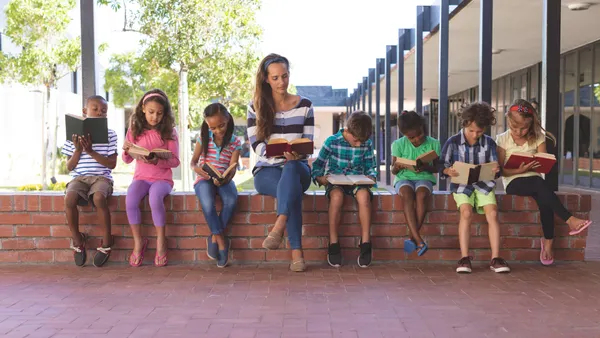

Reading is both an art and a science — and we’ll need to leverage both to make our nation’s young people fall back in love with reading.
When I was in school I was a voracious reader. My mom would take my sister and me to the library and I would check a stack of books by authors such as Judy Blume, Beverly Cleary, Roald Dahl, and Gary Paulsen. I would fill out my Book It! Chart so I could get that free personal pan pizza and as I devoured the gooey slices, my friends and I would talk about the books we read. You see, that was part of my motivation to read. Sure, the pizza, but really – the friends. My friends read books. My dad was often reading books one after another. It was part of being “cool.” It was part of our culture. And it felt like a part of our freedom. We could read and immerse ourselves in another world or another character’s plight, making everyday life more manageable.
Today’s teens have a different relationship with books.
The latest NAEP scores have revealed what many educators have already suspected: our youngest learners are improving, but our middle schoolers are stalling. Unlike elementary learners, 13-year-olds are not showing growth in reading or math: in fact, their scores are roughly the same as children their age many decades ago.
We’ve also learned that reading for pleasure is down among this age group. In 2012, 27% of 13-year-olds reported reading for fun. In 2025, that figure declined to 14%.
It would be easy to celebrate the gains we’re seeing in our youngest learners, taking these results as a “win” after a long period of disheartening results, and simply move on. But I believe that there is still time to turn the literacy trajectories of our middle schoolers around. These kids deserve to experience the feeling of falling in love with a book!
Let’s take a step back and consider who these 13-year-olds are, and what they need from us.
These are the children of the pandemic.
These students were in early elementary when the pandemic hit and schools shut down to keep their students safe. It’s no surprise that their reading skill gaps have been stubborn to close – many of them would have experienced major disruptions to critical foundational skills work. Now they’re in middle school, supported by teachers who are talented and passionate, but likely aren’t trained in the complex foundational skills instruction many of these students need. And while reading interventionists are staffed in elementary schools, supporting the 9-year-olds whose scores are improving, many middle and high schools aren’t structured or staffed to close foundational skills gaps at that scale.
They deserve to do more than catch up.
The reading for pleasure statistic shouldn’t surprise us — and while much of the discourse around this shift has been related to internet usage, which we absolutely should work to understand and address, we must also ask ourselves why a student would ever choose a book over a screen if they don’t have the skills to read fluently.
What actually rebuilds a reader who's already lost years? How do we provide them with the critical foundational skills they need without making reading feel tedious or discouraging?
How do we give them the precious gift of falling in love with a story?
Here’s the bottom line: we can't assign our way into pleasure reading if a student can't decode. The solution for this moment is cyclical — we can unlock the joy of reading by first fostering confident readers through the delivery of evidence-based instruction that ensures success. Success fuels confidence, and confidence unlocks joy.
Here’s an actionable framework to help your middle school students fall in love with reading:
1: Provide intensive, specialized intervention to those who need it.
At McGraw Hill, we believe that each of these students deserves two things: access to grade-level instruction and intensive intervention when needed.
My colleague Dr. Mary Eisele has written extensively about the role of Direct Instruction (DI) in a post-pandemic environment, particularly around its potential to serve secondary students. Here’s what we know: DI is the fastest path to decoding fluency for the students who missed it. These students have no time to waste, and DI is a scalable method of delivering explicit instruction that is proven by decades of research. Its design enables any teacher, regardless of experience, to deliver it with fidelity. It’s efficient, it leaves no room for misconceptions to linger, and it’s proven to work for diverse groups of learners across contexts and circumstances.
DI will restore students’ confidence in their ability to read without isolating them. Reading gaps can carry a social and emotional cost for older students. DI's materials reach far below grade-level but don’t feel babyish, preserving students’ dignity and protecting their self-esteem.
2: Provide evidence-based core instruction that views students not just as “decoders” but as readers, writers, thinkers, and dreamers.
Every middle schooler deserves access to grade-level core instruction — and I would challenge every school leader to begin thinking beyond the science of reading to an approach that encompasses a larger, more nuanced and interconnected body of research: the science of literacy.
The science of literacy, which links the science of reading, the science of writing, and knowledge building and comprehension, positions us not just to consider our students’ decoding gaps, but also their abilities as writers and as thinkers. And while the science of reading is absolutely critical for supporting these students, that doesn’t mean that core 7th and 8th grade instruction should be dedicating lots of time to decoding. Students who need it should get that support through intensive intervention, and in their core program, they should be working on written and oral language, vocabulary, syntax, and discourse.
A knowledge-building approach to core instruction gives students the tools they need to access texts on a deeper level — and that’s the fun of reading! That analysis, interpretation, and meaning-making are what we want our students to experience. We should challenge them to make thematic connections across texts, analyze and synthesize across genres, and gather evidence to build arguments that draw from both the texts they read and the worlds they know. Finally, students should be writing about what they read, with plenty of opportunities to both build proficiency and get creative.
3: Use what we know about the science of learning to design instruction for real middle schoolers– in all their complexities and contradictions.
13-year-olds are messy, contradictory, sometimes emotional, and wonderfully insightful, creative people. As they navigate their evolving identities, values, and place in the world, their teachers will observe them experimenting with a shift toward autonomy. If we want to reach them, literacy instruction has to work with that shift toward autonomy instead of against it, drawing on what we know about the science of learning to design literacy instruction that works for middle schoolers.
Belonging comes first. Before a student can become a confident reader, they need to feel like they're actually welcome in the room — like school is for them. That's not a soft, nice-to-have sentiment; it's closer to a prerequisite. A student who feels like a stranger in their own classroom isn't going to take the academic risks that real growth requires.
Once belonging is established, self-efficacy, or a student's belief that they're capable of succeeding at a given task, becomes the engine of everything else. It’s what makes a student willing to take an academic risk. And a student who's willing to take risks is a student who might actually pick up a book that looks hard, or stick with a story past the first confusing chapter, instead of giving up at the first sign of friction. Belonging makes self-efficacy possible, self-efficacy fuels the confidence to take risks, and that confidence is exactly what turns a reluctant reader into a joyful one.
4: Finally, put two things at the heart of instruction: the student and the book.
The student and the text should be at the heart of instruction. Text-based instruction that keeps students returning to a text to build skills and knowledge allows them to slowly foster a relationship with the story – to experience the rewards of diving deep into a text to see it for its parts, its meaning, and its implications. When we provide students with authentic, diverse texts that reflect their identities and communities, this work becomes even more meaningful. We should be at least sometimes providing them with full-length novels to do this work, building their stamina as readers and really giving them permission to sit with a story for a long time.
Choice is a powerful element here, too – both for students, who will benefit from opportunities to exercise agency, and for teachers. At this age, students often shy away from “long” texts or novels. They may find that non-fiction is their preference. Whatever it is, don’t limit it – allow them to explore it. Reading is a journey, and making a stop along the way shouldn’t stall the desire to keep reading. Instead of constraints on length of a text or text type, align choices with interest and explore a variety of text. The more text students consume, the more they will have an opportunity to comprehend.
And here’s a tip for leaders: allow your middle school teachers to choose their own favorite books for novel study. If we want students to fall in love with books, let’s model it. Let teachers “geek out” about the foreshadowing in The Giver or their favorite lines from Romeo & Juliet. A teacher’s joy is infectious!
Spark your middle school reading revolution.
This is the work ahead of us: build confidence before we expect joy, and give students a reason to choose a book over a screen. If you're rethinking what that looks like for your middle schoolers, take a look at Summit!, our new ELA program for grades 6–8, built on this same science of literacy foundation: Learn More

Nicole Franks is Vice President of Product Management for the Literacy portfolio within McGraw Hill’s School group, and is delighted to bring programs, tools, and services to educators that personalize the integrated reading, writing, listening, and speaking experience so each learner has the skills to reach their full potential