Dive Brief:
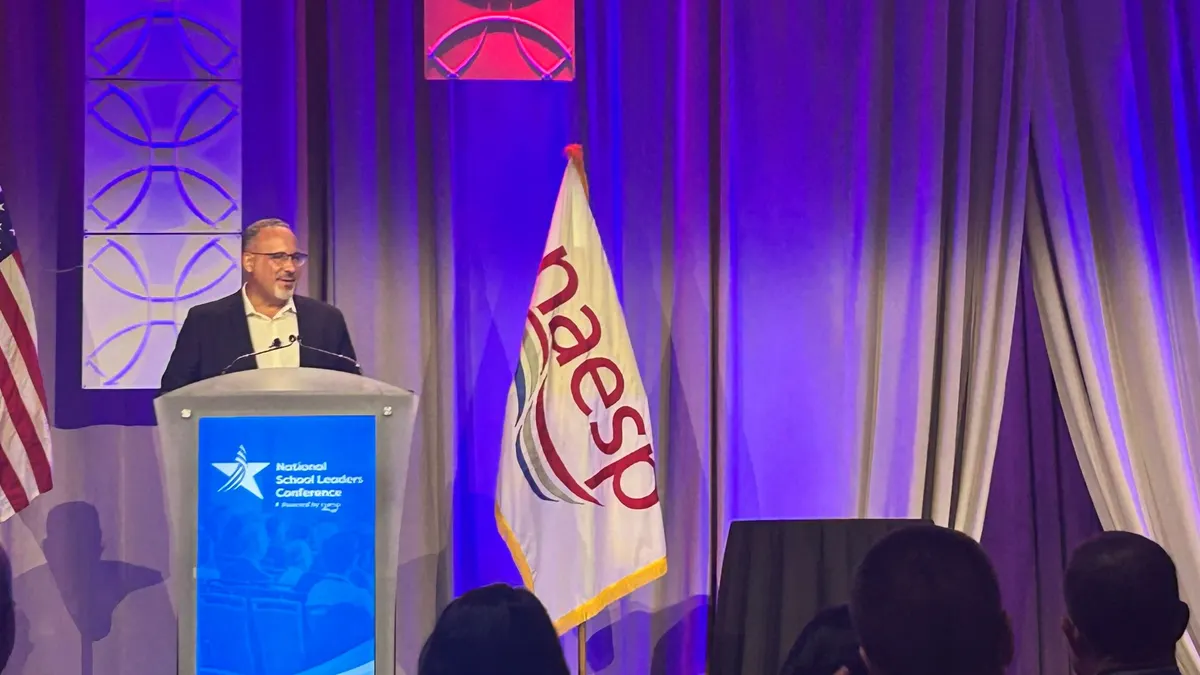
- The advent of artificial intelligence has several implications and applications for student assessment, says Temple Lovelace, executive director of the Assessment for Good program at the Advanced Education Research and Development Fund. Assessment for Good focuses on formative assessments for students ages 8 to 13.
- Among the use cases for AI in assessments are the generation of test questions, greater ability to measure durable skills like critical thinking and more rapid scoring, Lovelace said. There can also be greater coherence across assessment systems that capture a more complete, integrated “portrait” of learners over time to help inform teachers and school leaders as they design their next lessons, she said.
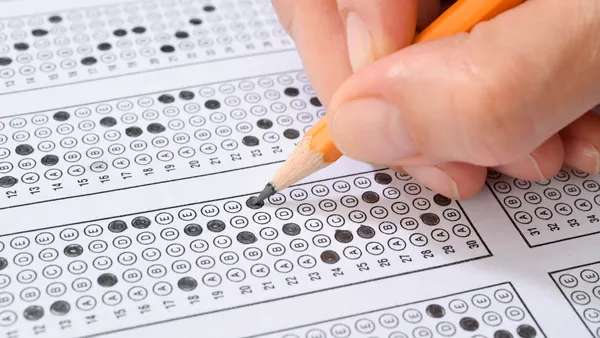
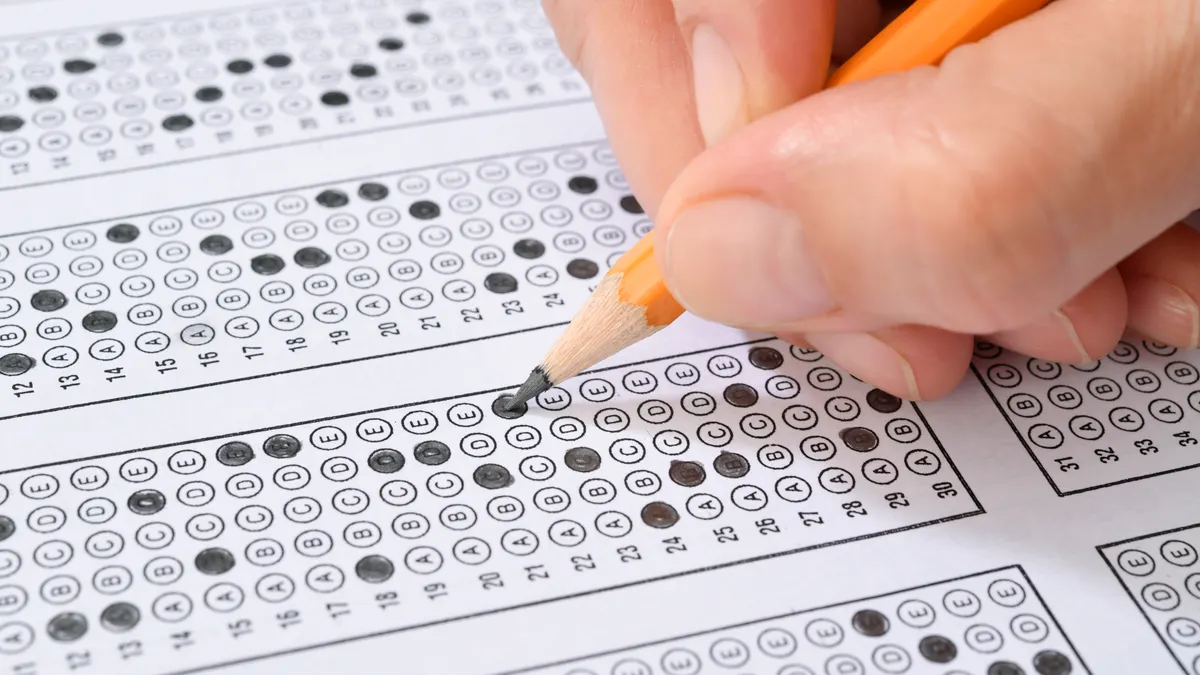
- When it comes to creating inventive question items, AI can take assessments beyond Scantron-style, fill-in-the-bubble test-taking, Lovelace said. “We have used it in the last 2 ½ to three years in getting inventive item formats,” she said. “The learner talks, and you assess what they’re thinking in a Socratic conversation back and forth.
Dive Insight:
Generative AI items perform just as well as those created by Assessment for Good’s subject matter experts because key information was used to generate that content, Lovelace said.
And speeding up the scoring of assessments, especially in the summative space, disrupts the usual time-frame where students receive results weeks or months afterward, she said.
“What AI has done is, it’s been able to score, one, more quickly and, two, with more rich information,” Lovelace said. “We’re able to get you inferences — and more unique inferences — back to learners or educators in the moment. The idea of leveraging AI in scoring has been great for us, whether that is an LLM [large language model] coming through and providing initial insights, or whether that is new models for scoring so we can provide more effective information back to learners.”
Assessment for Good — which last year released a “Future of Assessment” forecast that included a vision for how AI could be used — has tapped into AI in ways that go beyond a raw reading or math score to measure the “connective tissue” of how learners are using critical thinking and collaboration, she said.
“What are the misconceptions popping up in my math?” Lovelace said. “What closes that gap are often those durable skills that educators and learners leverage. What is important and really exciting about the advent of AI in assessment is that we can measure more dynamic and richer learning than before.”
Instead of sitting in front of a computer and clicking an answer, students interact in “conversations” with chatbots, upload examples of their work, and then the assessment system will note examples and evidence of critical thinking or cognitive flexibility, she said.
“AI has allowed us to change what it means to assess,” she said. “We’ve changed what assessment can look like and broadened it beyond taking a test, capturing all kinds of learning.”
That gives educators a more complete sense of how a student is growing and learning, and how best to support them going forward, Lovelace said. For instance, AI can help inform educators how to provide students with more precise, real-time tutoring services.
“How might that educator change what they’re going to teach next, having that be standard-aligned, and matching the curriculum better? AI makes that possible,” she said
Finally, AI can pull together results from different subject-related systems and provide greater coherence in building the “portrait” of a given learner, Lovelace said.
“AI can grab information from multiple systems so the superintendent and principal are able to see not only individual learners but people around them in the district,” she said. “The school, district and even state leaders can see how to best meet the needs of learners, and the educators too. AI and LLMs will allow us to get beyond this idea of accountability and think about how to customize learning.”
Stressing the importance of formative assessment, Lovelace described it as “the body of assessment that sits at that moment of teaching and learning.”
“How do we get the teacher the best information possible, and the learners themselves, almost immediately, to inform what they might do next?” she asked. “When you think about the fact that formative assessments have to be responsive, have to be quick, have to be nimble — that’s where AI starts to shine.”