How can leaders of high school career and technical education programs ensure those offerings remain relevant in preparing students to adapt in a rapidly changing workforce?
“That question is one everyone is trying to answer right now. I’m not sure there is one clear answer,” said Alisha Hyslop, chief policy, research and content officer at the Association for Career and Technical Education.
Hyslop said the main piece of advice for educators is to work closely with businesses and industries to ensure programs are preparing students with the skills they’ll need to be successful — and that’s probably the same, at least on the surface, as it would have been 10 or 20 years ago.
But there are important distinctions in 2026, Hyslop said.
Because technology is changing so rapidly, employers don’t always have a clear answer for workplace readiness approaches, she said.
Hyslop said ACTE is also hearing that students need to understand basic, foundational artificial intelligence skills and how to use them. Additionally, students should continue to "build up durable skills," which is "really critical," she said.
Despite employers’ own lack of clarity at times, regular conversations should definitely continue, Hyslop said.
“There should be a give-and-take between the CTE educators, and folks working on curriculum and instruction in CTE, and the employer community,” she said. And although technology will continue to rapidly evolve, “students are still going to need critical thinking and communications skills, and the ability to work in teams, and evaluate information — and all of those foundational skills that apply across technologies.”
CTE programs focused on information technology are changing the most rapidly, although Hyslop said she has seen plenty of research to show that across the spectrum of career fields, new AI tools are being implemented and deployed. One example is the use of the technology in the agriculture field to monitor soil health and predict crop growth, she said.
“We had some examples from a school in Bentonville [Ark.] that was using AI in health science programs. They had created a meal planning app for mothers with gestational diabetes, or for pregnant women who could get answers to specific questions; those were joint projects between healthcare and technology students," Hyslop said. "There were lots of applications in digital media, and lots of ethical considerations that students are exploring as they go through that process.”
While some industries are more impacted by the advent of AI and other changes in the workplace than others, at first glance, people might think it’s mainly an issue in technology classes, Hyslop said. “And that is not the case. Because we’re seeing applications across career areas, once students get into the workplace.”
During a panel discussion at a recent ACTE conference focused on the use of AI in CTE programs, Hyslop said, students emphasized how important it was that they learned foundational skills first.
One student pointed out the approach of using a calculator to solve math problems, she recalled. “But that’s not how we teach students in kindergarten. We teach them basic mathematical functions first, and then introduce the calculator to do more complicated things.”
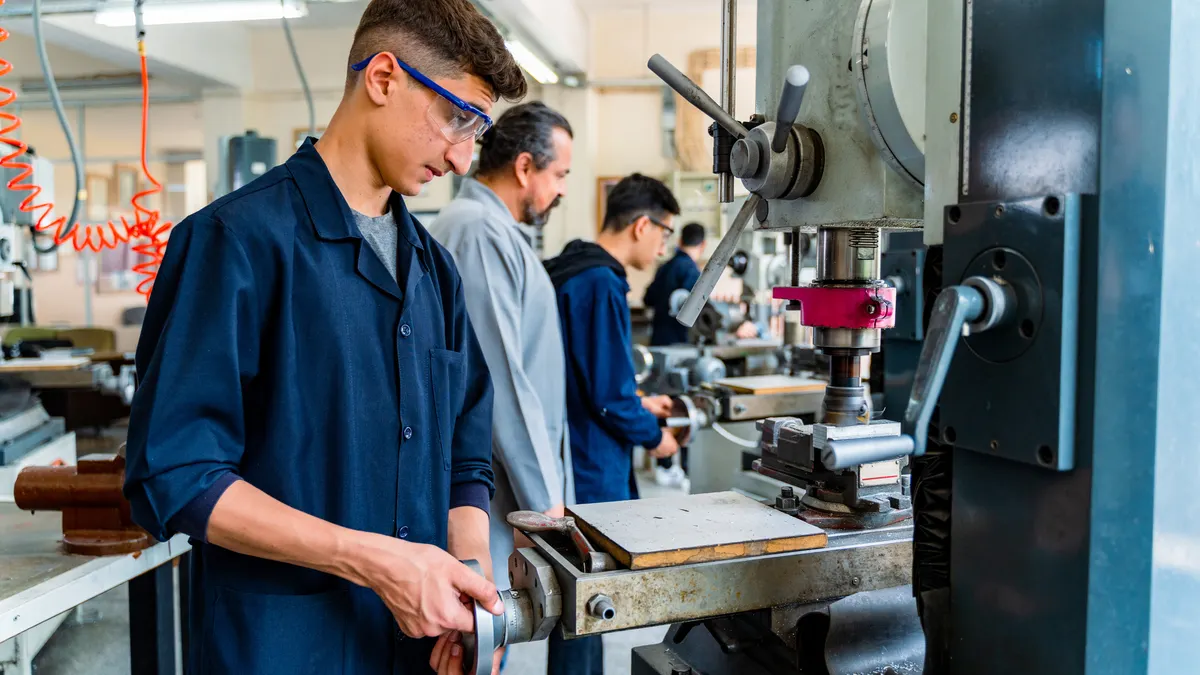
By learning the foundational level skills in CTE programs, they could evaluate the answers given by AI more competently, the students said. For instance, a student studying automotive mechanics could examine AI-generated instructions on how to fix cars.
“If you had no real understanding of those instructions, you wouldn’t know if it made a mistake,” she said. “That was a really important takeaway from that panel — that even students realized that AI, or whatever the next technology is, is still going to need people to instruct, evaluate and modify all of these technologies.”