This audio is auto-generated. Please let us know if you have feedback.
Most clicked story of the week:
An analysis of federal data by The Advocacy Institute found that the number of students with disabilities ages 3-21 who qualify for special education services in the U.S. rose 3.8% — or by 301,991 students — in 2024 when compared to the year before. Overall, about 8.2 million students ages 3-21 qualified for services under the Individuals with Disabilities Education Act in 2024. There were increases for both pre-K and K-12 students.
Number of the week:
9
The number of interagency agreements that the U.S. Department of Education has signed with four other federal agencies to transfer various program and funding responsibilities. The two most recent agreements, announced Feb. 23, are with the U.S. Department of Health and Human Services for family engagement and school supports, including school safety and community schools programming, and with the U.S. Department of State on foreign gift and contract reporting for certain public and private higher education institutions under Section 117 of the Higher Education Act.
Policy and legal notes
- In a long State of the Union address on Feb. 24, President Donald Trump touted that his administration “ended DEI in America” and briefly highlighted his artificial intelligence policies — touching on two issues that are significantly shaping K-12 schools without directly mentioning the state of the education sector. Trump’s claimed victory on ending diversity, equity and inclusion comes after the Education Department has repeatedly and aggressively targeted such practices in school districts and colleges during his second term.
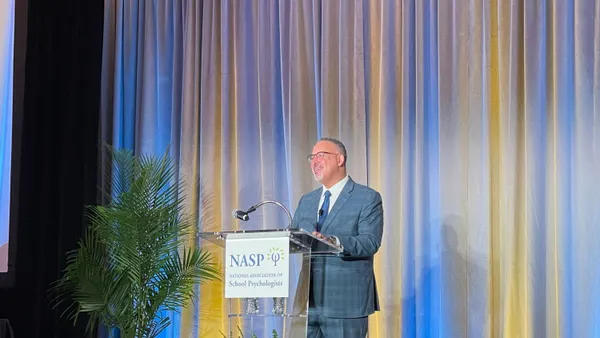
- Prior to his keynote address at the National Association of School Psychologists in Chicago on Feb. 25, former U.S. Education Secretary Miguel Cardona spoke with K-12 Dive about how student mental health cannot be seen as a blue or red issue. “Providing mental health support is not a Democrat or Republican thing,” Cardona said. “It’s a basic support for students in order for them to reach their God-given potential.”
- The Montgomery County Board of Education in Maryland must comply with court-enforced parental right protections and pay $1.5 million in damages to a group of parents who sought to opt their children out of LGBTQ+-friendly curriculum on religious grounds under a settlement in Mahmoud v. Taylor, ending the yearslong legal battle.
- The Special School District of St. Louis County in Missouri has violated Title II of the Americans with Disabilities Act through systemic and widespread use of restraint and seclusion practices, the U.S. Department of Justice charged in findings announced Feb. 23. During the 2022-23 and 2023-24 school years when the district was under DOJ investigation, the schools serving students with disabilities secluded more than 300 students almost 4,000 times and restrained almost 150 students 777 times.
Curriculum corner
- About a third of schools have recovered in either math or reading in the wake of the COVID-19 pandemic, a new NWEA study reports. But only 1 in 7 schools have recovered in both subjects, and schools with smaller initial declines were found to be more likely to recover. Those serving higher-poverty and historically marginalized students were less likely to have recovered, but also showed the largest gains since the 2020 health crisis caused widespread learning disruptions.
- Successfully infusing artificial intelligence into the classroom means boosting students’ AI literacy without using the tech to offload their thinking. But that requires teachers first getting up to speed on AI through professional development and being intentional about how they design lessons and assignments. Two teachers who have used ChatGPT in their curriculum shared their best practices with K-12 Dive this week.
- Students often don’t exercise deductive reasoning in traditional math curriculum until students take geometry in high school and are required to use it to solve proofs, said Jeff Wanko, dean of the College of Education and Health Sciences and a math education professor at Bradley University in Peoria, Ill. Organizations such as the National Council of Teachers of Mathematics, as well as other educators, say waiting that long does students a disservice, Wanko said. “I see these puzzles as one way we can develop what I call ‘proof-readiness.’”