Students born outside of the U.S. were less likely to show up for school in the months following the inauguration of President Donald Trump in 2025 — and the likelihood of student absences increased further if there was an immigration enforcement event in the community, according to research presented in a webinar by the Annenberg Institute at Brown University last week.
Those students born elsewhere — who had a stronger record of showing up to school compared to students born within the country — were about two percentage points more likely to be absent following the inauguration in spring 2025. This was especially true in the higher grades, with 11th graders being up to six percentage points more likely to be absent.
"These large increases are perhaps not surprising given the large increase in the immigration enforcement itself," said Andrew Camp, senior research associate at the Annenberg Institute and lead researcher of the study published in April, during the June 17 webinar. "So this does tell us that students are responding in real time to ICE activity in their communities."
Even reports of an Immigration and Customs Enforcement vehicle parked a block and a half away from a school building had a negative impact on student attendance, Camp and his team found. The research was based on student attendance and birth origin data provided by an unnamed Northeastern school district referred to in the study as an immigrant-friendly area called “Liberty City.”
"Immigration enforcement actions, almost regardless of their breadth, can and are still very disruptive," said Jonathan Acosta, a postdoctoral research associate at the Annenberg Institute.
Not only do material disruptions — like having a caregiver detained or deported, or losing employment — impact school attendance, but so does the general perceived risk of immigration enforcement activities nationwide, Camp said.
Schools are also having a hard time keeping up with the spread of information when an ICE incident does take place.
"The information was traveling faster than the district was able to respond," said Acosta. "If high school students all have cellphones, and they're getting social media posts about a car parked outside a block away from high school or somebody getting arrested on the main street of a community, they might be responding quicker than younger students with families who aren't as active on their phones."
What are schools doing?
Schools are adopting very similar strategies to respond to the increase in chronic absenteeism related to immigration enforcement, according to a separate study published in January by another team of researchers at Annenberg Institute.
"There's a common blend of strategies that schools are coming up with as they're thinking about approaching these things, and some of the strategies that were most typical in one state were also typical in another," said Jeremy Singer, lead researcher of the second study and a professor at University of MIchigan-Flint.
In reviewing strategies adopted by Michigan and Georgia schools, researchers found that around half of the approaches used by principals fell into improving the behaviors of parents and students, about a third were related to removing barriers to attendance, and around 15% fell into improving student experiences.
That means the most common strategies were related to communicating with families and pursuing other efforts meant to address student or parent behavior. Those included sending standardized attendance letters, talking about the importance of attendance, and making personalized or automated phone calls home.
Text messaging fell lower on the list.
"It was interesting to see that phone calls and letters — which are more traditional forms of communication — seemed to have staying power compared to more modern forms of communication like texting," said Singer.
ICE enforcement enhance post-pandemic challenges
Districts are scrambling to address increasing absenteeism as a result of immigration enforcement even as they continue to recover from pandemic-era impacts on attendance and other measures of student performance.
"ICE enforcement rates have really exacerbated that problem and virtually every other dimension of academic recovery from the COVID-19 pandemic — learning loss, mental health issues, enrollment loss, etc.," said Thomas Dee, a Stanford University education professor whose research focuses on public policy issues, during the webinar last week.
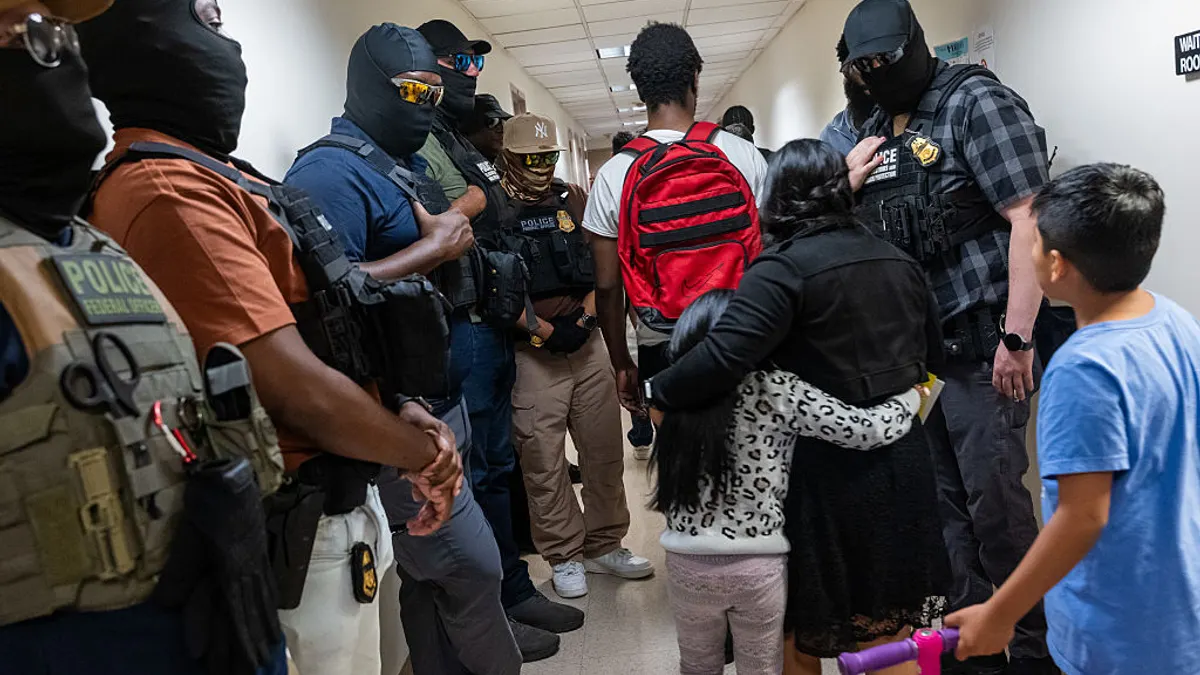
In the months following the launch of the Trump administration's immigration crackdown last year — which included changing policy to more easily allow enforcement on school grounds — schools went into lockdown, canceled in-person classes, and in some cases even provided families with know-your-rights training and legal counsel.
Although the U.S. Department of Homeland Security has said it is not conducting raids on school grounds, there have been at least 17 documented incidents of ICE presence on school property since K-12 Dive began tracking the issue in January 2025. That's not including federal agents patrolling near school bus stops or impacting other off-campusschool-related activities like field trips.
Research released last year by psychiatric researchers showed students are avoiding school or even withdrawing from public life generally as the administration’s immigration enforcement policies are having “ripple effects” on immigrant children and children who are U.S. citizens living in mixed-status families.
The researchers said that while schools were “critical sites for early identification and support," they can also be places where immigrant youth “experience trauma-related avoidance, disengagement, or behavioral challenges.”
"A broader point is that we shouldn't expect schools to solve this problem on their own," Singer said during the Annenberg presentation.