Faced with students staying home or switching to online learning because of immigration enforcement activity, special educators are working to continue individualized services for students with disabilities who are suddenly out of the school building.
"When we started even talking about a virtual learning option, it really came from a place of concern for our students and their access to education," said Heidi Nistler, assistant superintendent of specialized services for St. Paul Public Schools in Minnesota.
The district's 33,000 general and special education students have the option to enroll in temporary virtual learning, which began Jan. 22 after Immigration and Customs Enforcement activity roiled the Minneapolis-St. Paul community.
About 20% of the district's students have opted into the temporary remote learning model. Of those who qualify for special education services, 15% — or about 825 — were participating as of Jan. 28, Nistler said.
To meet the needs of students with disabilities in temporary virtual settings, a student's special education case manager reviews the individualized education program and talks with the family about what the virtual learning experience would look like and how to provide consent for those services, Nistler said.
Services that might need to shift to remote learning under this model could include academic supports, speech and language, and physical or behavioral therapies.
For both general and special education students learning virtually temporarily, the goal is to replicate in-person instruction through synchronous lessons. However, the individual needs of students with disabilities are taken into consideration, and some lessons may be adjusted for students who are challenged by extended periods of screen time, Nistler said.
In fact, schools are taking a page from their pandemic-era playbook to meet students' needs through temporary virtual learning, according to educators in areas with heavy ICE activity.
Nistler said St. Paul Public Schools' pandemic policies, procedures and learning resources became helpful starting points when the district first considered implementing a virtual learning option because of absences stemming from immigration fears.
"The current circumstances are different" than during the pandemic, she said. But using resources created then "gave us a place to start instead of having to build everything" from scratch. "There was a sense of urgency in making sure that our families were able to still access education for their children," she said.
Providing a welcoming and safe environment
On Feb. 4, two Minnesota school districts — the Fridley Public School District and Duluth Public School District, along with the Education Minnesota teachers union — sued the U.S. Department of Homeland Security and its ICE office to stop immigration enforcement at schools. The lawsuit alleges that immigration enforcement efforts have had a negative impact on school attendance and safe learning environments.
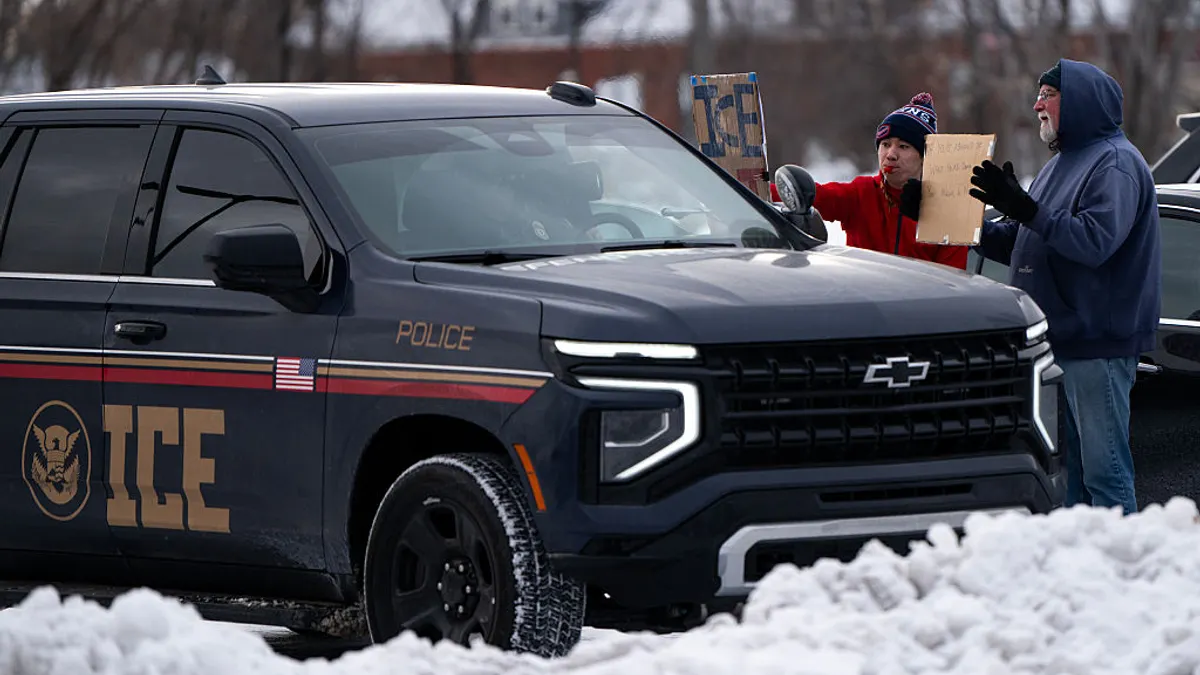
As federal immigration enforcement intensifies in various localities, districts like St. Paul Public Schools, Minneapolis Public Schools and Los Angeles Unified School District have opened or expanded virtual school options for families concerned about safety going to and from school.
The Trump administration has said it ramped up immigration enforcement to restore "integrity to the immigration system" and to protect American workers and reduce strain on local communities.
In doing so, the administration early last year removed schools, day care centers, hospitals and churches as "sensitive locations" to be avoided by federal immigration authorities. The move sparked fear among school communities that enforcement activities would happen on their campuses, leading to districts and community partners informing immigrant families of their constitutional rights — including their right to attend school regardless of immigration status.
There have been at least 11 incidents of ICE activity on school grounds since last April, including at public and private schools and early learning centers, according to a K-12 Dive tracker.
"The chilling effect of these efforts on students attending schools and seeking special education services directly conflicts with the legal obligation under federal and state law for school districts to locate, identify, evaluate and serve students with disabilities."

Statement from the New Jersey Principals and Supervisors Association
As immigration enforcement has increased over the past year, so too has chronic absenteeism in two Northeastern states, a study found. English learners in Connecticut were 50% more likely to be chronically absent than non-ELs during the 2024-25 school year. In Rhode Island, ELs were 25% more likely than others to be chronically absent, according to a December working paper published by the Annenberg Institute at Brown University.
The New Jersey Principals and Supervisors Association, in an April 2025 statement, warned that some families' immigration fears will prevent them from seeking or agreeing to special education services.
"The chilling effect of these efforts on students attending schools and seeking special education services directly conflicts with the legal obligation under federal and state law for school districts to locate, identify, evaluate and serve students with disabilities," the statement said.
The statement added that districts may need to rethink outreach and communication efforts with impacted families as districts help their children obtain the special education services they are entitled to under the Individuals with Disabilities Education Act.
Educators and advocates are emphasizing the need for safe and welcoming environments so young children and students with disabilities and their families can continue the supports they receive under IDEA.
According to the Council for Exceptional Children's Division for Early Childhood, young children especially need stability and family support for their healthy development.
"This is even more pronounced for children with disabilities, who often rely on consistent family care and support," the council's division said in a Feb. 3 statement. "Supporting strong, unified families in the early years lays the foundation for children’s long-term success and resilience, benefiting not just the families themselves but society as a whole."
CEC's Division for Early Childhood added that it is committed to ensuring that learning environments and other places where young children and their families gather remain places where all are welcomed and feel safe. "Furthermore, we are committed to assuring families feel safe in seeking medical care for their children, especially children with disabilities and significant health needs," DEC said.
In addition to hospitals, preschools and K-12 schools provide some medical services for students with disabilities.
The Council of Administrators of Special Education says it is emphasizing to districts and states that every child, regardless of their legal status, has a right to attend public schools. Phyllis Wolfram, executive director of CASE, said that includes access to a free and appropriate public education — or FAPE — under IDEA.
"In the current climate that might also mean services and supports, such as counseling and social work services, for children and their families to ensure schools are safe environments for learning," Wolfram said in an email. "CASE wants every child and family to know they are valued and will be supported.”
Julie Weatherly, founder of Resolutions in Special Education, a consulting and legal services firm that advises school districts and other agencies on educating students with disabilities, said schools must provide FAPE "in light of the child's circumstances" under the U.S. Supreme Court's 2017 decision in Endrew F. v. Douglas County School District.
Regarding adjustments to students' individualized services during increased immigration enforcement activity, "IEP teams must consider what is FAPE in light of these circumstances and have safe, respectful, and meaningful conversations with fearful and anxious parents about what that looks like," Weatherly said in an email.
It's "very similar to COVID times, in some respects," she said.
Jose Martín, a partner in the law firm Richards, Lindsay & Martín in Austin, Texas, which represents school districts, advises school systems to ensure that students' individualized needs can still be met in virtual learning environments.
If a school is "going to offer a placement that is not appropriate, it won't deliver FAPE. I don't think that's good for the kid, and that's not good for the district," Martín said. "The district can suffer legal repercussions."
Supports for educators
The districts offering temporary virtual learning are supporting not only their students, but also their teachers and related service providers working with the students and families.
In St. Paul Public Schools, special education teachers can access information about IDEA requirements for communicating with families and documenting decisions about student services on an online landing page, which lists other tools and resources as well. The page also features virtual learning and instructional resources for special educators — with some borrowed from COVID-era school closures.
"We have a lot of virtual resources that we were very quickly able to put together in an updated resource bank and provide out to our special education staff members," Nistler said.
Nistler said she's in contact with other special education directors in the state whose districts are in similar positions. The administrators exchange advice and help each other problem-solve. The Minnesota Department of Education has also been providing technical support, she said.
The school system does not yet have an end date for the temporary virtual learning option. "We're monitoring and assessing the situation and the needs of our community every single day," Nistler said.



 Dive Awards