Dive Brief:
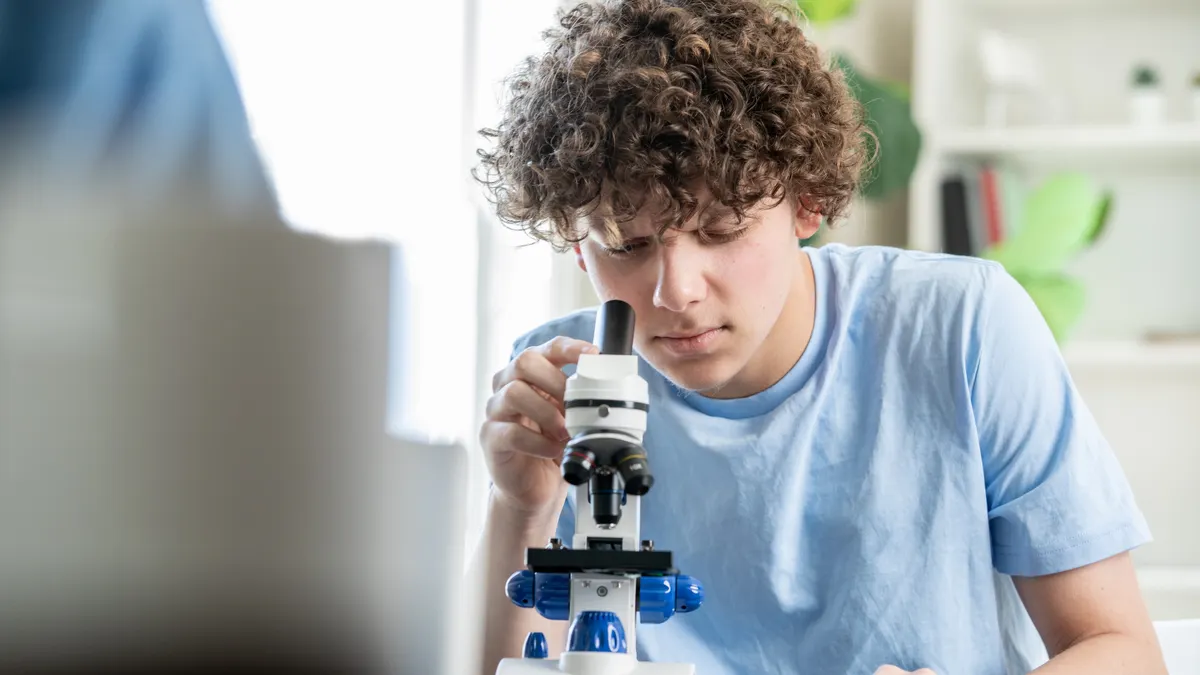
- Lab reports in science classes can be dry, compliance-based exercises, but they don’t have to be — and shouldn’t be, science educators say. Shifting them to an approach that encourages critical thinking and creative exploration makes them more engaging — and thus more memorable.
- Run-of-the-mill lab experiences will gain the enthusiasm of “rule followers and those motivated by grades,” but they mostly teach students to follow procedures rather than exploring or uncovering anything unexpected or novel, said Stephen Jehl, director of program design and innovation at the National Math and Science Initiative.
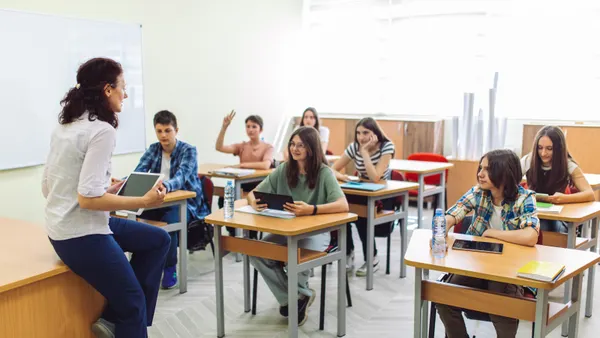
- Lab assignments should go beyond simply finding the right answer, Jehl said. Students should develop their own procedure, collect and analyze data, reach conclusions and justify them with the rest of the class.
Dive Insight:
How this plays out can vary by geography and type of school district.
At Lennox Math, Science and Technology Academy in Lennox, California, physics and engineering teacher Jose Rivas has solicited mentors and even internships from area engineering companies. In the Marion County School District in rural Columbia, Mississippi, former science teacher Alicia Conerly — now director of federal programs — recalls tapping into local resources ranging from horse breeding to local plant life to engage students.
“You have to start with the ‘need to know’ from a student perspective, which is one thing you don’t often get from a cookie-cutter lab,” said Jehl, a former physics and robotics teacher.
“Don’t just collect a lab report and grade it. Instead, have students stand up and explain their reasoning — why they did what they did,” Jehl said. “These are all soft skills students will need, in STEM careers but also in others.”
This also introduces a “peer aspect” that will motivate even those less concerned about grades and who haven’t developed a love of the subject matter, Jehl said.
“They, first of all, don’t want to look foolish,” he said. “Even the biggest joker in the room is going to feel a certain amount of peer pressure to not negatively impact their partners.”
With his school surrounded by companies like Northrop Grumman and SpaceX, Rivas said he’s constantly applying for grant money and forging connections, including with Lennox alumni who are employees of these types of companies. Advanced Placement Physics students have gained internships, he said, while his general physics students work with mentors on projects of local interest, like an exploration of how to reduce the noise of airplanes taking off and landing at nearby Los Angeles International Airport.
Inherent in the projects that his classes undertake is a purpose beyond compliance, Rivas said.
“Why did we solve for ‘X’? What does that ‘X’ mean for me?” he said. “You have to give them a purpose and a why.”
Science educators also need to give students room to “fail” in lab settings, Rivas said.
“The process of science and engineering is messy,” he said. “You have to iterate. Why didn’t it work? What do I have to fix? There’s never a mistake — it’s just something you need to improve. That fear of failure, a lot of times, prevents students from really engaging. A lot of times, grades get in the way of that.”
Conerly, who is a past president of the National Science Teaching Association, recalls lab projects that included seeing how far back students could trace the breed of a horse’s lineage, biology experiments made more relevant by interviewing family members with diseases like sickle cell anemia, and human anatomy and physiology students who had the opportunity to observe cadavers in partnership with Mississippi Christian University, formerly Mississippi College.
Since her teaching days, Conerly believes the district has entered into a wide array of higher education partnerships.
“Teachers are capitalizing on taking students to those sites … making an intentional effort to visit the applied science classes, to visit the nursing programs,” she said. “We’re seeing more emphasis on that because we’re trying to close the workforce gap in STEM fields.”
Districts need to ensure that teachers are adequately trained to get out of the compliance-based lab report box, Jehl said.
“If teachers are not confident in the subject matter and the pedagogy, they’re not going to try these types of things,” he said. “They wind up putting students in situations where they’re following a very narrow, structured path.”