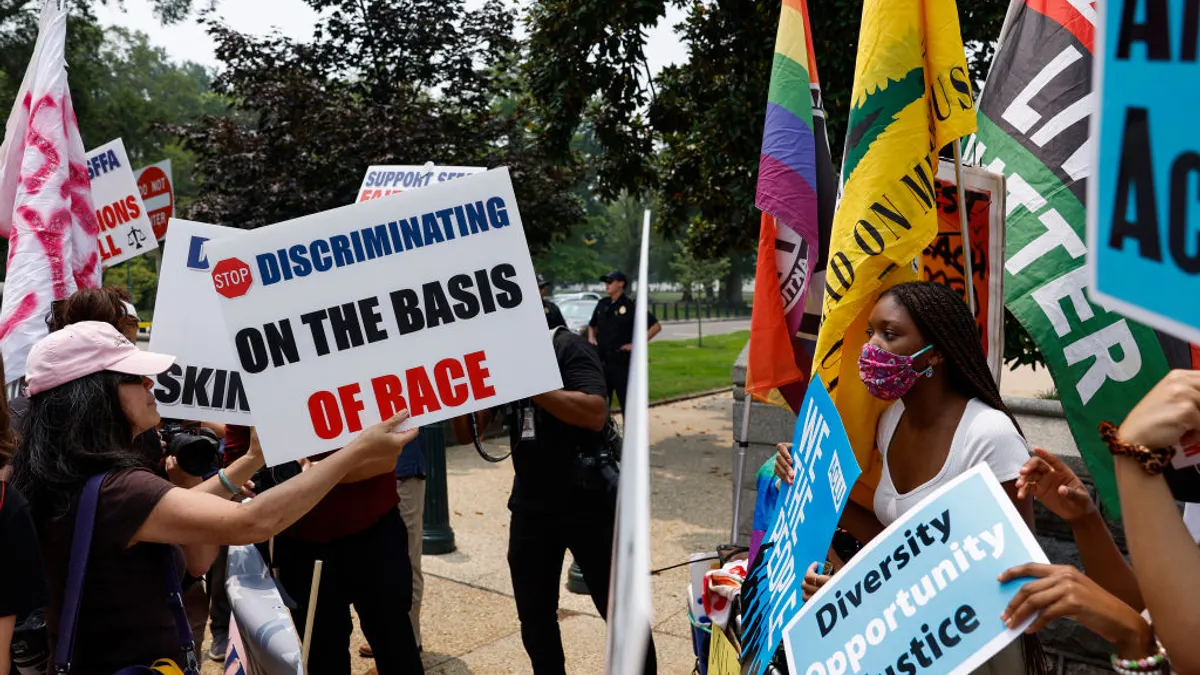
Schools can expect to see an upswing in discrimination complaints filed by White and male students and teachers — if they haven't already, said education civil rights experts. Such cases claim White or male individuals were discriminated against on the basis of their race or sex.
The civil rights statutes protecting against those forms of discrimination — Title VI for race, color or natural origin discrimination, and Title IX for sex discrimination — were originally codified to level the playing field for groups historically marginalized, such as students of color and women, within federal and education programs., As such, they have typically been invoked to protect those student groups.
However, under President Donald Trump, the statutes have commonly been tapped in an effort to protect White and male students and teachers, who have traditionally had a greater level of access and representation within the education sphere.
"I think there has been an uptick in reverse discrimination litigation brought against school districts," said John Borkowski, an education attorney at Husch Blackwell who often represents school districts in legal matters. The law firm represents clients in the education sector across multiple states.
Some of these cases started prior to the current administration and date at least as far back as Trump's first term as president, multiple experts said.
Shiwali Patel, who worked at the U.S. Department of Education's Office for Civil Rights during the first Trump administration, said the office had begun to see an uptick in Title IX sex discrimination complaints originating from male students as far back as 2016, leading up to Trump's first year in office in 2017. OCR enforces Title VI and Title IX in education programs.
"Reverse discrimination cases are nothing new," said Laura Dunn, a Title IX expert and civil rights lawyer who is running for New York's 12th congressional district.
"Under Trump’s first administration, Education Secretary Betsy DeVos and Assistant Secretary of Civil Rights Candice Jackson entertained them frequently,” said Dunn. “They have been happening in the Title IX space for the last decade, suggesting that Title VI reverse discrimination claims are the newer trend."
'A new minority: White students'
The 1776 Project Foundation, a conservative education advocacy nonprofit, sued Los Angeles Unified School District on Jan. 20 over the district's student integration efforts, saying in its lawsuit the district's policies discriminate against "a new minority: White students."
The lawsuit alleges that the nation's second-largest district also includes Middle Eastern students in its "disfavored group."
The district's integration program focuses on schools with resident populations that are 70% or more Hispanic, Black, Asian or other non-Anglo. The lawsuit said those schools — or PHBAO schools — get funding to support class size reductions and are also required to hold two parent-teacher conferences during the school year, which the 1776 Project Foundation said is discriminatory against White students.
"In today’s Los Angeles, over 600 public schools qualify as PHBAO. Fewer than 100 do not," the lawsuit stated. "So, the non-PHBAO schools are a minority."
The 1776 Project Foundation is seeking to end the integration program under the 14th Amendment, which guarantees equal protection under the law regardless of race, and Title VI.
While LAUSD didn't comment on the pending litigation, it told the Los Angeles Times that "it remains firmly committed to ensuring all students have meaningful access to services and enriching educational opportunities.”
The lawsuit comes after the Trump administration has ended multiple school desegregation orders born out of the civil rights movement in the last year and rolled back other directives across the federal government — such as one prohibiting federal contractors from allowing segregated facilities, which it said was “not consistent with the direction of the president,” per reporting by National Public Radio and The New York Times.
It also comes after the administration froze federal funding from already-approved education-related grant recipients for their diversity, equity and inclusion initiatives. One mental health grant serving a rural California district, for example, was rescinded because it partly sought to hire counselors who could better relate to the traumas faced by their Native American student population.
These DEI initiatives, the administration has repeatedly said, don't align with its priorities and are in some cases unlawful under its interpretation of Title VI.
In other examples, the Education Department has targeted districts through the initiation of Title VI investigations. In April, for example, it launched an investigation into Chicago Public Schools for the district's Black Students Success Plan, which the department said "favored students on the basis of race."
"I think that's part of the administration's strategy, right? It's to set up an environment where anything related to D, E and I is potentially subject to challenge, whether it be by the government or private litigants," said Burkowski. "And trying to get folks to step back and step away from some of those efforts voluntarily, for fear of being sued or losing federal funding or what have you. "
What kinds of programs could be impacted?
Patel and others agree that the current climate under the Trump administration is ripe for more complaints from White and male students and staff — and, in some cases, people with Asian origin.
These lawsuits have also proliferated after a key U.S. Supreme Court ruling in 2023 against Harvard University and the University of North Carolina at Chapel Hill overturned longstanding race-conscious admissions policies in higher education, which education policy experts warned at the time could be used to undo equity programs in K-12.
In one high-profile case that was appealed to the U.S. Supreme Court in 2023, petitioners argued a Virginia magnet public school's admissions policy aimed at diversifying its student population led to an intentional and discriminatory drop in Asian American enrollment.
The 2020 admissions policy for Thomas Jefferson High School for Science and Technology weighed “experience factors” and dropped the entrance exam and teacher recommendation requirements. Asian American students made up 73% of enrollment prior to the change and fell to 54% in 2021.
The Supreme Court denied the case in 2024, meaning the admissions policy could continue.
In addition to admissions policies and other efforts to ensure the academic success of historically underserved racial groups, Patel said, some education programs that have come under the microscope include student affinity groups, efforts to diversify the teacher workforce to better reflect the students they serve, and even programs aimed at providing more STEM opportunities to women and girls.
Race-related curriculum and materials are another impacted area, especially after a parental rights movement that has characterized them as "divisive" and sometimes discriminatory against White people.
"I attribute these shifts in the legal landscape to the 'Trump effect,' which is emboldening those in the majority –– socioeconomically speaking –– to challenge advancements that ensure women, LGBTQ communities, and people of color an equitable opportunity both at work and in school," said Dunn.
Patel suggests that schools should carry on with their initiatives to ensure equity in education.
Jonathan Segal, a partner at Duane Morris law firm who works with labor, benefits and employment law, warns that White, male or Asian students and teachers should also not be protected at the expense of other groups such as women, Black, Hispanic or LGBTQ+ students.
"That sends a dangerous message and is legally dicey, too," said Segal. "I do think that school districts need to be really very careful."
Although a school district may want to hire a teacher based on the candidate's race, sex or ethnicity to better connect with its student population, for example, they cannot favor a job candidate for those reasons, either, Segal said.
School districts could find themselves in legal battles from both White teachers who are not assigned to majority-Black schools and Black teachers who are assigned to those schools, he added as an example.
While this has typically been the case even prior to the Trump administration, enforcement in this area was low before, per Segal.
"Now the enforcement in this area is high, and the government has raised the issue of what was historically so called, 'reverse discrimination,'" he said. "So what I'm seeing is increasingly plaintiff's lawyers who see this is the new shiny penny for them to argue reverse discrimination, or that a historically not-marginalized group is being disadvantaged."





 Dive Awards