Dive Brief:
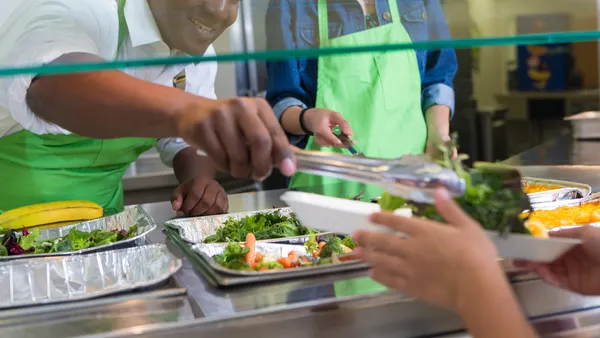
- Free school meal eligibility would be threatened for some 1.78 million children under a proposed rule published Tuesday by the U.S. Department of Agriculture that would limit Supplemental Nutrition Assistance Program benefits only to households receiving Temporary Assistance for Needy Families.
- Under the proposed rule from USDA's Food and Nutrition Administration, those children would no longer be categorically eligible for free school meals provided through the National School Lunch and School Breakfast Programs despite 97% still qualifying for free or reduced-price meals based on their household income.
- Instead, those students’ eligibility for free and reduced price meals would have to be certified through a different process. Under the proposed rule, 1.66 million of the 1.78 million impacted children would still receive free school meals, 93,000 children would move from receiving free meals to paying for reduced-price meals, and 28,000 students would have to pay full price for their meals.
Dive Insight:
The changes would come as a result of the USDA eliminating “broad-based categorical eligibility,” which is a state option that streamlines SNAP applications for households that already qualify for other assistance programs. More than 40 states and the District of Columbia use this option.
Eliminating this eligibility "may result in some level of increased administrative burden on states, a reduction in SNAP benefit spending, and associated effects on school meals eligibility," the USDA acknowledged in its proposal.
In addition to impacting school meal eligibility, the department estimates that approximately 42,000 children could potentially no longer receive the Summer Electronic Benefit Transfer beginning in summer 2029. The SEBT allows $120 in grocery benefits per eligible school-age child when school is out for summer.
The USDA’s new proposed rule would further exacerbate challenges for school meals, as well as students' benefits for summer meals, according to the Food Research & Action Center.
"Eliminating BBCE would reduce access to free school meals, making children hungry at home and at school," said FRAC in a Nov. 10 statement. "Children who lose SNAP are no longer automatically eligible for free school meals."
It would also increase administrative work for schools, such as those who were previously eligible for Community Eligibility Provision, the organization said. CEP helps high-poverty schools provide universal access to free school meals. The organization said it is concerned the impact could be “far worse than projected."
The public comment period on the proposed rule closes Dec. 10. The rule has so far received over 200 comments as of Thursday.
School districts have faced a slew of budget and eligibility challenges related to school meal programs under the second Trump administration.
In fall 2025, a prolonged government shutdown caused school systems and government agencies to provide outreach and extra supports for low-income families and children affected by the likely expiration of benefits.
Earlier that year, the Republican-led One Big, Beautiful Bill Act that went into effect July 2025 was estimated to reduce SNAP participation by roughly 2.4 million people in an average month between 2025-2034, putting school meals for children from those households at risk as they lost direct certification for free school meals.
The OBBBA changes also impacted CEP for districts. In Illinois, for instance, 47 fewer schools and 15 fewer districts participated in CEP between the 2024-25 and 2025-26 school years.
In addition to a reduction in eligibility, school district leaders have been concerned about the impact of federal budget cuts on school meals.
In May, 74% of school districts were concerned about the effect on school meals from looming federal budget cuts to SNAP and Medicaid, according to a report released by FRAC.
And in a September report by AASA, The School Superintendents Association, a majority — 67% — of superintendents said current funding levels are moderately or significantly hindering school meal programs. Two in 5 leaders said they had to pull funding from elsewhere in their district budgets to cover the cost of feeding students last year, including tapping into their rainy day balances or deferring maintenance upgrades.
When free school meals are no longer available to all students, teachers report an increase in student hunger and behavior issues negatively impacting students' focus on learning, according to a study published in September in the Journal of Nutrition Education and Behavior. The study reviewed the impact of the end of nationwide, pandemic-era universal school meals in June 2022.