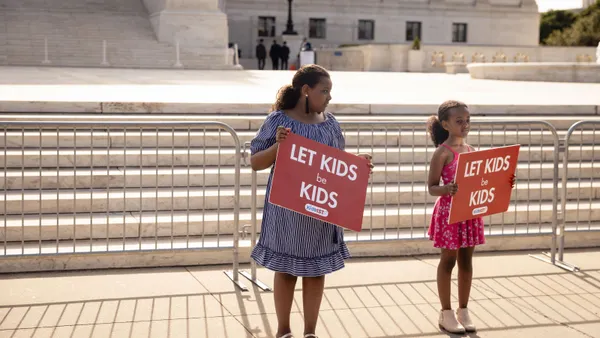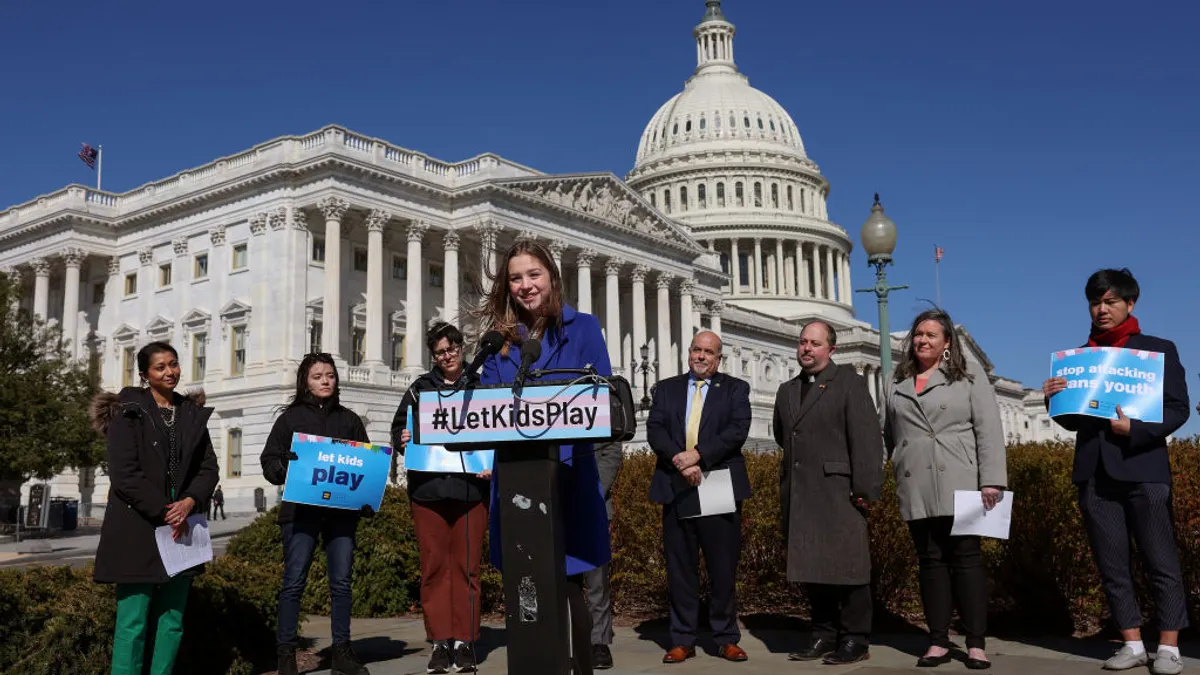
U.S. Supreme Court justices seemed torn Tuesday about how to settle the controversial question of whether states can ban transgender students, and especially transgender girls and women, from playing on sports teams aligned with their gender identity — and how to account for a student's age and any hormone therapy or puberty blockers they may be taking.
"I don't think you're a Ph.D. in this stuff, and neither am I," Justice Brett Kavanaugh told a U.S. Department of Justice attorney during oral arguments on two cases concerning school and college policies on transgender athletes. DOJ, arguing on the side of Idaho and West Virginia, backed the state transgender student bans at issue in the cases.
In West Virginia v. B.P.J and Little v. Hecox, justices were asked to weigh whether federal statute protects transgender students who want to play on sports teams aligning with their gender identities, as well as whether state laws preventing their participation violate Title IX and the 14th Amendment's equal protection clause.
The cases could change the course of transgender student rights and school district policies under Title IX, the federal statute that protects students against discrimination based on sex.
However, during oral arguments on Tuesday, while the conservative majority seemed inclined to uphold state bans, justices on both sides of the ideological spectrum questioned the broader implications of issuing a sweeping decision even as states take partisan approaches to the issue.
“I’ve been wondering what’s straightforward after all this discussion,” said Justice Neil Gorsuch.
Laws banning transgender students from athletic teams aligning with their gender identity have proliferated in red-leaning states in recent years, with at least 27 states enacting such measures, according to the Movement Advancement Project. Idaho, which is at the center of Little v. Hecox, became the first state to pass such a ban in 2020, per MAP.
High school athletic associations, state agencies and school districts also often have their own policies, further fracturing the implementation of Title IX in transgender student issues nationwide.
Path to the Supreme Court
While Hecox relates to transgender athlete participation at the college level, B.P.J. was filed on behalf of a West Virginia teen who has publicly identified as a girl since the 3rd grade. The student took medication to stave off male puberty and has also begun estrogen hormone therapy, according to court documents.
When B.P.J. was an 11-year-old rising middle schooler in 2021, her principal told her mother that she couldn't try out for the girls' cross country team because state law barred participation on sports teams based on gender identity. Prior to the law’s passage in 2021, West Virginia schools allowed transgender students to play on teams aligning with their gender identity on a case-by-case basis, according to court documents.
"States have long assigned sports by sex. West Virginia is no different," said Michael Williams, solicitor general of West Virginia, representing the state on Tuesday. "The question today is whether this enduring structure can continue. It can."
However, B.P.J.'s attorney argued that excluding transgender athletes — especially those who have undergone hormone therapy or prevented the onset of male puberty through blockers — from athletic teams aligning with their gender identities excludes them from sports.
"Excluding B.P.J. from the girls team is excluding her from all athletic opportunity," said Joshua Block, an attorney for the American Civil Liberties Union who is representing B.P.J.
But Williams rebutted: "The error in it is they're not being excluded, they're choosing not to participate."
'A wrecking ball' to Title IX
Justice Kavanaugh went so far as to acknowledge that a decision in favor of West Virginia's argument could take "a wrecking ball" to Title IX.
He and others weighed how the case, part of which considers biological differences between males and females, could be applied to programs like remedial classes for boys who statistically underperform in some subject areas compared to girls, or chess clubs in which Justice Elena Kagan said "there are not a whole lot of women."
And while LGBTQ+ advocates have openly worried about a decision's impact in areas such as locker room facilities and bathroom access for transgender students, Justice Amy Coney Barrett said that "opens a huge can of worms that we don't need to get into here."
Block, in fact, argued that justices shouldn't issue a broad decision. "This is an important issue, it may affect the whole country, and the court wants to get it right," he said, suggesting to justices they could wait for additional legal developments in this or other cases before issuing "a sweeping conclusion."
Effect on Title IX enforcement
The cases were heard amid an increasing divide between red and blue states. Republican-led states have been passing laws preventing transgender students from participating in women’s and girls' sports, while Democratic-led ones lean toward protecting transgender students' rights to participate.
The issue has also reached the halls of Congress, which has attempted to legislate the issue.
Meanwhile, the Trump administration has escalated its crackdown on state and district policies protecting transgender students — especially their participation in sports.
Maine was the first state to be penalized by the current U.S. Education Department over its transgender athlete inclusion policies, with a federal Title IX investigation launched after a public dispute between Gov. Janet Mills and President Donald Trump. That case was referred to the Department of Justice, putting Maine at risk of losing over $800 million in federal funding.
The Maine case served as a blueprint for Title IX enforcement blocking transgender student inclusion in other states, including Minnesota and California. The administration has said it intends to continue pursuing Title IX enforcement against states and districts that allow transgender student inclusion in sports and in other areas such as access to facilities.
A decision by the high court, which is expected by spring or summer, has the potential to change the Education Department's Title IX enforcement, states’ policies, and districts' adoption of transgender athlete policies. However, a narrow decision could avoid — for now — an upheaval to how sex-based discrimination under Title IX is defined and prevented across states and by the federal government
"How can we decide that question without knowing what sex means in Title IX?" said Justice Samuel Alito. "It could mean biological sex, it could mean gender identity, it could mean whatever a state defines it to mean. But it has to mean something."




 Dive Awards