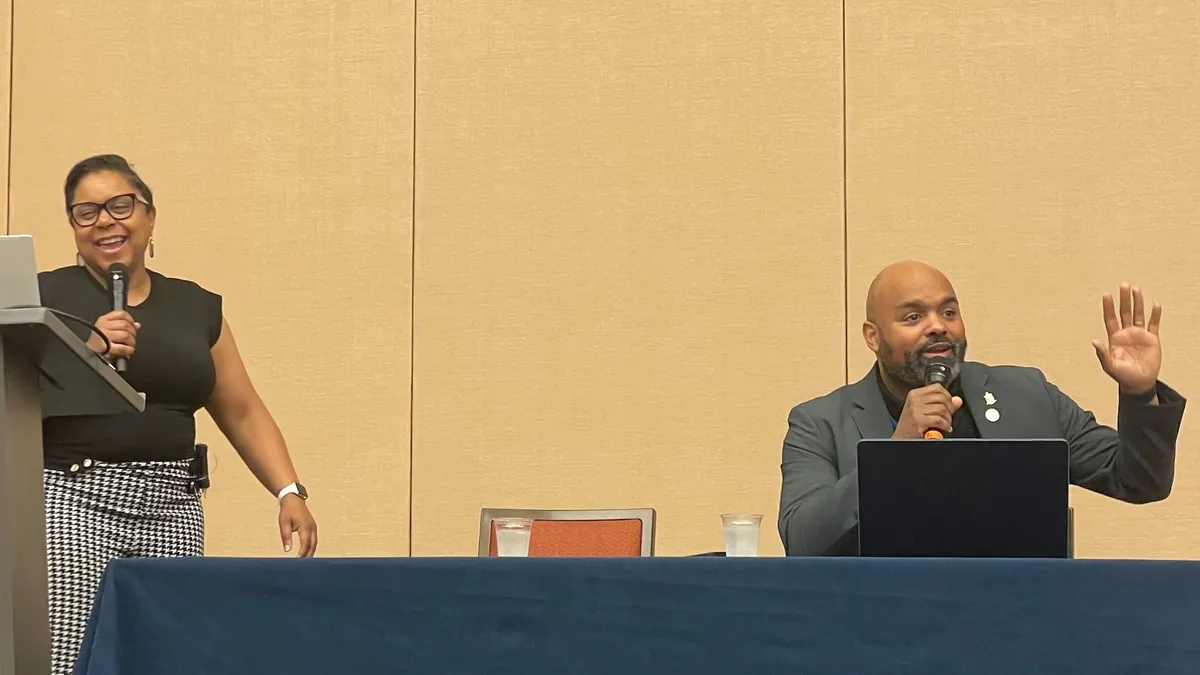
CHICAGO — Change is tough. Carrying it out in a meaningful way is even tougher.
This is true on an individual level, and exponentially more so when you’re introducing a new tool or changing a process for an entire school or district.
“You can manage a thing into oblivion, but you cannot manage people into oblivion, because unfortunately people actually have emotions and their own ideas and thoughts,” Amy Jackson, information technology project manager at Fairfax County Public Schools in Virginia, told attendees during a Wednesday morning session at the Consortium for School Networking’s annual conference.
Unfortunately, the COVID-19 pandemic also reinforced a lot of bad habits in the realm of change management, added Dwight Levens, chief technology and information officer at Oakland Schools in Michigan.
When learning had to transition to a virtual space, he said, districts picked the best thing they thought would work and then just left people to deal with it and move forward.
“We skipped over the part of engaging the people and at that time we didn't have time to engage and take a lot of surveys,” Levens said. “We just had to react and make decisions, so we skipped over the people part.”
So how can administrators ensure new tools and processes are ultimately successful? Over the course of an hour, the duo shared several considerations for keeping people first in conversations, managing the expectations of district leadership, and guiding faculty and staff through deployment and implementation.
Think of change management as a grieving process
“If I have a favorite pair of shoes and they break or they wear out, I don't want to go buy another different kind of shoe,” Jackson said. “I'm going to go find that same shoe, because it's what I like.”
That mindset is at the core of change management, because if someone is using a product or process for a long time, that’s what they’ve learned and are comfortable with, and they don't want another product they have to learn, she said.
With any change, people will initially go through shock, followed by the other stages of grief, Jackson said while citing the Kübler-Ross Change Curve.
Consider, for example, a meeting where you say there’s a need to upgrade the securities for a product, or that its contract is expiring and a decision needs to be made on keeping or replacing, she said.
Some people might have responses like, “It's not secure? What do you mean it’s not secure?” And this may even happen several weeks after those same people said they didn’t like the product or it wasn’t meeting their needs. But now that a decision needs to be made, they’d rather keep it, Jackson said.
“They’re grieving a pattern. They're grieving a product that they may have sat in on the implementation of. They're grieving an idea. They're grieving a day-to-day thing,” Jackson said.
Is the change in question really a priority – or even needed?
Sometimes, an administrator may attend a conference and see or hear about a product or platform that is “better” than what they have. They’ll then return and make it an “urgent” priority, Jackson said. But “better” isn’t necessarily always better.
“So we end up wasting time, resources and care trying to implement something that the end user doesn’t want,” Jackson said. “We hurt relationships because we’re trying to do better.”
Citing restaurant chain Wendy’s as an example, Jackson noted that the company has on several occasions over the years considered abandoning their square hamburger patties. “They always say that they get to the point where they're like, ‘It works. That’s what sets us apart from everybody else, right?’” Jackson said.
When a new change is presented from leaders as “urgent” or an “emergency,” Jackson suggests asking the following questions:
- Is it going to stop business needs? If it’s something with, say, a two-year timeline, technology leaders should urge slowing down, working through a process, and also potentially discussing the definition of an emergency, she said.
- Will all the stakeholders involved be coming to the table? Let’s say the chief of academics, for instance, believes a new digital curriculum needs to be implemented in August, it’s already March, and they won’t be bringing the heads of each of their content departments to the table.
“I say, have you ever met educators? Because telling them they're changing their curriculum in three months? You're not,” Jackson said. “You're getting ready to do a five-year implementation on a product that's going to run out before you ever get it in the building. Because if we can do nothing else, we can stall.” - Are all the stakeholders in agreement? What’s important to one person may not be important to another, Jackson said, which can ultimately compromise the vision for the change. If you have a meeting with five chiefs, six directors and three senior managers where everyone isn’t in agreement on what needs to be done, that’s a million-dollar meeting that could have been an email.
To avoid these scenarios, Jackson said her district has an IT project proposal form that requires detailed responses on who the key stakeholders are, what the need is, who will be making the decisions, and where funding is going to come from. This helps everyone involved have a better understanding before the above scenarios arise.
Take time to gather input matters
Ultimately, the more you understand the needs or fears of key stakeholders — from staff to administrators — the more successful implementing a new tech product or platform will be.
Secretaries can be key in this process, Levens said.
“They know everything,” he said. “They know who doesn’t like what, and they’re going to sit on the sidelines and watch these things implemented. They can probably tell you from the top down who's going to be a holdout, who should you go to first, and who you need to make sure you get on board from the teacher ranks because they're going to have influence on the other teachers.”
Middle school teachers are also crucial, because out of any grade band, they’re most likely to have “9,000 questions and 9,000 reasons why it's not going to happen,” Jackson added.
“I always say if you don't have a middle school teacher on your stakeholders side, it's not happening,” she said, joking that middle school teachers also know how to find “a trusted adult” like a board member or community partner or superintendent when they don’t like a change.
Your rollout — and training — need room to breathe
Once everyone is onboard with change, building in enough time for training and the actual rollout is critical to success.
“We do a good job of telling people we're going to implement something, but what don't we do? Show them how to use it,” Jackson said.
If a district purchases a product and the vendor says, “Our implementation guide is 16 weeks of in-depth training,” leaders shouldn’t try to squeeze that into two hours in the middle of a professional learning day, she said.
District leaders can’t expect people to walk themselves through using a product they don't have any familiarity with and that the rollout will be successful, Jackson said.
Ultimately, a commitment to that professional learning time is something that should be spelled out in project planning from the beginning, Levens said.
“Where is that time going to come from?” he said, adding that you can’t just say, “We'll figure it out along the way.”
Because ultimately, Levens said, “we often don't, and then people don't get trained and they can't participate effectively.”