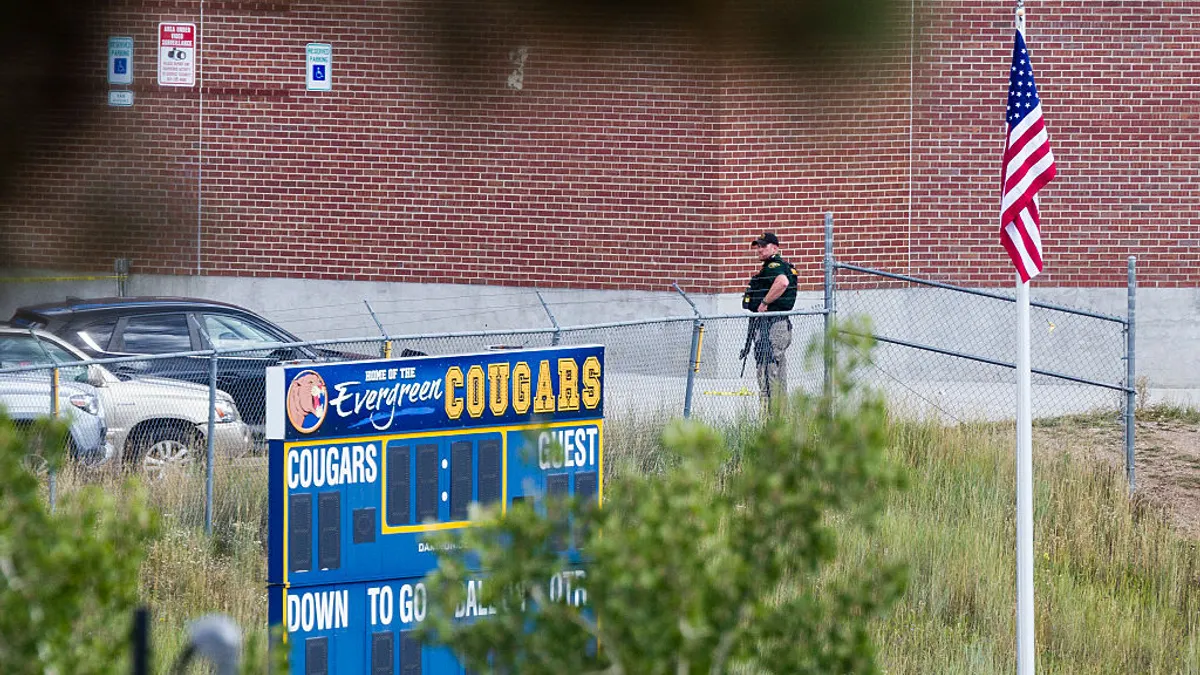
The number of school shootings continued its downward trend in 2025 with a recorded 233 incidents — the lowest number since 2020, when 116 school shootings took place at elementary and secondary private and public schools, according to the K-12 School Shooting Database.
The number of annual school shootings, as recorded since 1966, peaked in 2023 with 352 incidents, according to the database. The tracker defines school shootings as any time a gun is fired or brandished with intent or when a bullet hits school property, regardless of the number of victims, time, day or reason.
Additionally, the number of shooting victims who were injured or fatally wounded on K-12 campuses last year was 148, down from an all-time high of 276 in 2024. The database tracks that metric back to 1970.
David Riedman, founder of the K-12 School Shooting Database and an assistant professor at Idaho State University, said it's unclear what is contributing to these trends. In a Dec. 30 Substack post, he wrote that crime trends need to be measured across decades to see patterns.
Other K-12 school shooting resources also show recent decreases in this activity. According to Everytown for Gun Safety, as of Dec. 13, there were at least 159 incidents of gunfire on school grounds in 2025, resulting in 53 deaths and 148 injuries. In 2024, there were 229 incidents, 60 deaths and 169 injuries. Everytown tracks every time a firearm discharges a live round inside or into a school building, or on or onto a school campus.
There is no national standard definition of a school shooting.
2025 K-12 school shootings were lowest in five years
Ken Trump, president of National School Safety and Security Services, a Cleveland-based national school safety consulting firm, said the drop in the number of school shootings in 2025 could be a reflection of overall decreases in certain types of violent crimes. The Gun Violence Archive shows slightly fewer gun violence deaths — 38,760 in 2025 as of Jan. 9, compared to 41,044 in 2024.
"Many very experienced and credentialed people will have different theories and opinions" as to why school shootings are trending downward, said Trump. "Nobody knows exactly for sure. It's certainly not one particular cause."
Trump does say schools overall are doing a better job with school safety infrastructure, partnering with local law enforcement, and providing student mental health supports compared to 40 years ago when he started in the school safety profession — and since 1999, the year of the Columbine High School shooting in Colorado that left 12 students and one teacher dead.
But, he said, school security challenges are also different from decades ago. "We're dealing with a lot more unknown unknowns," he said, including school safety scenarios that can be atypical, such as strangers trying to enter school campuses and parents fighting during school events.
Research released in March by KFF, a policy research and news organization, shows that even a single school shooting incident in a state can impact many youths beyond those who are physically injured. The U.S. average yearly rate of student exposure to a school shooting has increased from 19 per 100,000 students in 1999-2004 to 51 in 2020-24, according to KFF's analysis of The Washington Post's School Shooting Database.
State-level student exposure rates can vary greatly due to factors like student enrollments and state population. For example, KFF found that the rate per 100,000 students in 2020-24 was highest in Delaware (359), DC (356), and Utah (166).
School shootings are linked to adverse mental health consequences like suicide risk for students and communities at large, KFF says, even though these incidents account for a small portion of overall gun violence.
What to watch for in 2026
When Trump consults with school systems on safety protocols and practices, he urges "less is more." This means shifting from placing unrealistic expectations and pressures on teachers and school staff to prioritizing core fundamental areas, including:
- Focusing on situational awareness. This could include trainings to emphasize the importance of adults being present and having active supervision of students. Trump said schools may have all the school security technology in place and collaborations with first responders, but if two teachers are standing in the corner of the playground looking at their phones and talking to each other while 60 kids are on the playground, that's not active supervision.
- Being able to recognize abnormalities and patterns. Trump says educators are naturally very good at this. Spotting unusual activity is "like a sixth sense" for teachers, he said. Identifying inconsistencies, such as unfamiliar cars in the pick-up line, can help avert potentially dangerous situations, he said.
Daily behavior and operational patterns imprint on the brain, and educators consciously and subconsciously pick up on cues when things are outside the norm, he said. The key, Trump said, is for teachers to not only consciously recognize these cues, but to also not talk themselves out of acting upon them.
"Too often people fear they may be wrong or may offend someone, when the chances are they are correct on their observations and gut feeling, and should trust and act upon their concerns," Trump said. - Supporting staff decision making under stress. This includes training staff and empowering them to make decisions in a crisis, particularly if crisis point people are unreachable during an ongoing threat.
"I'm seeing a lot of teachers and some frontline staff who are freezing and afraid to make a decision because they think they're going to make the wrong decision, or they haven't memorized the emergency plan," Trump said. That, he added, can be worse than "doing something that makes sense based on the facts that you have."
"I think that if we focus on those three things, we're simplifying school safety," Trump said.
He also advises against "security theater," which is when school systems tout new school security technologies but haven't done a comprehensive analysis of actual threats or have not integrated the new technologies into established security protocols and practices.
"I think this year we really need to continue stressing being more intentional than performative," Trump said.