Dive Brief:
- Iowa became the first state approved for a waiver for certain federal education regulations that will allow the state to have greater decision-making in academic programming and fiscal management, according to a Wednesday announcement by Iowa leaders and U.S. Education Secretary Linda McMahon.
- The state's waiver allows the Iowa Department of Education to combine four federal funding streams into one and will reduce compliance costs by $8 million, according to a U.S. Department of Education statement announcing the waiver.
- The application for waivers under the Elementary and Secondary Education Act was announced last year and aligns with the Trump administration's goal of reducing the federal education footprint. However, some policymakers and disability rights groups are concerned that the waivers would reduce state and district accountability for federal requirements and add to educational inequities.
Dive Insight:
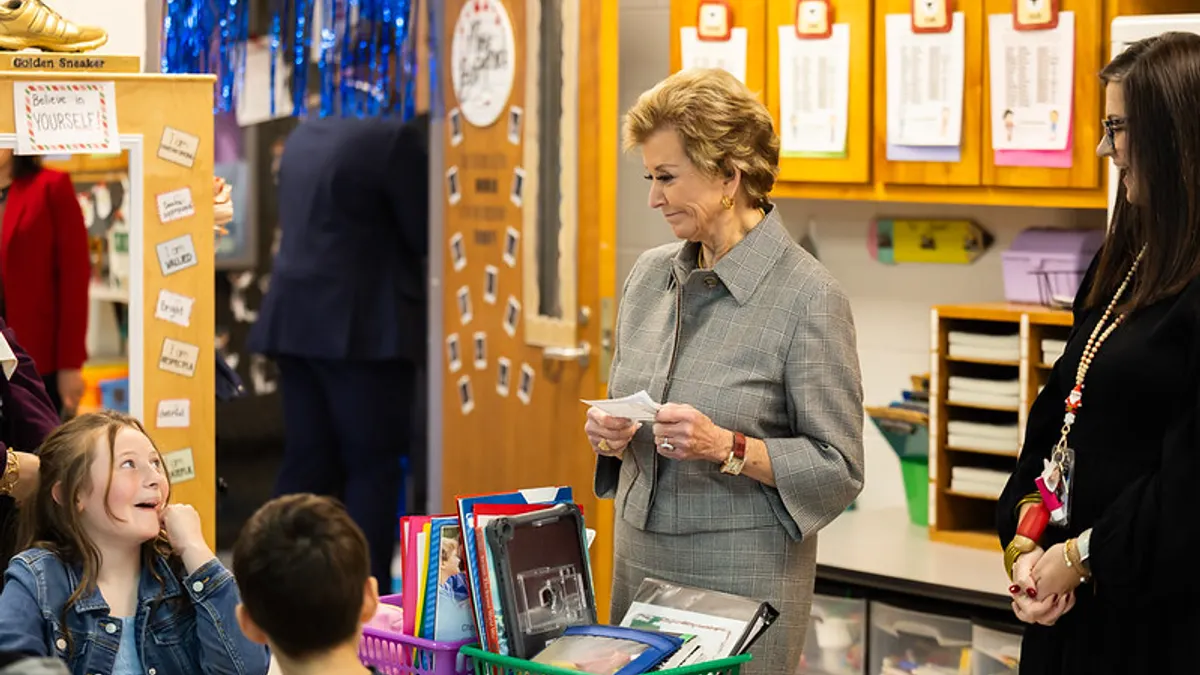
At a press conference at Broadway Elementary School in Denison, Iowa, on Wednesday, McMahon praised the state's ESEA waiver as the "groundbreaking first step that gives state leaders more control over federal education dollars."
Iowa's waiver applies to the state activities funds set-aside under:
- Title II, Part A — Supporting effective instruction.
- Title III, Part A — English language acquisition.
- Title IV, Part A — Student support and academic enrichment.
- Title IV, Part B — 21st Century Community Learning Centers.
ESEA, also known as the Every Student Succeeds Act — a decades-old law last updated by Congress in 2015 — details statewide K-12 accountability and assessment requirements, among other provisions. Other presidential administrations have offered and granted ESEA flexibilities.
The Education Department has also approved Iowa’s application for Ed-Flex authority, which allows the state to grant waivers to districts from certain federal requirements without first having to submit individual waiver requests to the federal Education Department.
"This approval cuts through federal red tape, eases compliance burdens for districts and empowers them to implement strategies that best meet the needs of their students," McMahon said.
Iowa Gov. Kim Reynolds, speaking at the press conference, said the state is "confident that we can do even more by reallocating compliance resources. Iowa will begin shifting nearly $8 million and thousands of hours of staff time from bureaucracy to actually putting that expertise and those resources in the classroom."
Specifically, the state wants to invest in increasing student achievement, building professional development resources, strengthening teacher recruitment and retention, supporting local ESEA flexibilities and modernizing fiscal reporting, according to Reynolds and McKenzie Snow, director of the Iowa Department of Education.
"States are best positioned to serve families, and we're committed to reduce the barriers that stand in the way," Reynolds said.
Even as the Education Department is working with six other states on waiver requests, there is opposition to these flexibilities from those concerned they potentially violate the intention of ESEA's accountability framework, sidestep rules on funding formulas, and lead to a reduction of high standards for student performance.
In September, a coalition of 24 disability rights organizations urged the Education Department to deny any state or district requests to waive accountability and assessment requirements, because the standards help set high expectations for all students, including those receiving special education services.
"Any action to subvert federal law through waivers that illegally promote or support the block granting of ESSA funds would have lasting negative impacts on students, families, educators, and the future of millions of children with disabilities," the coalition said in a letter to McMahon.