
Dive Brief:
- $130 billion in federal funds earmarked for facilities upgrades would flow to U.S. K-12 schools under a bill lawmakers in the House and Senate introduced this week.
- This is the fourth time the Rebuild America’s Schools Act has been introduced. When it was introduced in 2019, it passed the House Education and Labor Committee but wasn’t taken up on the floor. It was introduced in 2022 and 2023 as well, but didn’t get out of committee in those years.
- “We are hopeful that the federal government recognizes that this investment would provide a much-needed solution to a glaring problem,” Ally Talcott, executive director of Build America’s School Infrastructure Coalition, said in an email.
Dive Insight:
Under the bill, $100 billion would be provided through formula grants to the states. Ninety-five percent of the funds would go to districts based on criteria that include the poverty level of children in the school district, fiscal limitations to raise funds to improve facilities and the severity of the facility needs.
An additional $30 billion would be provided in bond authority for two types of bonds: qualified school infrastructure bonds and qualified zone academy bonds, both of which were eliminated in the Tax Cuts and Jobs Act of 2017. The bond authority would be spread out in increments of $10 billion for each year between 2027 and 2029.
“Local communities have shown us time and time again that they support investments in modernizing our schools, as evidenced by the overwhelming support for bond initiatives to address these issues,” said Talcott.
For lower-income areas, which lack the tax base to get bonds passed as frequently as wealthier areas, inclusion of the qualified zone academy bonds in the bill could become an important tool; they’re targeted to low-income areas and, in rule changes the bill makes, school districts wouldn’t have to put up as much matching funds and there’s more flexibility in what the money can be used for.
The disparity in bond issuances between higher-wealth and lower-wealth areas is one of the reasons California and Arizona faced lawsuits last year accusing them of violating their state constitutions for leaving it to school districts to come up with their own funding for facility maintenance and upgrades. Arizona lost its case and must now re-write its rules for funding its schools; California’s case is pending.
“Unfortunately, the system … requires tremendous reliance on bonds and overrides, which is local funding, which … creates disparity in the system,” the judge in the Arizona case said in the ruling.
To help Congress keep tabs on how school facilities are faring after the money goes out, the bill would require each state to develop a database on the condition of their schools, something most states don’t do.
“An online, publicly searchable database [should provide] an inventory of the infrastructure of all public school facilities in the state,” the bill says.
To the extent facility conditions are tracked, it’s done at the school district level, the Government Accountability Office said in a 2020 assessment. “Most states do not conduct statewide assessments,” the agency said.
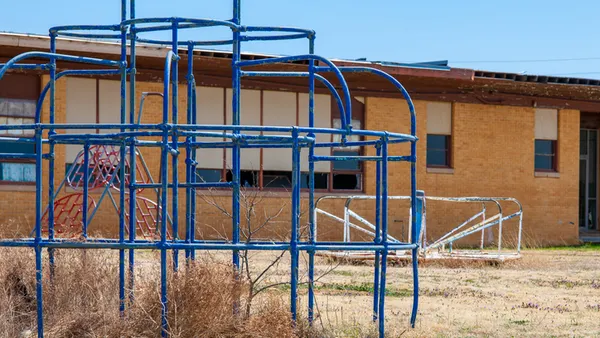
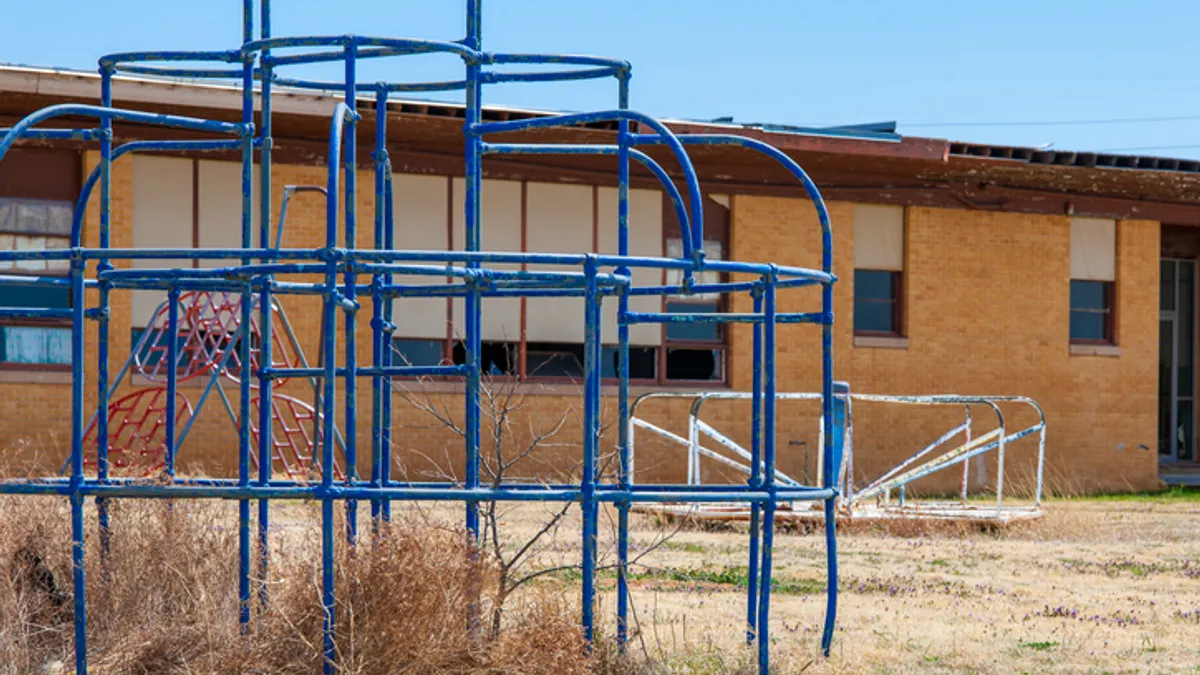
If enacted, the money could make a dent in what a report says is a $90 billion facilities repair backlog.
Schools are behind by $56 billion in capital investment and $34 billion in maintenance and operations, according to the 2025 State of Our Schools, released last month by the National Council on School Facilities, the International WELL Building Institute and the 21st Century School Fund.
Federal data the GAO compiled in its 2020 assessment finds a big backlog as well. It says more than half of the country’s school districts need to replace or update major systems in their buildings. Older HVAC systems, one of the biggest problems schools face, “frequently malfunction or leak and damage flooring or ceiling tiles,” said GAO.
An infrastructure report card that the American Society of Civil Engineers released last year gave schools a D+ grade and called for the federal government to “establish regular, predictable funding mechanisms for physical school infrastructure,” something the bill could help to do. But the likelihood of the bill moving to a floor vote soon is low, reporting suggests.
The bill was introduced the day after Congress passed the FY 2026 Consolidated Appropriations Act, H.R. 7148, which ended the partial government shutdown. That leaves the bill without an immediate legislative vehicle it can be attached to. The Trump administration, which favors eliminating the U.S. Department of Education, is unlikely to be a supporter.
“Education is fundamentally a state responsibility,” Secretary of Education Linda McMahon said in a statement last year. “Instead of filtering resources through layers of federal red tape, we will empower states to take charge.”
The bill could find favor due to its support for U.S.-based labor and materials by ensuring projects use domestic iron, steel and manufactured products and meet labor standards, which would create at least 2 million jobs over the next five years, according to U.S. Sen. Jack Reed, D-R.I., and Rep. Bobby Scott, D-Va., who introduced the bill.
The bill is cosponsored by 15 senators, and supported by a coalition of over 50 organizations, including the 21st Century School Fund, IWBI, American School Superintendents Association, the International Association of Sheet Metal Air Rail and Transportation Workers and other education councils and skilled trades organizations, according to Reed.





 Dive Awards