Dive Brief:
- The Federal Communications Commission voted on Thursday to seek public comment on whether the federal E-rate “should be narrowed or reoriented” to meet the goals Congress established 30 years ago for the program.
- The FCC’s notice of proposed rulemaking will ask how E-rate-funded networks are being used for educational purposes, as well as what safeguards are in place to protect against waste, fraud and abuse.
- The commission is also considering policies to ensure participating schools and libraries are protecting children’s online safety and ensuring positive academic outcomes, including through limits on screen time and access to social media in schools.
Dive Insight:
The FCC’s notice of proposed rulemaking is a significant step toward considering changes for the federal discount program that helps connect nearly every school district in the U.S. to affordable internet.
E-rate advocates expressed deep concern, however, that the notice would lead to the FCC ending the program.
In the notice, the FCC signaled that ending the program could be on the table. Broadband access in schools and libraries has substantially expanded over the last three decades since E-rate was created to address limited internet access, the commission noted.
“We seek comment on whether and to what extent the E-Rate program has fulfilled that mission and whether continued funding is consistent with Congress’s original objective,” the FCC’s notice states. “Should the E-Rate program be limited or sunset to reflect today’s extensive connectivity rates? At what point should policymakers conclude that the program’s core objective has been achieved?”
Because internet prices are higher in areas with less competition, the FCC’s notice asks, should the E-rate program be limited to rural locations or places only served by one internet provider?
In a June 16 letter to the FCC, a coalition of E-rate advocates and stakeholders called for the commission to remove any consideration of ending E-rate or limiting it to certain areas from the final notice of proposed rulemaking.
The groups sending the letter included:
- Schools, Health & Libraries Broadband Coalition.
- American Library Association.
- AASA, The School Superintendents Association.
- American Federation of School Administrators.
- National Education Association.
- State E-rate Coordinators’ Alliance.
- Consortium for School Networking.
The letter said nothing in the E-rate statute empowers the FCC to end the program, including "after a certain period of time or after certain benchmarks are met.”
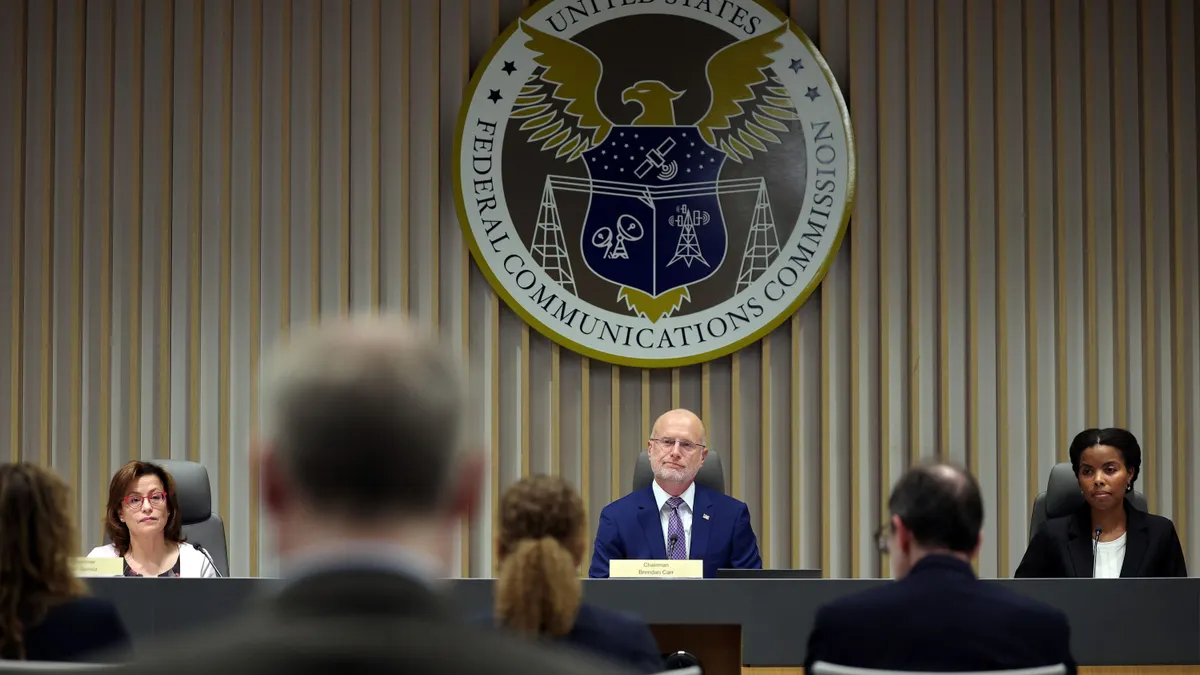
During Thursday’s meeting, FCC Chairman Brendan Carr said the notice will also consider reorienting the E-rate program around the growing questions and research about screen time in schools.
Carr pointed out that, as of April, at least six states had imposed screen time bans or limits while over a dozen more have introduced similar proposals. He also pointed to this week's approval by the Los Angeles Unified School District to ban or limit screen time based on grade level.
“Against this backdrop, I think it’s appropriate for the FCC to also look at its own programs,” including the $3 billion E-rate program, Carr said.
But opponents say eliminating E-rate would worsen the digital divide it was designed to fix.
The FCC notice “conflates two very different things: screen time and connectivity,” said Paul Lekas, executive vice president for global public policy and government affairs at the Software & Information Industry Association, in a Thursday statement.
“SIIA urges the FCC to recognize this distinction and target genuine concerns with precision, rather than risk severing the connectivity that closes the digital divide,” said Lekas.
FCC Commissioner Anna Gomez, who approved the notice in part, said eliminating E-rate would contradict the U.S. Department of Education’s call for students to learn how to safely and effectively use artificial intelligence.
“We cannot elevate national expectations for digital and AI literacy while simultaneously stripping away the digital tools required to meet them,” Gomez said. “We cannot declare that AI leadership is a national priority while questioning whether schools should continue to receive the connectivity required to teach it.”
Although concerns with children’s use of screen time should be taken seriously, Gomez said, it’s a conversation for homes and classrooms — and among local, state and federal legislators. “The FCC is not the nation's parent. It is not the nation's teacher. It is not the nation's school board.”