
Dive Brief:
- The U.S. Department of Justice last week issued an opinion to the U.S. Equal Employment Opportunity Commission finding that its guidelines about disparate impact liability under Title VII of the Civil Rights Act are unconstitutional.
- The “guidelines are unconstitutional because they contemplate liability based on disparate effects alone, without regard to an employer’s likely intent, and pressure employers to engage in race-based decisionmaking,” per the 25-page opinion issued by the Justice Department's Office of Legal Counsel on June 9.
- The U.S. Department of Education's Office for Civil Rights under the Obama and Biden administrations regularly conducted disparate impact investigations — or systemic investigations of school districts' policies and practices — to determine whether they impacted Black or historically underrepresented students, even if those policies and practices were not on their face discriminatory. Those types of investigations were paused during both Trump administrations.
Dive Insight:
“We believe this opinion will provide clarity regarding the Constitutional limits of disparate impact in employment discrimination matters,” EEOC Chair Andrea Lucas said in a June 9 announcement.
While this opinion was specific to employment issues, the push against disparate impact liability has been a focus of the Trump administration, including by the Education Department.
President Donald Trump issued an executive order in April 2025 directing federal agencies, including EEOC and the Education Department, to stop enforcement of disparate impact liability under civil rights laws. The Education Department conducted its disparate impact investigations under Title VI, the law prohibiting race-based discrimination in federal funded programs.
However, disparate-impact liability “not only undermines our national values, but also runs contrary to equal protection under the law and, therefore, violates our Constitution,” Trump said in the executive order.
EEOC on June 4 rescinded its Biden-era 2024-2028 Strategic Enforcement Plan and voted to replace it with a Trump-friendly national enforcement plan. That plan specified that the agency will comply with Trump’s order directing the federal government to eliminate the pursuit of disparate impact liability.
“Despite trying to promote equality, EEOC’s disparate impact liability interpretation under Title VII actually fosters the very discrimination its guidelines seek to address,” Department of Justice Acting Attorney General Todd Blanche said in a June 9 statement. “This opinion will now allow businesses to hire based on performance, restoring equal opportunities in the American workplace.”
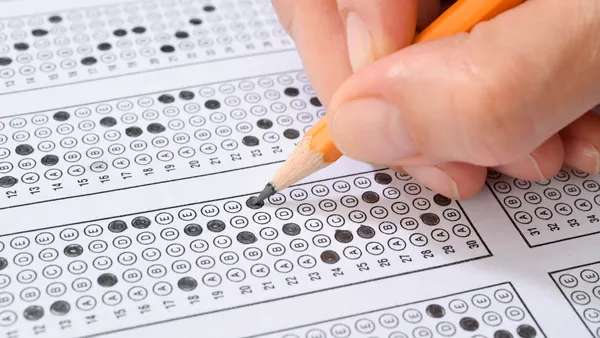
Businesses can use hiring practices such as aptitude tests, knowledge-based tests, criminal-background checks and SAT scores “without fear of violating Title VII simply because such practices may result in different outcomes for different demographic groups,” DOJ said. To do so, employers need to show “the practice is reasonable, useful, or helps serve a valid business purpose.”
The opinion calls for workers bringing disparate impact claims to meet two requirements: Show that a specific hiring practice caused unequal outcomes, and provide an alternative approach that would be “equally effective for employers but would result in fewer unequal outcomes.”
The K-12 sector has seen a push, especially following the George Floyd protests in 2020, to diversify the teaching workforce, in part as a strategy to improve academic outcomes for students of color.
However, the Trump administration has targeted efforts like those as "illegal" and "discriminatory" as part of its campaign against diversity, equity and inclusion that it says discriminates against White people.
The Justice Department last year sued the Rhode Island Department of Education and the state's Providence Public School District over their Educators of Color Loan Forgiveness Program. "By its own terms, the purpose of the Program is to aid PPSD’s efforts to recruit a more 'diverse' faculty,’" the administration said in a September 2025 complaint. "But in doing so, RIDE and PPSD engage in blatant race discrimination, which federal law has long prohibited."
That same month, the Justice Department also launched an investigation into Iowa's Des Moines Public Schools over requirements listed on its website that teachers and learning staff "match the student population in terms of 'demographics and cultural responsivity,'" as well as a plan to increase teachers of color and a staff retention strategy that included "lift[ing] up voices of our People of Color” and “creat[ing] a safer environment for People of Color.”
Naaz Modan contributed to this story.