When Congress passed the fiscal year 2026 budget for the U.S. Department of Education earlier this month, many critics of the Trump administration's efforts to dismantle the agency had hoped the appropriation would ban the outsourcing of certain education programs to other federal agencies.
It did not.
But while the appropriations statute does not prohibit the Education Department from carrying out or entering into interagency agreements with other federal agencies, the legislation's accompanying explanatory statement — which is nonbinding — strongly condemns and discourages the transfer of key programs out of the department.
The bicameral and bipartisan statement said that no authorities exist for the Education Department "to transfer its fundamental responsibilities under numerous authorizing and appropriations laws" to other federal agencies.
The statement also raised concerns that "fragmenting responsibilities for education programs across multiple agencies will create inefficiencies, result in additional costs to the American taxpayer, and cause delays and administrative challenges in Federal funding reaching States, school districts; and schools."
It added that there are concerns the interagency agreements will “weaken Federal support to protect the rights of students, children, youth, and families under Federal education laws."
The document called for biweekly briefings with Congress from the Education Department and its partner federal agencies on the status of interagency agreements, including staffing transfers, implementation costs and how the agencies are measuring the delivery of services.
"I think the bottom line is there was a lot of debate in Congress about whether to put the brakes on these agreements in some way, whether that was walking back some of the ones that had already gone into effect, prohibiting new ones, or something else," said Julia Martin, director of policy and government affairs at The Bruman Group, a Washington, D.C.-based education-focused legal and consulting group. "And ultimately, the people who were very concerned about these agreements lost that negotiation."
The seemingly mixed messaging from Congress has brought some confusion into the already unfamiliar territory of moving numerous core programs out of the Education Department.
Collaborations on federal education
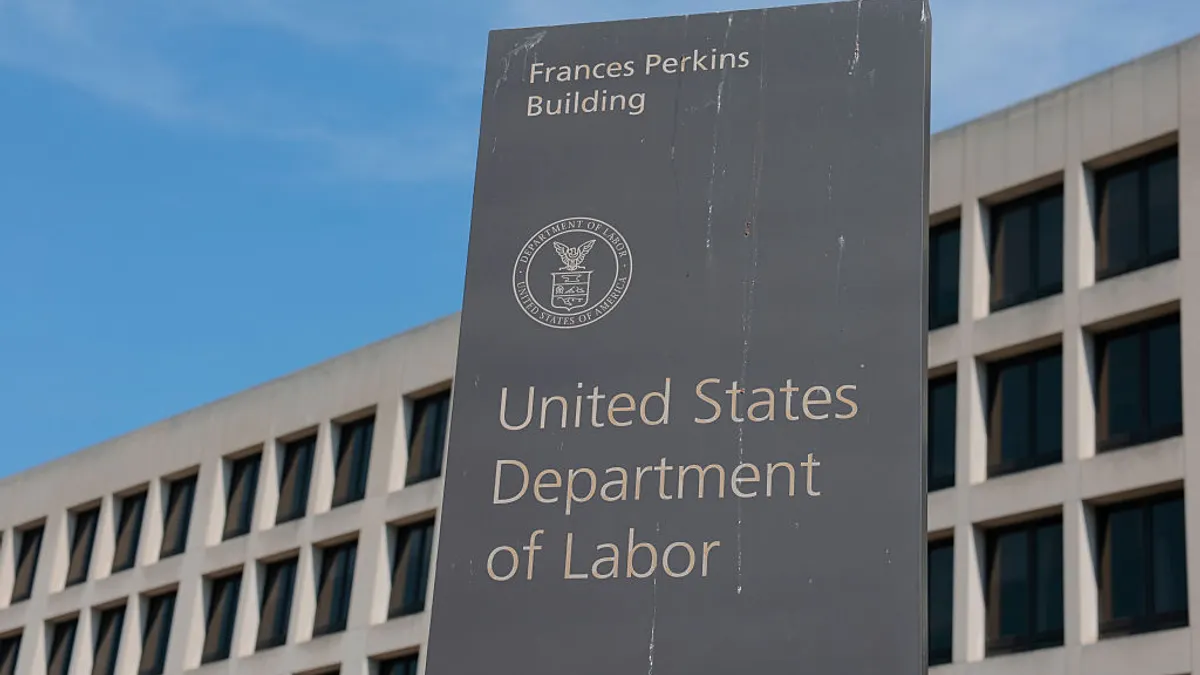
As part of its “Returning Education to the States” initiative, the Education Department under President Donald Trump announced in November it was developing interagency agreements with other federal agencies to support six programs. One of those agreements was with the U.S. Department of Labor to handle the management of about $28 billion across multiple K-12 program grants for low-income school districts, homeless youth, migrant students, academic supports, afterschool programs, districts receiving Impact Aid and other activities.
The Education Department said the Labor Department would take on a greater role in administering these federal K-12 programs to ensure that they better align with workforce and college programs to improve student outcomes, according to the interagency agreement.
Under another interagency agreement announced in November, the Labor Department will coordinate about $3.1 billion in postsecondary education and workforce development programs, including activities for TRIO and GEAR UP.
On Monday, the Education Department revealed two additional interagency agreements.
The first is with the U.S. Department of State on foreign gift and contract reporting for certain public and private higher education institutions under Section 117 of the Higher Education Act. The second is with the U.S. Department of Health and Human Services for family engagement and school supports, including programming for School Emergency Response to Violence, School Safety National Activities, Full-Service Community Schools and Statewide Family Engagement Centers.
Earlier last year, the department created an interagency agreement with the Labor Department for the day-to-day management of career and technical education programming. As of January, the Education Department's Office of Career, Technical, and Adult Education processed nearly 1,627 payment requests totaling $575 million from 51 states and territories and has onboarded all grantees to the Labor Department's grant management and payments systems, according to a fact sheet on the Education and Labor departments' elementary and secondary interagency agreement.
Several of the interagency agreements assign the Education Department responsibilities for budgeting, policy, hiring and overall program accountability, while the other agencies are tasked with managing grants, technical assistance and other services.
In total, the Education Department has announced nine partnership agreements with other agencies since last year.
"We will continue to deliver successes through these partnerships, further solidifying the proof of concept that interagency agreements provide the same protections, higher quality outcomes, and even more benefits for students, grantees, and other education stakeholders," said Savannah Newhouse, Education Department press secretary, in a Feb. 13 email.
The Education Department did not provide a status update on potential interagency agreements with other federal agencies to outsource oversight of special education programming, federal student financial aid services or civil rights investigations.
'Have their cake and eat it too'
Interagency agreements, memorandums of understanding and joint task forces between federal agencies are not uncommon and have been used by both Republican and Democratic presidential administrations. The Education Department has entered into interagency agreements in the past with other federal government agencies for specific research, technology or other projects.
Those agreements typically have had broad support, because they aim to create alignment on specific programs between two or more agencies through shared funding and programming.
The breadth of the outsourcing in the recent multiple interagency agreements is more unusual, said education policy experts.
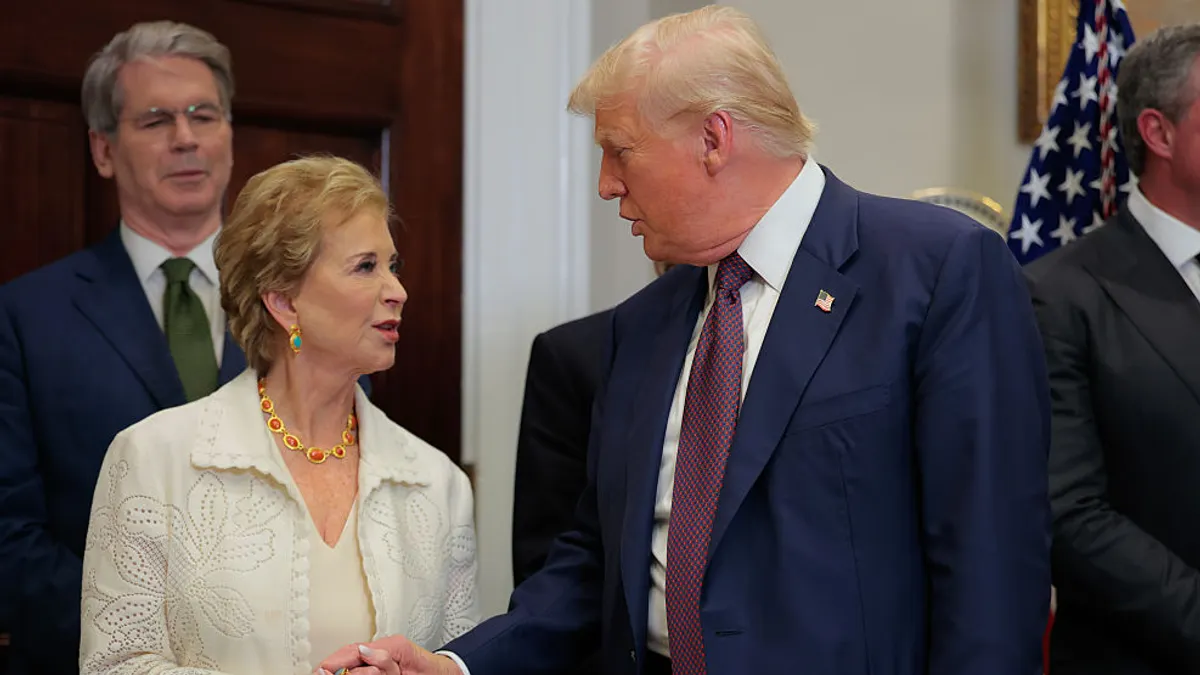
Supporters have said that cross-agency management shifts are needed to right-size the 46-year-old Education Department, which has seen its budget increase over the years while reading and math achievement in recent years has dropped. Last March, President Donald Trump signed an executive order directing U.S. Education Secretary Linda McMahon to “take all necessary steps to facilitate the closure of the Department of Education."
Trump cannot close the department unilaterally without the approval of Congress.
The expansion of interagency agreements at the Education Department, which — in addition to Congress' FY 2026 appropriations statute and statement — is creating a swell of Constitutional, organizational and legal questions about the department's statutory responsibilities and limitations.
A Feb. 4 Congressional Research Service report on interagency agreements at the Education Department said the Economy Act does not authorize the "transfer of statutory functions." The department also "may not ignore" a statutory mandate, the report said.
But CRS also said it is "unclear" if the Education Department's interagency agreements represent a transfer of statutory functions under the department's authorities and under the Economy Act, which the Education Department is citing for its ability to enter into such contracts.
That determination may depend on the specific tasks being carried out by the partnering agency, as well as those retained by the Education Department, the report said.
Researchers, education policy experts and advocacy organizations say there are a lot of unknowns about the Education Department's strategy to reduce the agency's federal footprint through the use of interagency agreements.
Neal McCluskey, director of the Center for Education Freedom at Cato Institute, a public policy research organization that advocates for limited government, said the elimination of the Education Department should occur through an act of Congress. Currently, there are several bills before Congress that propose reducing or eliminating the agency's activities and there have been similar proposals in past congressional sessions.
The FY 2026 appropriations language regarding the Education Department's interagency agreements seem like Congress "wanted to have their cake and eat it too," meaning lawmakers don't really like this approach but are letting the agreements proceed for now, McCluskey said.
"While I think there is probably a reasonable argument that the president has authority to do these interagency agreements, I think that it's questionable, and it is not the ideal way to eliminate the Department of Education," he said. "I think that Congress needs to do that."
A question for the courts
McCluskey and other education policy experts and researchers said the validity of the Education Department's interagency agreements may be addressed through the court system.
"We are in basically uncharted territory with these IAAs," McCluskey said.
An ongoing lawsuit opposing the Education Department's downsizing was amended in November to include opposition to the agency's interagency agreements. The lawsuit called the agreements unlawful and harmful to K-12 and higher education systems.
The updated complaint in Somerville v. Trump was brought forward by a broad coalition of school districts, employee unions and a disability rights organization. That case has been consolidated with New York v. McMahon, which was brought against the Education Department by groups of states, school districts and teacher unions. The case is ongoing.
Additionally, several Democratic Senate leaders are asking the U.S. Government Accountability Office to investigate the Education Department's current and any future interagency agreements.
"We are deeply concerned that the administration’s decisions to implement CTE and adult education grant programs in this manner delayed crucial funding that millions of students and schools rely on, created administrative inefficiencies, increased the cost of program administration, and compromised the quality of technical assistance provided to states and grantees," the senators wrote in a Feb. 19 letter to GAO.
During a Feb. 11 discussion in Washington, D.C., coordinated by House Democrats, Ashley Harrington, senior policy counsel at the NAACP Legal Defense Fund, said that while all federal agencies provide important services in the country, "none of them are adequately prepared to take on the massive portfolio of programs that these interagency agreements strip from ED. These agencies are already short staffed."
Harrington added that if the interagency agreements are carried out, the Labor Department would disperse more education funding than money for labor programs. "These changes will not help schools, districts, families or states," she said. "At best, these changes would just add more layers of bureaucracy and more red tape between schools and the federal funding that Congress has promised them."
Last July, about a dozen former federal special education leaders from Republican and Democratic presidential administrations wrote a joint letter to Congress urging that special education oversight remain at the Education Department.
Stephanie Smith Lee, policy and advocacy co-director at the National Down Syndrome Congress and a former OSEP director in the George W. Bush administration, was one of the letter's signers.
In a Feb. 17 email to K-12 Dive, Lee said, “Scattering education programs to different agencies is causing confusion, weakens collaboration among programs, and puts the rights and opportunities of millions of students — particularly those with disabilities — at risk.”
As far as what's next, Martin, the director of policy and government affairs at The Bruman Group, said, "it's a developing question."
The potential changes under the interagency agreements are difficult for states and school districts to prepare for, because there are still many unknowns, Martin said. "And frankly, the department doesn't have a lot of details either," she said. "They're still figuring all this out — and we've been told to stay tuned.”
Anna Merod contributed to this article.